"It's the first exhibition of contemporary Tibetan art to ever come to New York and it's also the first to ever come to Dartmouth College," Bianco explained in an interview with The Dartmouth.
Although each artist featured in the exhibit creates distinct pieces, employing a variety of materials and techniques, they all use their work to explore their relationship with traditional Buddhism.
Bianco described this focus on "self-expression opposed to religious expression" as a relatively new trend in Tibetan art, emerging in the past 30 years as people have left Tibet to live in places like Europe and the United States.
Bianco said the exhibition represents the work of both native Tibetan artists as well as those in the diaspora living in Europe and the United States.
"[It shows how artists] are looking to traditional forms and Buddhist forms and how they are rethinking [being] global citizens," she said.
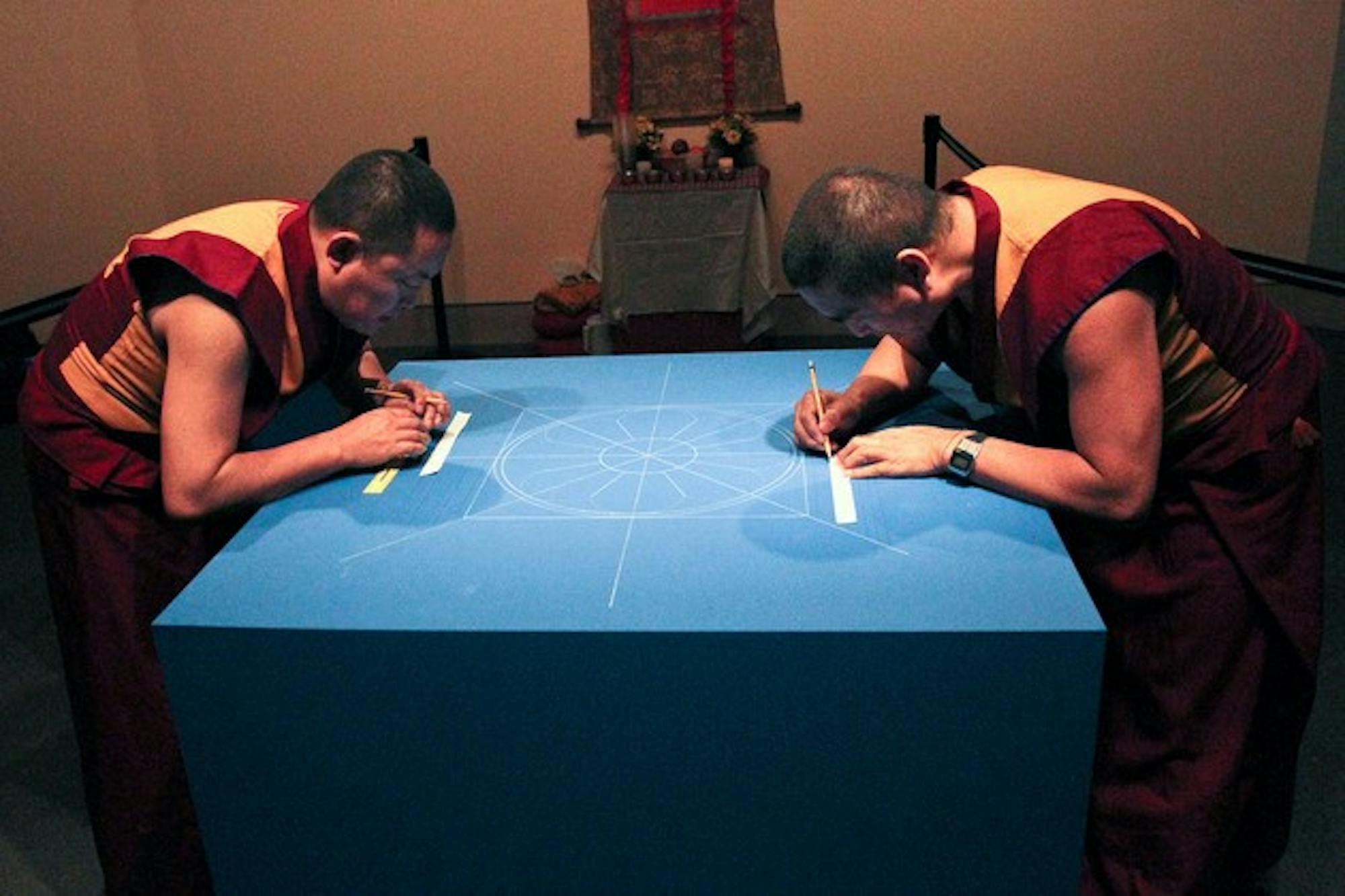
The monks are collaborating to create a sand mandala in the galleries over the course of four days, from Wednesday to Saturday.
Mandalas are traditional Buddhist teaching tools that represent the relationship between the heavenly and the earthly. To symbolize the impermanence of earthly life, the mandala is destroyed after its creation. As part of its destruction, the mandala's colorful sand is cast into a body of water.
Because mandalas are highly sacred forms of art and meditation in Buddhist philosophy, the Dalai Lama only began allowing mandalas to be made in public in the past 22 years.
Since then, Dartmouth has twice hosted monks to create these intricate pieces.
Two of the artists featured in the exhibit, Tsherin Sherpa and Tenzing Rigdol, will visit the Hood to give lectures. Rigdol will speak in the exhibition's galleries at 12:30 p.m. on Tuesday, Jan. 25, while Sherpa will lecture in Loew Auditorium at 4:30 p.m. on Tuesday, Feb.15. Both programs are free and open to the public.
"We're bringing an opportunity for students to interact with the artists which I think is one of the best ways for students to learn the material," Bianco said.
In addition to sponsoring the lectures, the Hood is hosting monks from the Namgyal Monastery Institute of Buddhist Studies this week.
Liana Chase '11, who works at the Tucker Foundation and is involved in the Buddhist community on campus, said the monks' visit was made possible by a fund from the Hood and a special student fund from Tucker.
The event will help expand the diversity of activities available to Buddhists at Dartmouth, she added.
"There are not a lot of opportunities for Buddhists on campus and there's a surprisingly large Buddhist community in the Upper Valley," Chase explained.
She also expressed excitement about interacting with and learning from the monks.
"It's a great cross-cultural experience to spend time with them and the ritual of the sand mandala is so interesting and visual," Chase said.
Shunichi Homma '77 who donated funds to support the exhibition expressed enthusiasm for the show's ability to popularize the relatively unknown Tibetan art movement in an e-mail to The Dartmouth.
Homma said the exhibit will help expand students' cultural horizons.
"It's important for us all to be exposed to a variety of cultures and thoughts," Homma wrote. "Hanover is a global community and the Hood is one of its beacons."
Bianco said the exhibition was initially brought to her attention by anthropology professor Sienna Craig and interim Director of the Hood Kathy Hart.
Craig's connections with the Rubin Museum and Hart's positive reaction when she saw the exhibit in New York helped Bianco realize that "there would be a lot of support for this exhibition," she said.
Bianco and Craig worked together to coordinate the show's visit to the Hood with Craig's Introduction to Cultural Anthropology class, thus allowing Craig to use the exhibition as a teaching tool.
According to Bianco, the exhibit and related events are relevant to students because they explore religion in both its traditional and contemporary context topics on the minds of many young people as organized religion undergoes changes in our rapidly globalizing world.
"With this exhibition, the artists are grappling with many of the same issues that students are dealing with as global citizens and through art-making," Bianco explained.
She added that the exhibit demonstrates art's ability to expand our understanding and appreciation of people who come from different backgrounds or cultures.
"I think what is exciting about learning from art is to connect with shared values that are expressed in so many different ways from so many different life experiences," Bianco said. "You're connecting with an individual who may or may not occupy the same space as you but you are in the same space when you're with their work of art and whatever you bring away from that is meaningful."
The Hood Museum is open Tuesday through Saturday, 10 a.m to 5 p.m., on Wednesdays from noon to 9 p.m and on Sundays from noon to 5 p.m.