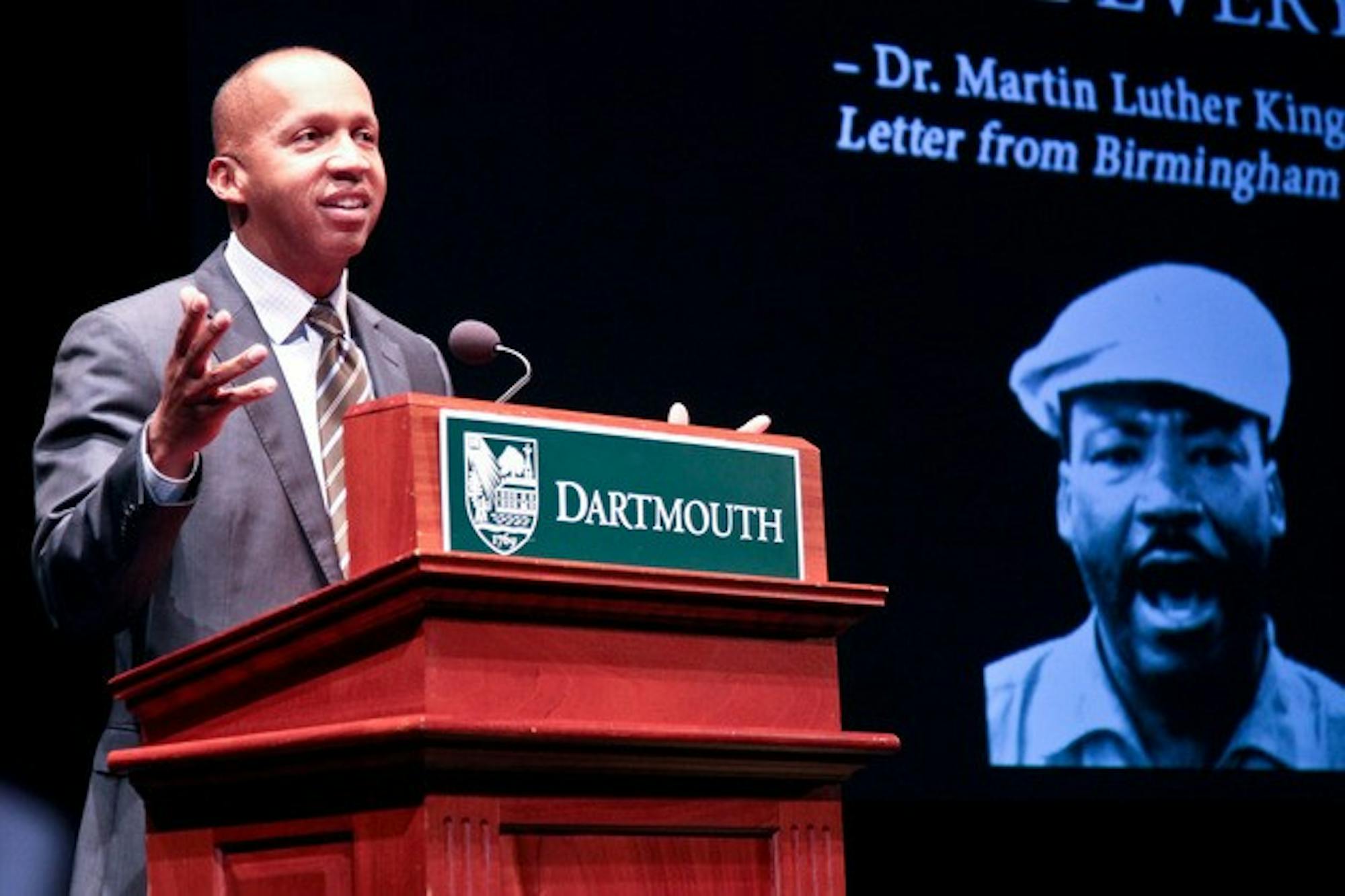
Stevenson, a New York University clinical law professor and founder and executive director of the Equal Justice Initiative, discussed his work fighting discrimination in the American justice system.
This year's events sought to "represent social justice in its many issues," addressing subjects such as environmental justice and global health, according to Gabrielle Lucke, chair of the Martin Luther King Jr. Celebration committee and director of training and educational programs for the Office of Institutional Diversity and Equity.
The college's multi-week celebration began in early January and continued on Sunday with a speech by Diane Nash, a leader of the Nashville sit-ins that helped desegregate the city's lunch counters. The commemoration will culminate on Jan. 28 with the MLK Social Justice Awards, which celebrate student groups that promote justice. Dartmouth's chapter of Habitat for Humanity will receive the award this year, and other groups will be honored as well, according to Lucke.
Stevenson said that while he appreciates the College's efforts to promote discussions of diversity, issues of civil rights remain relevant year-round.
"Civil rights history isn't just something for February [when Black History Month takes place]," Stevenson said.
Stevenson advised students to improve their own lives and the lives of others by following three pieces of advice.
"First, do the right thing, even when it's the hard thing to do," he said. "Second, do not educate yourselves away from passion ... Finally, never persuade yourself that it's a problem to care deeply about the things you care deeply about."
In his speech, Stevenson addressed what he described as "the collateral costs of mass incarceration" in the Deep South.
"In Alabama today, 35 percent of the African-American male population has permanently lost the right to vote [due to felony charges]," Stevenson said. "We have actually projected in the next 10 years the level of disenfranchisement of African American men will be higher than the level of disenfranchisement when the Voting Rights Act was passed in the 1960s," Stevenson said.
Socioeconomic strata are essential to understanding these criminal trends, he said.
"In the criminal justice context, poverty is absolutely lethal," Stevenson said.
Stevenson said he often tells his law students that "the system treats you better if you are wealthy and guilty than if you are poor and innocent."
In light of these inequities, society must be judged by the treatment of the condemned rather than the privileged, Stevenson said.
Victimization perpetuates as individuals dehumanize others, and such behavior was key to systems of historic injustice such as slavery, lynching and segregation, according to Stevenson.
"There's so much inequality around us you can either become sensitive to it and be concerned about how to change it, or become numb to it and just become indifferent to it," Stevenson said in an interview with The Dartmouth.
Elite educational institutions like Dartmouth draw together talented students who have a duty to remember in their career choices that not all rewards are monetary, he said.
"Sometimes it makes sense to do what is not comfortable and not convenient," Stevenson said in the interview.
Lucke expressed excitement regarding students' increased involvement in planning the Martin Luther King Jr. Celebration events.
The Jan. 22 songwriting workshop with Noel Paul Stookey from the band Peter, Paul and Mary, as well as Amy Carol Webb, Josh White, Jr. and rapper Baby Jay, as an example of how the celebration is bringing together generations to fight for the common goal of increased social justice, according to Lucke.