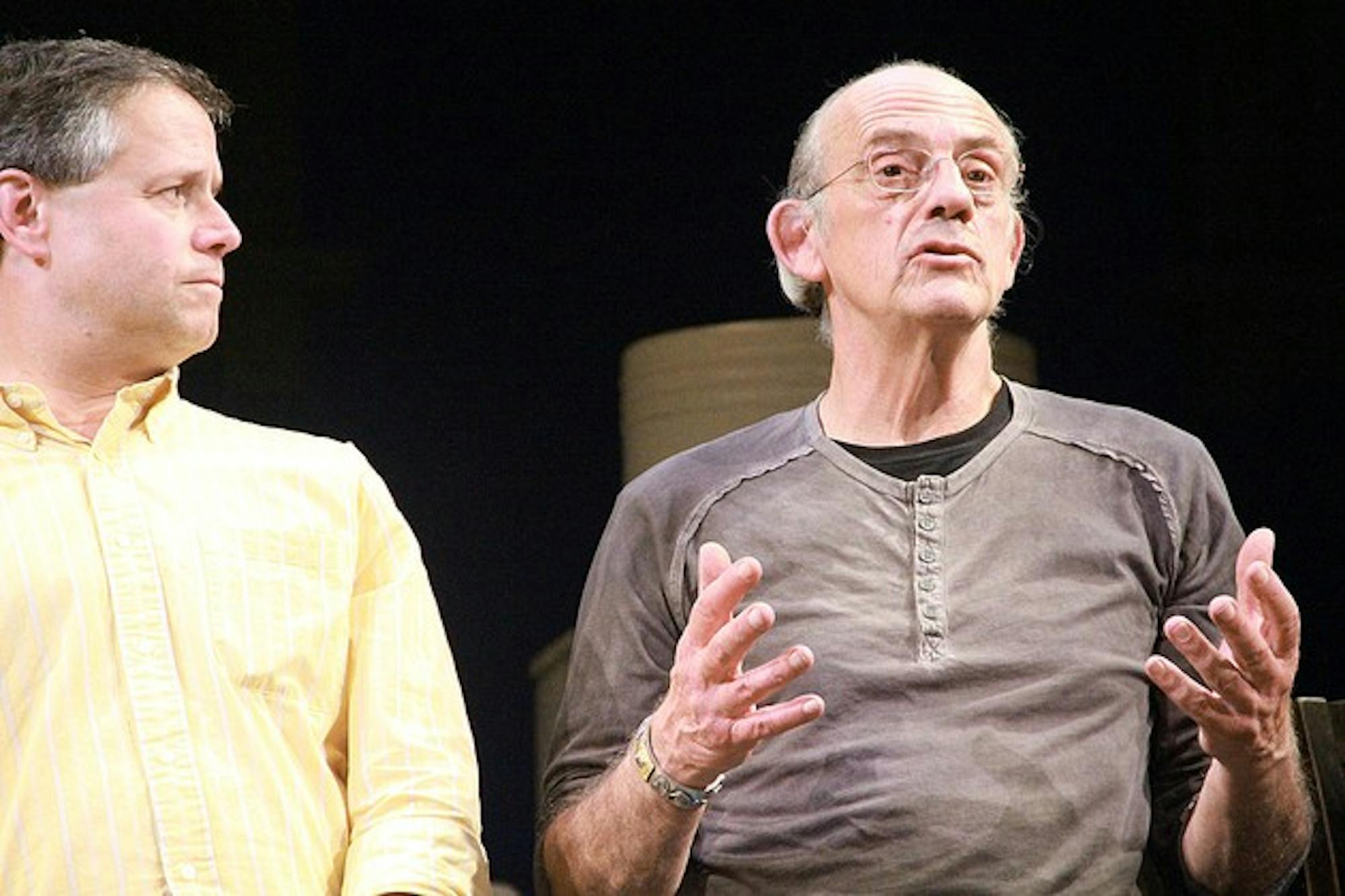
Lloyd plays the titular salesman with such force and intense vulnerability that it was almost unpleasant to watch his fanatical interactions and reminiscent hallucinations on stage for three hours. The honesty with which he portrays Loman, however, and his slow spiral downward from scene to scene, made it impossible for audience members to look away once. He demanded the attention of every soul in the Moore Theater, keeping viewers with him from start to finish.
"He's wonderfully prepared and excellent. I think he's very special in this role," Nathan Darrow, who played Happy Loman, said in an interview with The Dartmouth. "There's something that he brings to it, in a kind of effortless way, that is really important and revelatory in the play."
The rest of the cast works brilliantly with Lloyd to recreate fully the world Miller wrote of in 1949, when competition in the economy forced salesmen into a dog-eat-dog existence to try to make it in America. Amy Van Nostrand gives a heartbreaking performance as Willy's wife Linda, offering the necessary strength throughout while simultaneously moving the audience to tears in the final scene when her solidity gives way to her desolation.
Darrow and Markus Potter, who play Loman's sons Happy and Biff, give charming portrayals of brothers trying to help their father and at the same time trying to figure life out for themselves. All of the nuances from their likeable Brooklyn accents to their portrayals of their characters as boys in Willy's memory scenes flesh out the characters and amplify them as important figures in the Loman family and in the play. The beauty of the fragile relationship between Willy and his sons, especially the older Biff, stems from the initial conflict the actors are forced to embrace. The ensemble's support for and from its members helps this process of discovering hurtful moments and emotions, according to Potter a sentiment echoed by other members of the cast.
"There's an important-seeming paradox, which is it has to be dangerous for the characters up there, and in order to be dangerous it needs to be safe for the actors," Matt R. Harrington, who plays the Lomans' neighbor Bernard, said.
The ensemble's closeness is apparent not a moment is wasted in this performance. All the actors approach their scenes with determined emotion, submerging themselves into Miller's complex tragedy, an emblem of American theatrical canon for over 60 years.
"It really is harder to not go all the way," Van Nostrand said in the post-performance discussion on Saturday. "It is harder to fake it. There is no faking it."
The show's visual artistry complements the actors' performances with an equal amount of creativity and honesty. The set is simple and realistic for the time period, with three different rooms occupying the stage at once. In a clever touch, the windows change throughout the performance as an indication of time and reality. Whenever Willy's brother Uncle Ben enters, the background of the windows turn to clear blue sky with puffy white clouds. When Willy remembers his affair with the woman from Boston, one window shows a closed shade with seductive lighting behind it.
Despite the specificity of the time period and the setting, the themes in the play are universal to the human condition, according to Potter. This cast achieves the task of connecting the audience with that theme, going above and beyond simply making a social commentary. The actors' emotions are so true that the audience cannot help but sympathize, from moments such as Biff crying in his father's arms to Loman crying, "A man is not a piece of fruit!"
"The economic factors make it relevant again," Harrington said. "But as far as a father pouring a lot of love in perhaps slightly the wrong direction at his son what that creates is timeless."
"Death of a Salesman" will continue its three-week tour of New England through Oct. 17, concluding with a stop in in Durham, N.H. The cast performed for three weeks in Weston, Vt. prior to this tour. According to Harrington, the site of each performance has a special connection to the play itself.
"It's interesting, because we're touring Willy Lowman's route. He was the New England salesman," Harrington explained. "So it's kind of fun that we're actually on the road, driving the roads that Willy feasibly would've driven."