The United States lags behind other nations in geographic knowledge because American education focuses more on history rather than geography, Blij said.
"We are not nearly as good as Nigerians, Australians, Brazilians or I hate to say it even the French," he said.
Ignorance about geography still persists among politicians today and was prevalent prior to the invasion of Afghanistan, Blij said.
Blij said he wanted to shoot a "bazooka through the television" after hearing Sen. Carl Levin, D-Mich., say that ethnic divisions do not exist in Afghanistan like they do in Iraq what Blij called a geographically ignorant statement.
The presence of distinct ethnic groups within Afghanistan adds complexity to the problems beyond the national borders encompassed in the Perilous Triangle, he said.
One problem that limits our understanding of the Middle East is the inaccuracy of available data sets about the country, according to Blij. The inability of even Afghanistan's largest cities such as Kandahar to conduct basic censuses makes it difficult to properly evaluate the region, Blij said.
Afghanistan does not have a single population with ethnic dominance over others, but rather has a very small, centrally-located majority of Pashtun people surrounded by a variety of other fractured ethnic groups, he said.
"It is simply an intractable geographical situation," Blij said.
The United States and its allies still honor the official 1893 Durand line border that divides Afghanistan and Pakistan while many of the natives of region do not, which makes policing borders difficult when conducting military operations in Afghanistan, according to Blij.
Blij said he thought that calls from the United States and other Western nations for a runoff election following the highly contested Afghani election in August 2009 were "misguided." While there was little possibility of improvement in leadership with the re-election of Afghani President Hamid Karzai, there was the threat that things could get "a hell of a lot worse," Blij said.
The country's Hazara population which consists of approximately four million Shiite Muslims has more women enrolled in schools and colleges than men and serves as an example of "model progressives" in America, according to Blij.
In order to stabilize the Afghani economy and reduce its dependence on opium poppy cultivation, the United States should buy the crop annually to reduce the illicit use of opium throughout Afghanistan and should develop the crop into a legitimate product, Blij said.
"There is enough legitimate use of [opium] in the anesthetic industry and for anesthesia," Blij said. "If we manage to capture that economy, it might be a better way to spend $4.5 billion than on another 45,000 troops."
Blij said that the United States cannot limit its focus to the rise of the Taliban in the Middle East, but must also be aware of the group gaining popularity in African countries.
"While we are spending a great deal of time focusing on the Taliban, we have a situation [in Africa] that is simply not in our vision right now," he said.
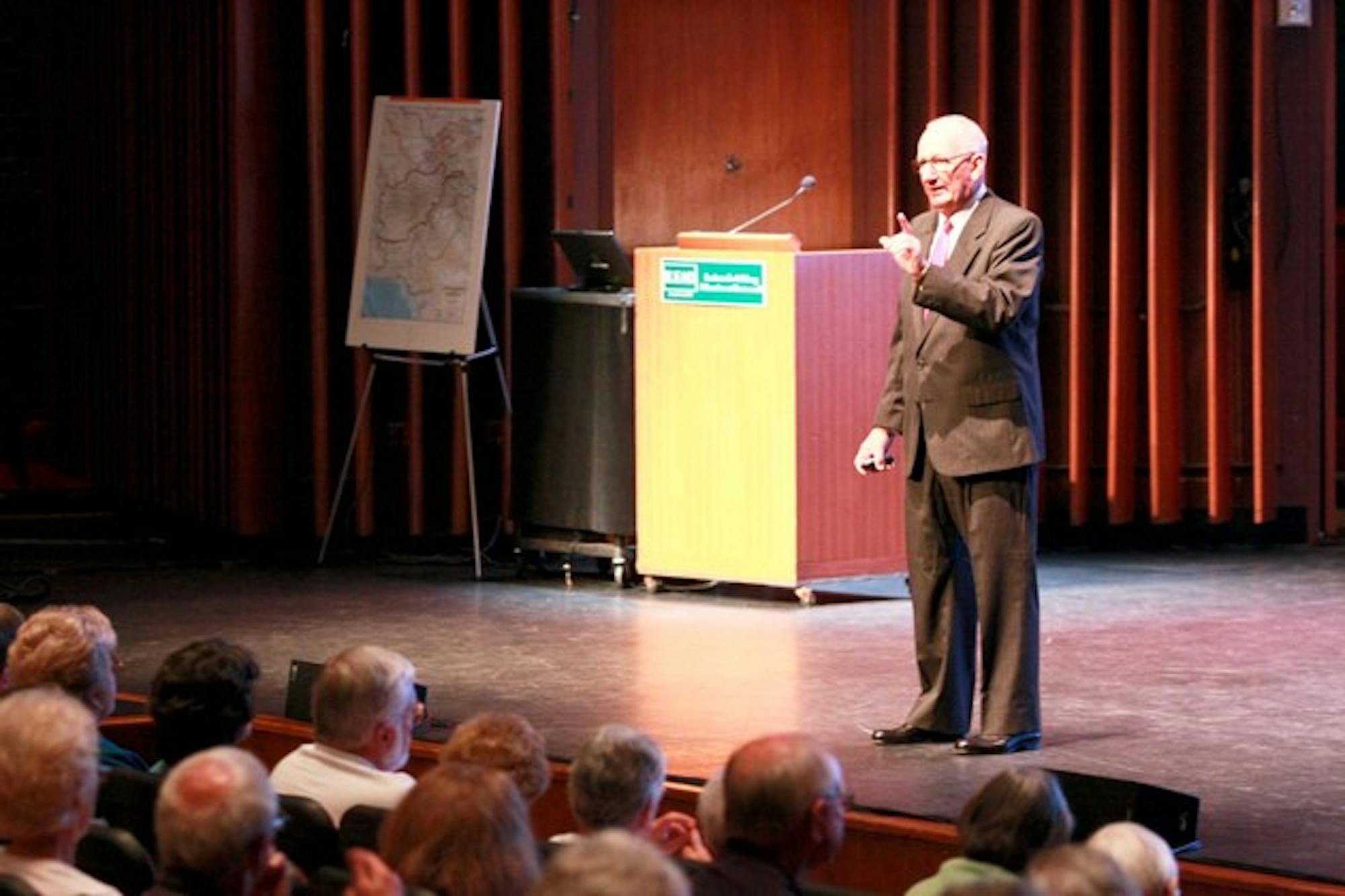
The lecture was the first installment of the summer lecture series "Perilous Triangle: Afghanistan, Pakistan, and Iran," sponsored by the Institute for Lifelong Education at Dartmouth.