A collaboration by students and professors from DDTE, the theater department, the computer science department and the digital arts minor program, "Viscera" took around a year to put together, according to the program notes. Theater professors Ford Evans and Peter Hackett conceived and directed the piece, while computer science professor Lorie Loeb directed the animation and theater professor Dan Kotlowitz served as the lighting and video designer. At the opening of the performance, the stage was set with a see-through screen showing images of the Dartmouth Green throughout the year. The scenery soon transitioned into bombings, while the dancers stood behind the screen, dressed in white clothing and paint.
As the screen went down, the dancers started off on the floor underneath a sheet that turned a shade of turquoise and rolled gently like a sea. The calmness of this opening sequence was cut off by dancer Mayuka Kowaguchi '11 from the DDTE, who clung onto the other dancers while twitching and screaming on the floor as the sheet was removed. While the performers' cries artistically depicted the soldiers' struggles with physical pain, helplessness and frustration, their jagged yet free-flowing dance movements foreshadowed the tone of the rest of the show.
After getting up from the floor, the members shouted quotations that emphasized the show's apparent anti-war sympathies. The screen also reappeared to display battle images with quotes at the bottom, such as, "When the going gets tough, they call out the sons of bitches." The violent war scenes and strong messages provided a stark contrast to the dancers, whose movements behind the screen were graceful, as if they danced in solitude and the screen protected them.
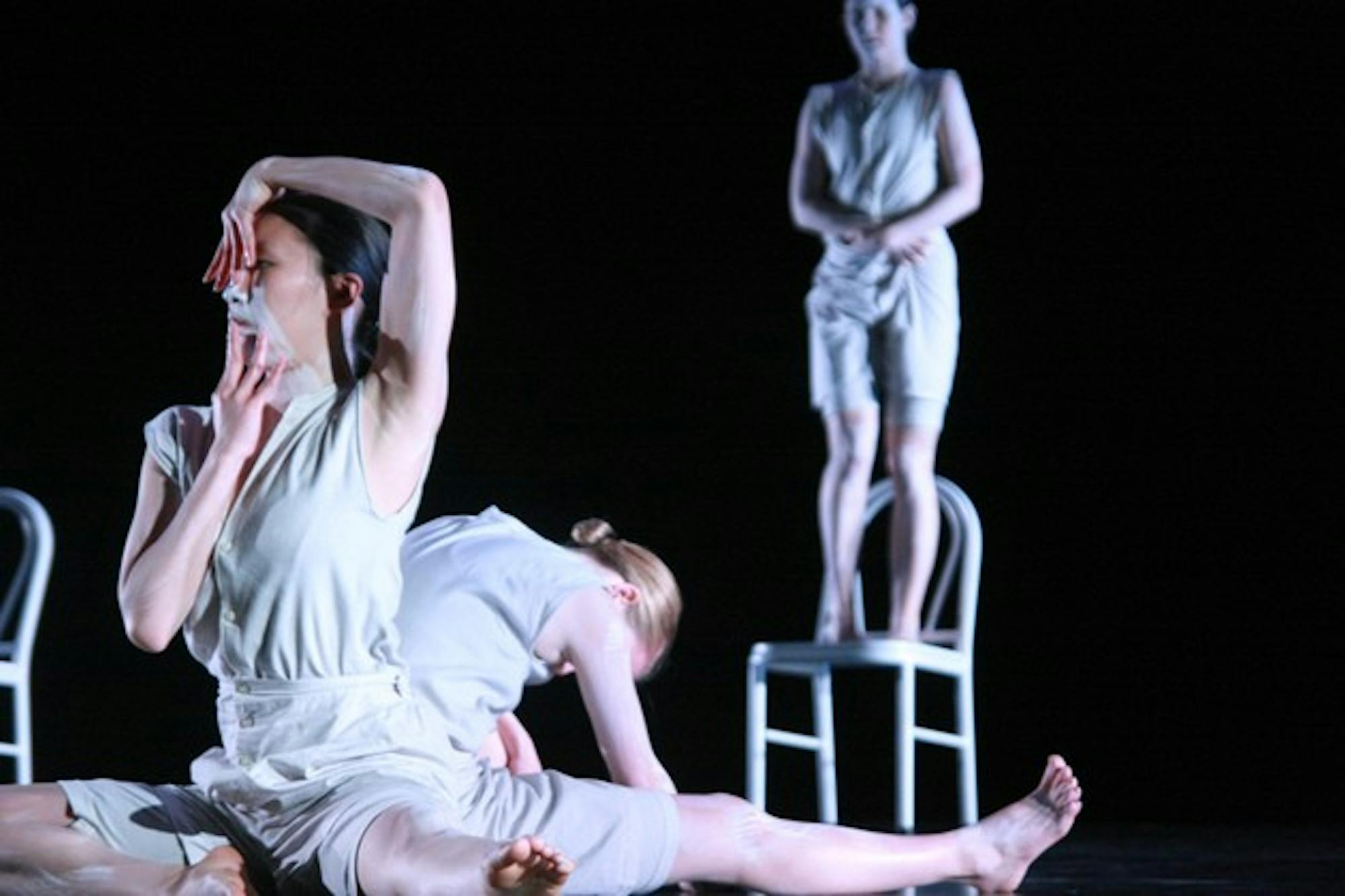
In another striking scene, DDTE members Christine Averill '13, Elizabeth Hoffman '13 and Chloe Moon '13, accompanied by a few others, brought out chairs to perform a sequence of contemporary and interpretive dances that clearly emoted their views on war. The repetitive, sharp and disturbing movements gave me goose bumps as I visualized soldiers doing the same routine and seeing the same bloodshed day after day.
While some moments of the show had direct and easily comprehensible messages, others left some audience members considerably confused. One scene, for example, featured dancing skeletons on screen and prop guns in front of the soldier-like performers, with Kanye West's "Jesus Walks" playing in the background. The dance, in which the performers moved to avoid being shot by a skeleton character, was supposed to be an attack on weapon use in battles. At first, I thought it played like a humorous insert in the performance that is, until the dancers shouts of "motherf*cker" at the end cemented the number's aggressive character.
Many other scenes also carried this sense of roughness and violence, including the numbers that mixed martial arts with interpretive dance to portray combat, and the edgy, red-lighted rape scenes. Yet despite this brutality, the skill and grace of the performers was highly evident. Their thoroughly polished routines, precise timing and body extensions showcased their skill range.
The ensemble's talent was particularly evident during a piece by Benja Wurzel '10, in which he performed an interpretive piece on crutches, representing the obstacles soldiers face after returning from war with severe and sometimes irreversible injuries. The dance brought out emotions of sadness and sympathy, as opposed to the aggression and hatred conveyed during previous acts. For this reason, this portion stood out as one of the highlights of the night.
Overall, "Viscera" dealt with war in an abstract manner, defamiliarizing typical symbols of death and war and presenting them to the audience with an air of aggression that revealed the piece's anti-war position. While segments of the performance seemed disconnected and performers' intentions unclear, all of the performers were stunning, and their efforts paid off through a thought-provoking depiction of the dances of war on stage.