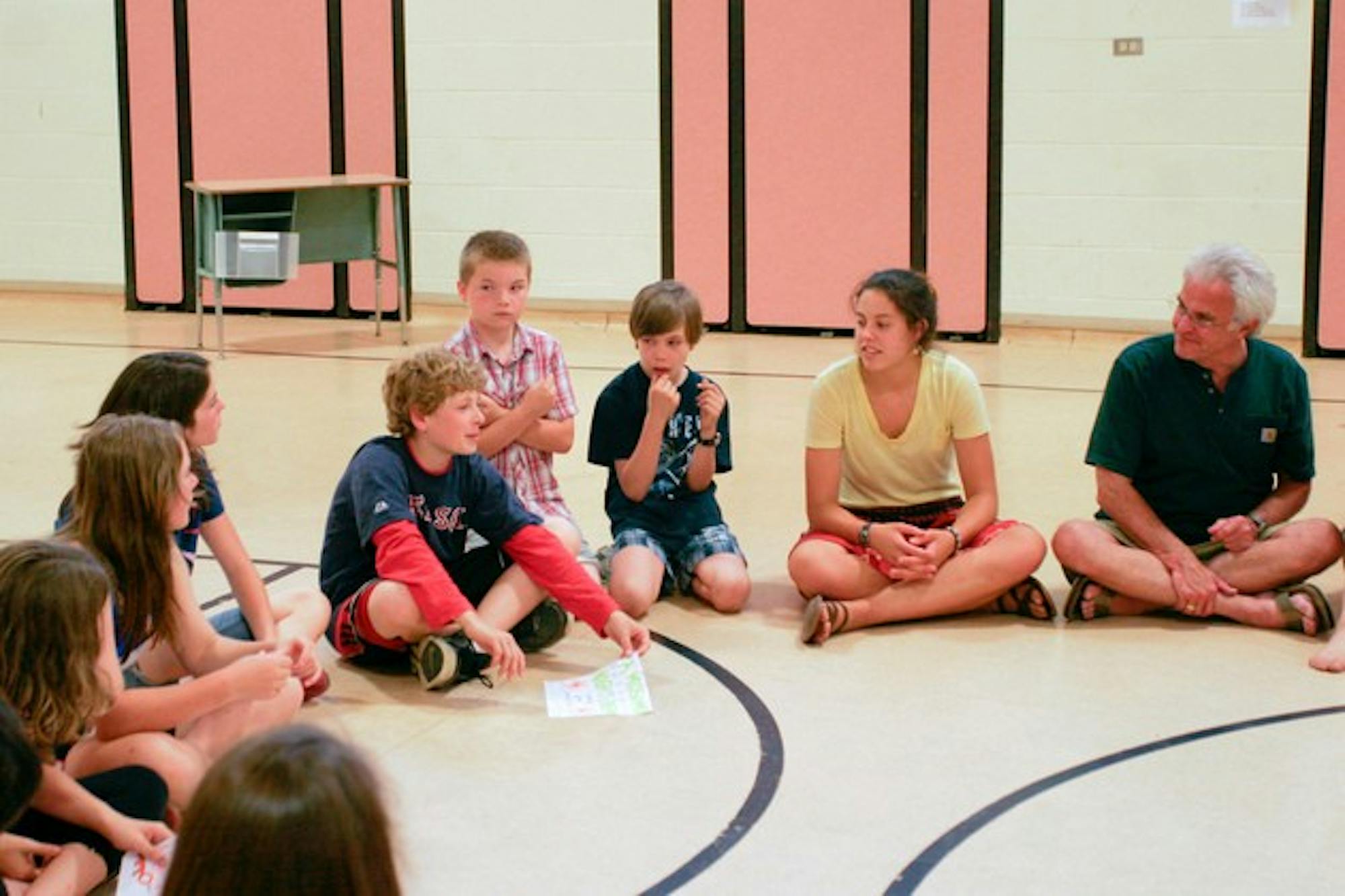
The Dartmouth Shakespeare Project, modeled on the outreach programs of the Lennox, Mass.,-based theater group Shakespeare & Company, introduces Shakespeare's language and plots to students who might otherwise have little access to arts programs, according to program participants. Thirty-five students from Martin Tewksbury and Janis Boulbul's fifth and sixth grade classes have worked for nine weeks on learning and producing the play.
Tailoring Shakespeare's language to a middle school audience was challenging, Markson said.
"It's tough," he said. "Basically you have to balance what's vital for the plot and what's memorable and famous and beautiful. So, we try to keep in famous lines like Lord, what fools these mortals be,' but a lot of long monologues often end up as one or two sentences."
To help the students understand the archaic language of the play, the directors ask them to break down and rephrase their lines in modern English, according to Markson and class member Cassandra Cooper '11,
"It is necessary that we keep the beauty of Shakespeare's writing, but also that they are not just reciting words that have no meaning to them," Cooper said in an e-mail to The Dartmouth.
Educational games and high energy levels help make Shakespeare come alive for the students, Cooper said in the e-mail. One game, called "text layups," involves two students passing a ball down a basketball court and shouting a line from Shakespeare when they shoot, she said.
"Changing it up every day is key and keeps them on their toes," Cooper said.
Every child is guaranteed a part in the play, Markson said. Because there are more students than characters in the play, most roles are shared by at least two children who wear the same costume to retain continuity from scene to scene, he added.
One of the most difficult parts of the project was organizing the scenes to include each student, according to Markson.
Each of the Dartmouth student participants directs a scene in the play and works on one or more committees that prepare the lighting, script, publicity, costumes, set design and sound, according to Markson.
The class holds a planning session at the beginning of each week and visits Sharon Elementary in two-and-a-half hour sessions twice afterward, according to Markson.
"The biggest challenge has been trying to fit all of the work we have to do with the kids into such few meetings with them," Cooper wrote.
Working with children has provided useful directing experience and offered Rice's students a new perspective on Shakespeare's work, Markson said.
"It forces you to explain things directly, but in simple terms," he said. "And it gives you an idea of what in Shakespeare is most viscerally entertaining, because kids don't have any guile or pretensions."
Cooper said that she predicts the students' enthusiasm and their unique talents will make for a successful show.
"I've been surprised at how much energy these kids have for Shakespeare," she said in the e-mail. "They all bring something different to the table that forms a very well-rounded group of kids that are going to put on a fabulous show."
Markson said he appreciated that the Sharon students have "never thought that Shakespeare was not cool enough." He attributed the students' comfort with the program to the fact that "it's a running tradition, and the younger kids see the older kids doing it. They anticipate it."
The Dartmouth student directors come from a wide variety of backgrounds, according to Markson. Some are drawn to the class by an interest in education or theater, while others appreciate the unconventional nature of the class.
"A lot of students are looking to do something fun and different for their senior Spring." Markson said. "And the kids are just absolute sweethearts."
The Project was founded by Rice in 2003 and has staged an abridged Shakespeare play biannually, according to a Dartmouth Shakespeare Project press release.