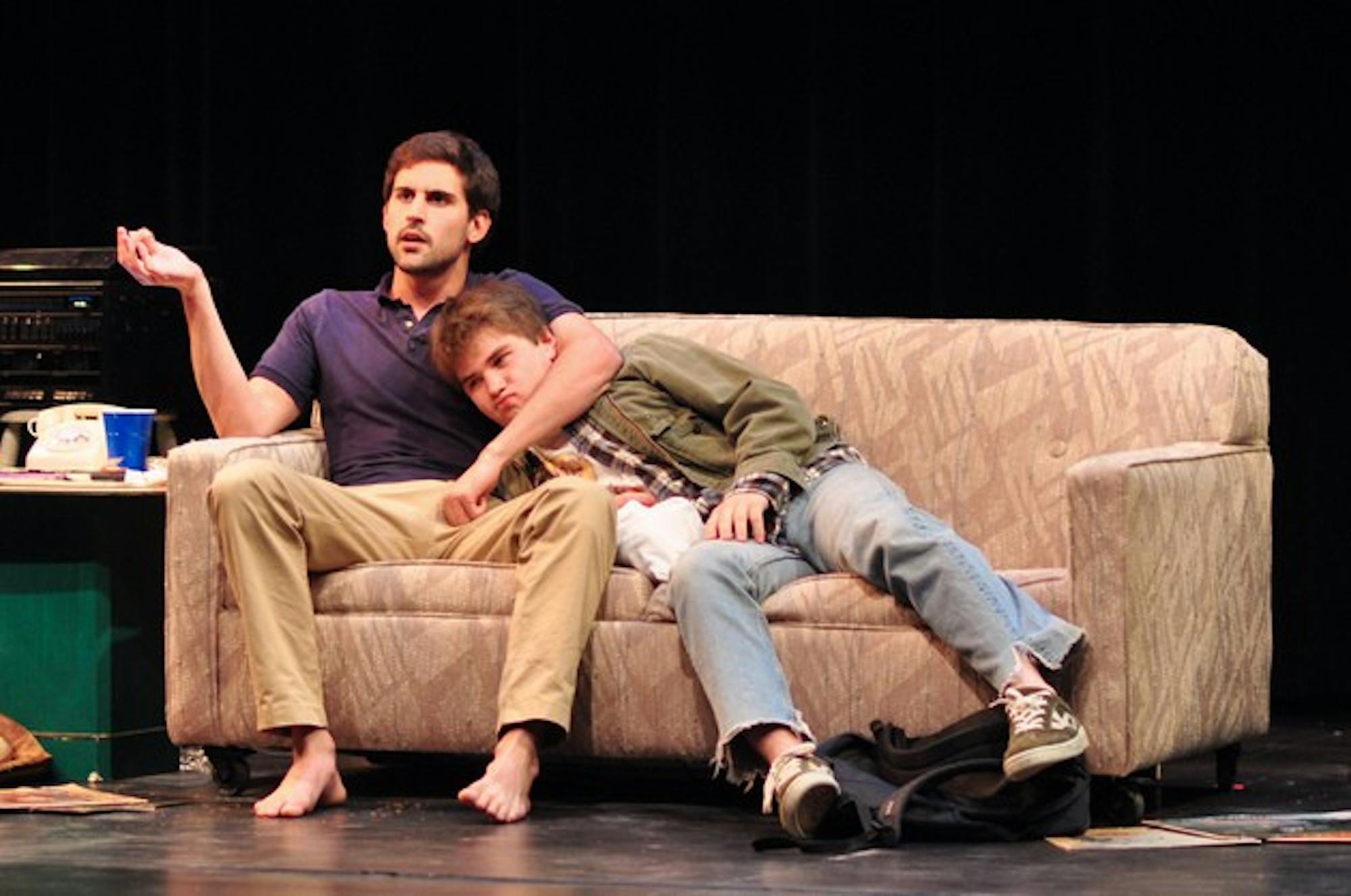
Director Genevieve Adams '11, who is majoring in English modified with theater, said her interest in putting on the play was sparked during her off-term in New York City last Winter. In addition to auditioning in the city and working for a casting director, Adams spent the term reading a variety of plays including the 1998 play by New York-based playwright and director Kenneth Lonergan, which has gained a reputation for tackling edgy, modern themes that are highly relevant to the younger generation.
"When I was in New York, I was reading a lot of plays, and I've always been a fan of Lonergan's writing the specificity of the dialogue and his unique brand of humor," Adams said in an interview with The Dartmouth. "Lonergan has a talent for writing such eccentric, yet lovable characters."
Adams proposed the show to the theater department a week into the Spring term, leaving just five weeks to prepare for the three-night run, she said. Students worked tirelessly on the production to create a realistic set, complete wardrobe and believable performance style before opening night.
Adams praised the show's actors Ben Gifford '10, Jack Coster '13 and Marguerite Imbert '11 for their speedy line memorization and expressed gratitude to the student production team costume designer Ellie Hunter '11, set designer Marian Mathias '11, lighting designer Olivia Baptista '12 and sound designer Lane Bracken '11 "for creating the visual world of the '80s in New York City."
Gifford is a former member of The Dartmouth Senior Staff.
Adams' praise was well-placed, as the different design elements converged with fluidity and grace, enhancing the realism of the performance. The set, for example, consisted of a mattress haphazardly positioned on the floor and a faded sofa at center-stage, perfectly evoking a sparse Manhattan apartment.
This true-to-life set represented a suitable dwelling for its tenant the rebellious, drug-dealing Dennis Ziegler, played by Gifford helping the character to seem much more believable and complex. Although he makes his living dealing cocaine, Dennis actually hails from a wealthy family: his father is a famous artist and his mother a well-meaning philanthropist. He begrudgingly agrees to allow his friend Warren Straub (played by Coster) to stay at his home after Warren steals $15,000 from his parents after they kick him out of their house.
According to Adams, the divide between the two young men and their parents is relevant to current audiences, as it reflects the disconnection that today's youths may feel from older generations.
"I think the way these characters feel disillusioned with themselves and the materialism of the city and their parents' detachment mimics our generation in some ways," Adams said. "We all feel this youthful restlessness and resentment of older generations."
Apart from this generation gap, Adams said she focused on the depth and complexity of the show's three characters while directing "This is Our Youth" her first directing experience at Dartmouth, apart from a staged reading last Spring.
"There's not that much blocking or action in this play, but the characters are extremely complex," Adams explained.
Indeed, different facets of the characters' personalities are revealed as the show progresses. While Dennis, for example, provides comic relief throughout the play, his vulnerability is exposed at the end of the show, when the death of a fellow drug dealer forces him to face his own issues with family and death. Meanwhile, Imbert plays Jessica Goldman, the most hopeful of the three characters, who exposes Warren's emotional baggage from the death of his sister 10 years prior.
"We all worked together to make these characters three-dimensional," Adams explained. "The most challenging [aspect of the performance] was making these apathetic kids, who have given up on the world in a sense, be likeable. Giving them agency and making them powerful while still being vulnerable was the ultimate goal."
The actors and the design team tackled this goal successfully portraying complex characters and drawing connections between the problems facing Warren, Dennis and Jessica, and their modern counterparts in the audience.
She also cited the play's relevance to college students as an impetus to produce the show at Dartmouth.
"This is Our Youth' is a play that centers on the confused lives of three misguided 20-year-olds, and I thought it'd be great to produce a play at Dartmouth that deals with kids our age," Adams said.