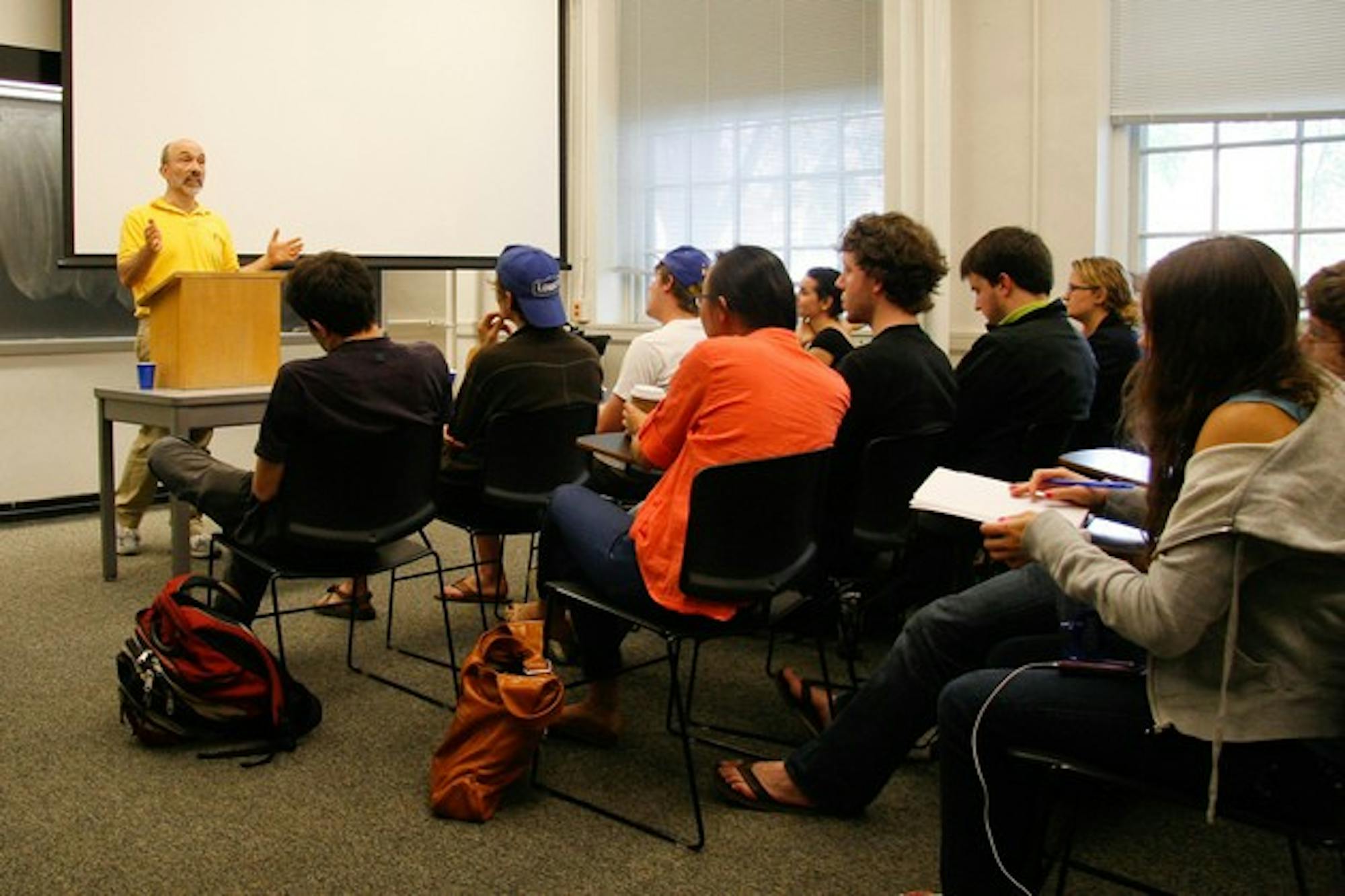
Kohn explained that his libertarianism is "empirical" and is based on his life experiences, not on ideology.
Kohn described his early life in the United Kingdom, where he joined a Zionist socialist movement in London at age 16. As a socialist, he believed that "money [was] the root of all evil" and that unhappiness was caused by material desires.
Kohn relocated to Israel at age 18 and lived in a kibbutz in Ami'ad, a town just north of the Sea of Galilee.
Kohn's kibbutz, which is an agricultural settlement, was based on socialist ideals, Kohn explained.
"All members of the kibbutz worked where they were assigned," Kohn said, noting that individual preferences were given consideration.
In the kibbutz, Kohn worked as an irrigation worker, he said.
"Wherever you work at the kibbutz, you don't receive pay [for your work], but you receive benefits in kind," Kohn said. "There was no private property."
Cigarettes, for example, were free for everyone in the kibbutz, which is why Kohn said he became a smoker.
Kohn said that he became disillusioned with socialism while in Israel. His experience living in a kibbutz in Israel taught him that socialism "doesn't bring happiness."
"People were not more or less happy than they were if they were anywhere else," Kohn said.
He explained that on a kibbutz, while "material circumstances were pretty equal" for everyone in the community, "perceptions are refined in proportions to the smallness of the differences."
Kohn added that socialism also did not have long-term appeal to most people because "incentives mattered."
He explained that there were only two groups who stayed at the kibbutz the "deadbeats," or lazy and unmotivated people, and the "saints," or staunch socialists. Everyone else left the kibbutz, Kohn said.
After he left the kibbutz, Kohn abandoned his socialist views and went on to university, where he became a progressive, he said.
Kohn said that his progressive philosophy was grounded on two main tenets that "we have the understanding of how to make things better," and that "we have the means to make things better."
Kohn said that his experience in teaching Economics 26, a course on the economics of financial intermediaries and markets, and his individual research made him question his faith in progressivism.
Government regulation in the financial sector, which is supposed to prevent banking crises, has not been effective historically, he said.
The recent global financial crisis was not a crisis caused by a lack of regulation, but "was a crisis of regulations," Kohn said.
"Far from stabilizing the financial system, [the regulations were] the cause of most of the instability," he said.
Every time there was a banking crisis, the federal government responded by adding yet "another level of regulations," including stricter capital requirements, Kohn said.
Government regulations have "distorted" the way people seek to make profits, Kohn said.
For example, deposit insurance, which was implemented in the early 20th century and designed to protect smaller banks from failure, created a "moral hazard problem." With deposit insurance, banks began to engage in riskier investment strategies, he explained.
The government today is "an organized use of force," using its legislative authority to enforce policies including taxation to redistribute resources from one sector of the society to another and to promote particular national interests, Kohn said.
According to Kohn, this arrangement is problematic because societies often "do not have the knowledge to make things better" and because people are often "the best judges of what's good for [themselves]."
"Government is not a particularly good instrument to make the world a better place," Kohn said.
Kohn said that he became a libertarian by default, after coming to "an absence in belief" that government regulations can make things better.
"If you lose your progressive faith, you become a libertarian by default," Kohn said. He added that he is open to changing his political views in the future if he finds compelling "new evidence."
Kohn acknowledged that while we "live in a society that is imperfect," it may be "better to live with the imperfections" than to attempt to correct them through regulations.
Governments should not cease to exist altogether, Kohn said, because they still have important roles to play in protecting individual rights and preventing foreign aggression.
The role of governments, however, should be limited to these two responsibilities, because "anything else the government seeks to do will not turn out well," Kohn said.
Kohn is working on a book, "How and Why Economies Develop and Grow: Lessons from Preindustrial Europe and China," which will analyze the different types of government approaches to economics.
The talk was sponsored by the College Libertarians.