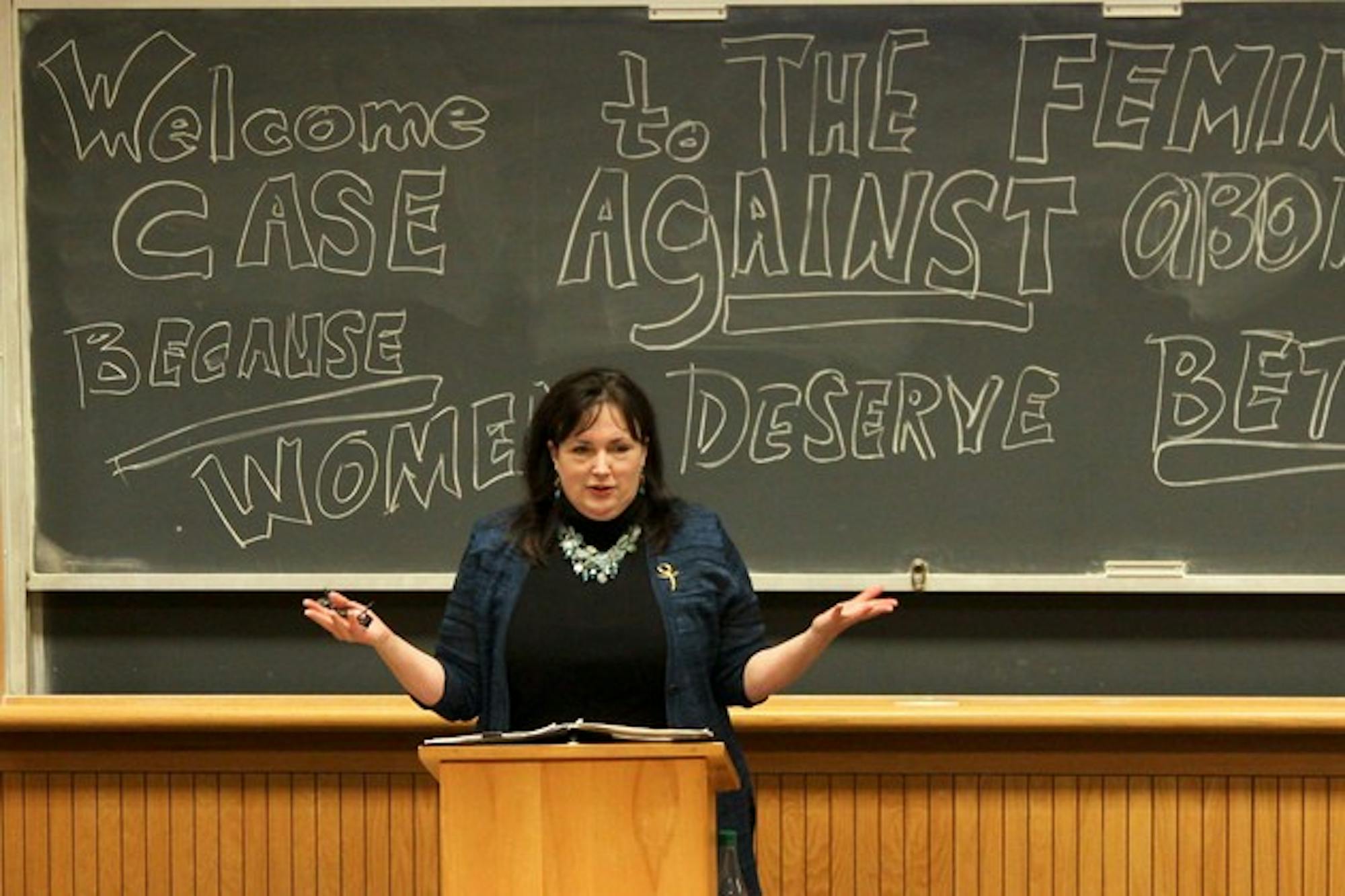
"I'm not here to criminalize women," Foster said. "I want to free women from abortion. Abortion is a reflection that our society has failed to meet the needs of women."
According to Foster, the current abortion debate is polarizing and forces women to choose between the "woman's side" and the "baby's side."
Foster said the ideals of feminism support the equality of all people, including women and unborn children.
In the 1970s the American feminist movement rejected the use of force to "dominate, control or destroy one another," a statement Foster said should apply to fetuses.
Abortion issues were an important factor in the women's rights movement of the 19th and 20th centuries, Foster said, and influenced discussion of women's suffrage among leaders such as Susan B. Anthony, Lucretia Mott and Elizabeth Cady Stanton. Some suffragists believed that after gaining the right to vote, woman would be empowered to choose alternatives to abortion, Foster said.
Despite laws against the practice, abortion was common in the 1800s, according to Foster.
American feminist Alice Paul, who led the movement to achieve women's suffrage in the United States, connected abortion and women's rights, Foster said. During a conference in the 1970s, Paul referred to abortion as "the ultimate exploitation of women," according to Foster.
But the "second wave" of women's rights movements during this time resulted in the creation of other women's organizations that "didn't ask the right questions," Foster said.
In her speech, Foster disputed the views of Bernard Nathanson and Larry Lader, who co-founded the organization that became the National Abortion Rights Action League in 1968. Nathanson, was a self-described "ex-abortionist" who cited the number of "botched" abortions he had witnessed as a reason for advocating safe and legal abortions for women, she said.
"Women who are suffering as prostitutes are trapped in an awful life," Foster said. "Rather than asking How can we free them from this life?' [activists like Nathanson] say we should give them condoms and free health care. Instead, we should be looking at holistic solutions, so we can find out why they are having abortions."
Domestic violence and desperation often lead women to unsafe abortion clinics, Foster said. Furthermore, societal pressures, such as a perceived need to "fulfill everybody else's expectations," also drive women to choose abortions, she added.
"There are 50 million children we will never know in this country," Foster said. "We mourn with women who swallowed a bitter pill called choice. The terminated child left them with an empty womb and an empty heart, and for many, they got back to the same old violent husband."
Foster also challenged attorney Sarah Weddington's defense of Jane Roe in the landmark Supreme Court case Roe v. Wade. Foster said Weddington's argument that women cannot complete their education if they have a child "undermines" the capabilities of women.
Feminists for Life works to provide women with resources to pursue education and careers without "sacrificing the unplanned joy" of motherhood, according to Foster.
The "inconvenience" of motherhood often results in a lack of support from society and women's employers, Foster said, posing difficulties for those seeking maternity leave.
For professors on tenure track or college students seeking part-time or academic leave, this poses additional problems, according to Foster.
"You have to ask, what choice do you have here?" Foster said. "Do you have housing? Childcare?"
Feminists for Life works to "systematically eliminate the root causes that drive women to abortion," Foster said. The organization works on three levels policy, campus-level and celebrity advocacy, according to a brochure provided by the organization at th event.
"We need to do something to change society's view on abortion," Foster said. "We need to make it unthinkable, beyond illegal."
On the campus level, the organization addresses the needs of birth parents, faculty, administrators and staff, Foster said.
Feminists for Life representatives point students towards available resources, establish support groups and spaces on campus for parents and pregnant women and support the academic and career goals of college faculty and students on and off campus, Foster said in an interview with The Dartmouth.
Anna Niedbala '12, treasurer of pro-life student organization Vita Clamantis, said she agreed with Foster's argument.
"I think she sends an important message about kinds of accommodation that could and should be made for women so they don't have to choose between opportunities and having a child," Niedbala said in an interview with The Dartmouth. "Maybe this can help Dartmouth think about what we can do for women so abortion isn't the only option they feel they have. We don't want to condemn these women but maybe change the reasons why they would seek an abortion in the first place."
Other students took issue with certain aspects of Foster's argument.
Nelly Cubahiro '13 said she disagreed with Foster's interchangeable use of the terms "fetus" and "baby," as well as her focus on long-term policy rather than short-term solutions, such as expanded birth control and contraceptive techniques.