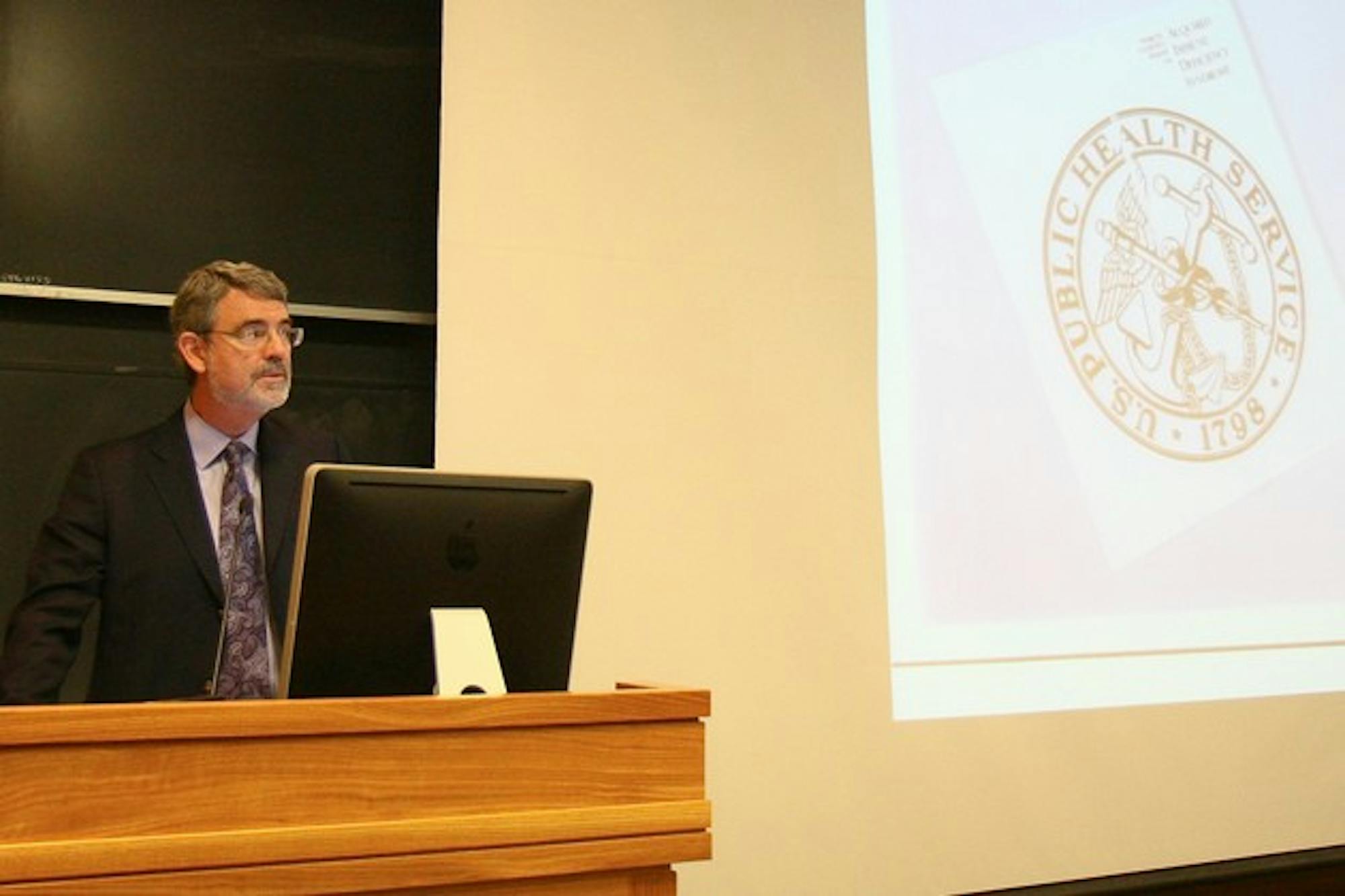
The ability to practice medicine is both a personal and professional privilege given to doctors, Mullan said. These privileges are "gifts," he said, which assign doctors a "social responsibility."
Both historically and today, funding from the National Institutes of Health has gone largely toward research at top-ranked medical schools instead of addressing medicine's social mission, Mullan said. Medical schools play a key role in developing this mission, he said, but the "prestigious" schools that typically receive the most NIH funding are often the least focused on social issues, according to Mullan.
The nation needs a physician workforce that is more evenly distributed across the country, more diverse and more focused on primary care, Mullan said.
Mullan described a recent study that assessed the "social mission score" of various medical schools, determined by the number of physician graduates from each medical school practicing primary care, the number practicing primary care in underserved areas and the number of minority physician graduates from the school.
The study will be published in the Annals of Internal Medicine in June, Mullan said.
The schools that received the highest social mission scores were historically black universities, Mullan said. Public schools generally received higher scores than private schools, and the northeastern United States had the fewest high-scoring schools, Mullan said. A school's social mission score generally is inversely proportional to the amount of funding received from the NIH, he said.
"We have essentially inverted the U.S. News and World Report rankings, for those of you that follow them, which are heavily based on research and heavily based on reputation," Mullan said.
Dartmouth Medical School received a "respectable" ranking of 60th among American medical schools based on its social mission score, Mullan said.
DMS ranked 22nd for primary care and 35th for research in the most recent U.S. News ranking, according to the publication's web site.
Mullan also voiced support for several aspects of health care reform policy, including expanded health insurance coverage, increasing the size of the National Health Service Corps, expanding the number of community health centers and increasing support for primary care practices.
Health care policies in the United States have an international effect, Mullan said. He cited the consequences of "the brain-drain," that result from the "immoral" importation of "the best and the brightest" physicians from abroad to work in the United States rather than in their native countries.
Mullan also criticized the commercialization of health care, citing the growth of for-profit hospitals and advertisements by pharmaceutical companies from the 1970s through the 1990s.
The lecture was part of the Harold Wade lecture series, presented through the C. Everett Koop Institute at DMS.