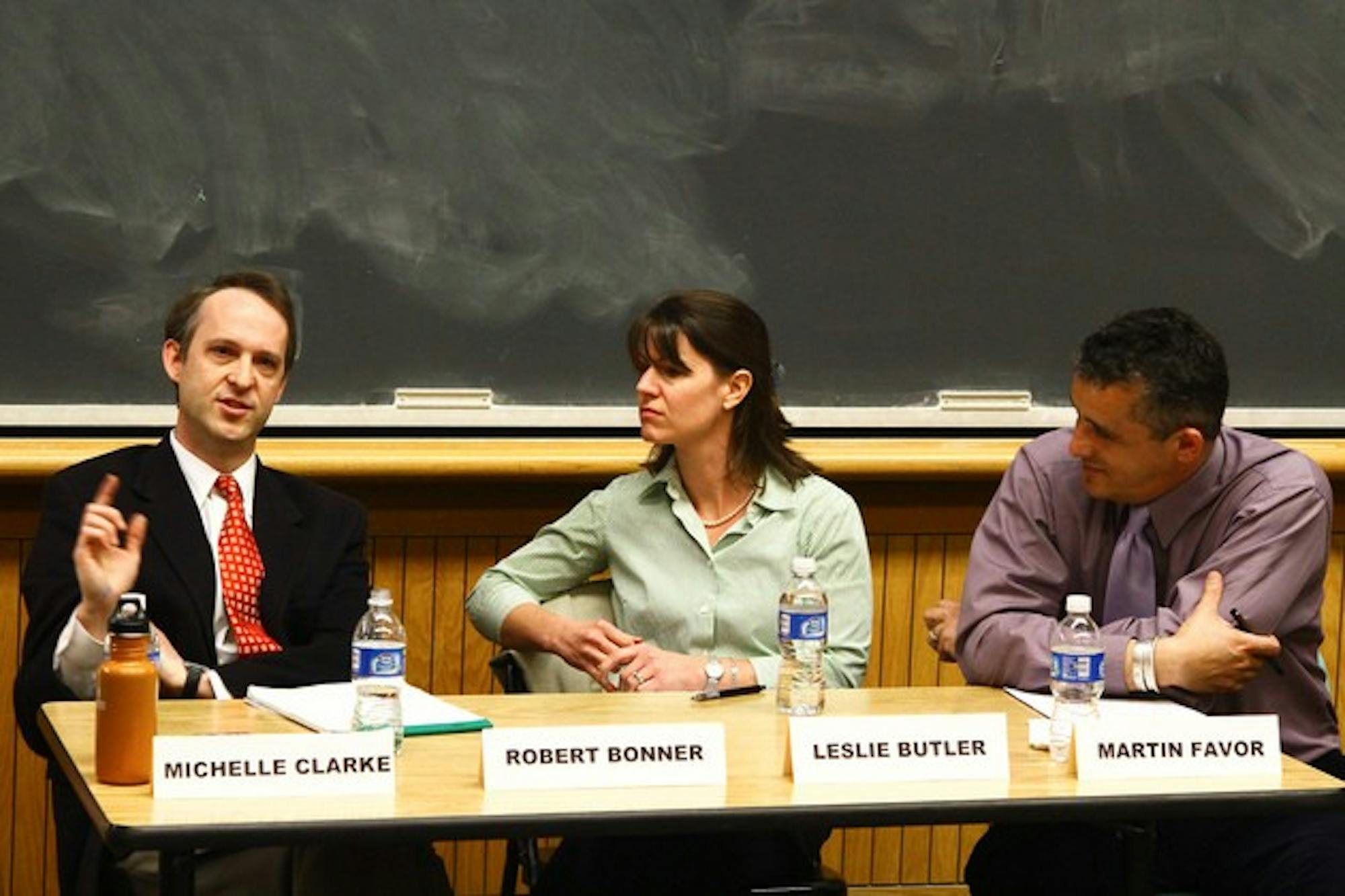
Lincoln's ability to "accommodate and even blur the differences" between varying opinions regarding slavery helped to make him a "skillful politician in an internally divided country," panelist and history professor Robert Bonner said.
Lincoln viewed the question of racial equality as separate from that of slavery, history professor Leslie Butler said. Lincoln's personal correspondence demonstrates the gradual intensification of his views against slavery, although his politics reflect a tempered evolution of his opinions, Butler said.
"He knows that his views [on slavery] have evolved and that the public isn't ready for that yet," Butler said. "He had the Emancipation Proclamation ready to go but was waiting for the right moment during the [Civil] War to announce it."
Lincoln nudged public opinion as much as he followed it, Butler said, adding that some of Lincoln's most famous speeches, such as his Second Inaugural Address and the Gettysburg Address, were not speeches that pandered to his audience.
"Lincoln took a very angular and pointed role in calling out the direction of the country," Bonner said. "He sees the outrage but then offers a way to purify it."
Part of Lincoln's appeal resulted from his ability to stand for everything, Butler said.
"He was this folksy common man, frontiersman, a Northerner and a Southerner," Butler said.
Politicians link themselves to Lincoln because the public connects to him "not necessarily in a thick intellectual way but in a thick emotional way," Martin Favor, chair of Dartmouth's African and African-American studies department, said at the panel.
"We Americans have reinvented Abraham Lincoln in order to reinvent ourselves," said government professor Michelle Clark, who moderated the panel, quoting the writer Henry Louis Gates Jr.
Butler cited links between Lincoln's contributions to democratic theory and practice and Barack Obama's presidency as an example of this phenomenon in current politics. Lincoln's key political legacies include his ability to "speak the truth to people, deal in complexity, not appealing to the lowest common denominator and assuming that people have to be reasoned with on some level," Butler said.
The panelists also described Lincoln's changing role as a unifying figure during the Civil War by focusing on contradictions between his political actions and personal feelings regarding slavery.
These contradictions are not only "admirable" but also show a progress of thought that is "a perfect emblem of American history," Favor said.
Favor, who focused mainly on Lincoln's literary legacy, said that the record by black writers regarding Lincoln's assassination was "fairly silent" until the following generation began to write about reconstruction and Lincoln's death.
"Our veneration of Lincoln didn't come true until 100 years later with Martin Luther King," Favor said. "This has become a sort of fetish for an unattainable arrival of ideals."
Lincoln remains intriguing because of his contradictions, his evolution of thought and his redemptive qualities, Bonner said.
The discussion was sponsored by the Bill T. Jones/Arnie Zane Dance Company. The company will perform their production about Lincoln, "Fondly Do We Hope Fervently Do We Pray," in the Moore Theatre April 6-8.