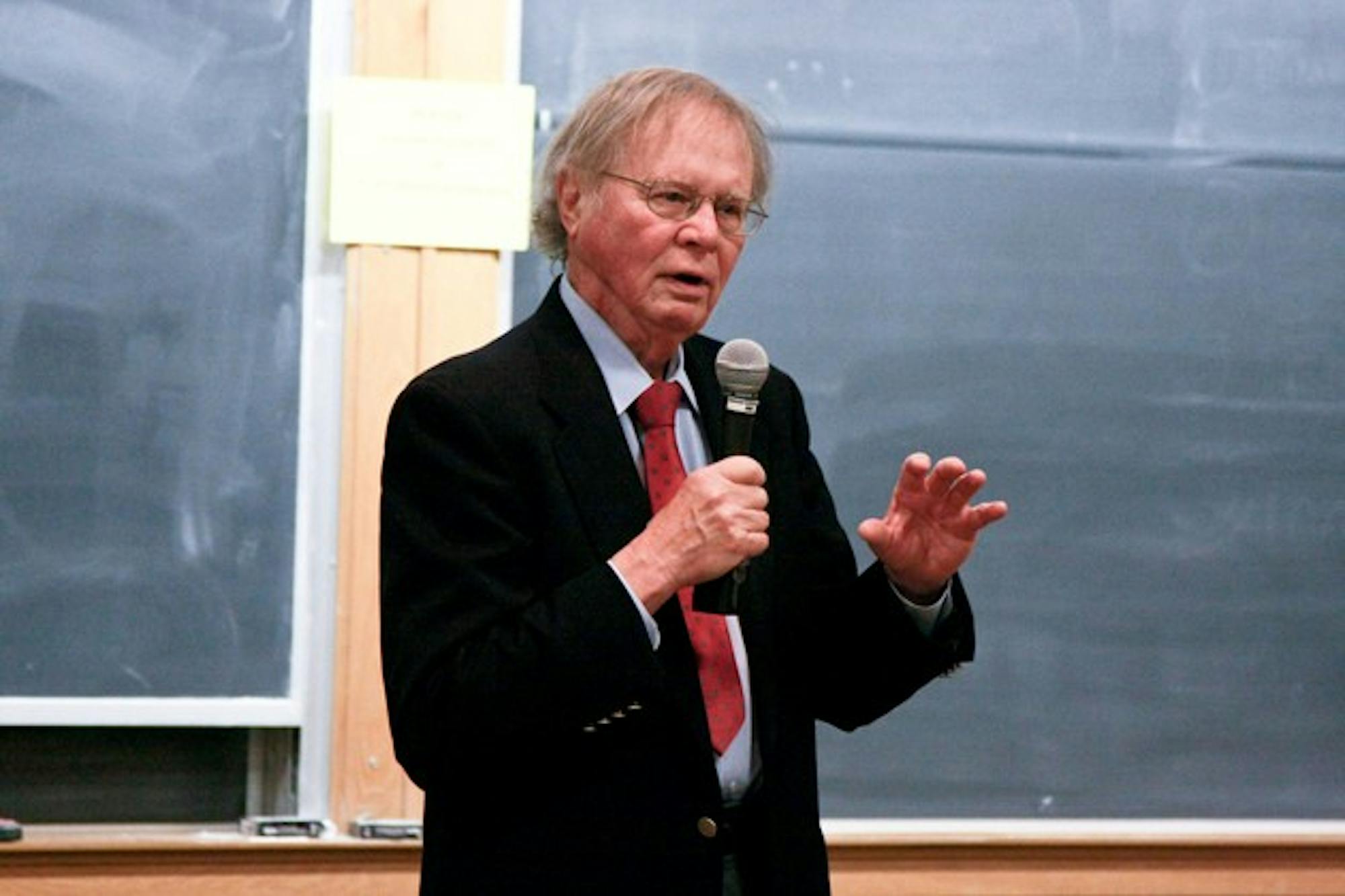
Because both policy makers and the public seem to be "burying their heads in the sand," scientists need to produce potential solutions to climate change in the meantime so that they are prepared to take immediate action when public opinion shifts, Broecker said.
The increasingly apparent effects of global warming over the next 25 to 30 years may provide the necessary impetus to convince policy makers and the public of the validity and scope of the problem, he said.
According to Broecker, the use of wind, solar and nuclear power as alternative energy sources can contribute to any solution but are insufficient and too expensive to completely replace fossil fuels. Developed countries continue to fail to reduce or halt the growth of their carbon dioxide emissions, and developing countries such as China will continue to increase their emission levels for some time, he said.
"Carbon capture is absolutely essential," he said in an interview with The Dartmouth. "If we don't do it, we're not going to solve this problem."
In the lecture, Broecker described the work of Columbia's Earth and Environmental Engineering chair Klaus Lackner on carbon dioxide capture as a prime potential solution to the inflated concentration of carbon dioxide in the atmosphere.
Before the economic downturn, Lackner co-founded Global Research Technologies, a company that developed the technique of capturing carbon dioxide from the air.
The company found that a commercial plastic developed to purify water included a chemical substance that absorbed carbon dioxide, which could later be stored in another container, he said.
The harvested carbon dioxide could be injected into sandstone aquifer rock bases, he said.
In the future, if the cost of hydrogen decreases, the harvested carbon dioxide could be combined with it to inorganically produce gasoline, Broecker said. This would effectively create a closed loop of fuel usage, he said.
The implementation of this technology would take some time, Broecker said, noting that the amount spent by the U.S. government on developing ways to combat carbon dioxide "is a pittance" compared to what is spent on national security or the fight against AIDS, he said.
An alternative, temporary solution to "cool the planet" would involve the release of "huge quantities" of sulfur into the stratosphere, he said. The sulfur would naturally convert to droplets of sulfuric acid that would remain suspended in the atmosphere for up to two years, scattering about 10 percent of the sunlight they intercepted, he said.
The measure could have dangerous consequences, Broecker said.
"There's no free lunch environmentally," Broecker said in the interview. "You do something, you're going to have side effects."
The intentional release of sulfur could "mess up the ozone cycle," cause acid rain and produce erratic instead of uniform temperature decreases, he said. The measure is dangerous because its total effects are unknown and there is no way to completely anticipate them before implementation, he added. While the release of sulfur would deflect sunlight currently entering the atmosphere, it leaves the problem of continued carbon dioxide emissions unaddressed, he said.
"Unfortunately, it's 10 times cheaper than any direct solution," Broecker said.
Despite the risks, Broecker said he believes that the intentional addition of sulfur dioxide into the atmosphere will occur during current students' lifetimes.
Broecker suggested raising the price of fossil fuels as another way to reduce fossil fuel usage and help the development of alternative energy, although he noted that "at this time taxation is political death."
"Until we put a direct tax on taking carbon out of the ground, we're in trouble," he said.
Broecker said he hopes California will institute a tax on the least fuel-efficient cars that equals the cost of removing the extra carbon dioxide they emit.
Norway currently has a tax on excessive carbon dioxide emission, which led Broecker to call it "the most advanced nation" on the issue of controlling fossil fuel use.