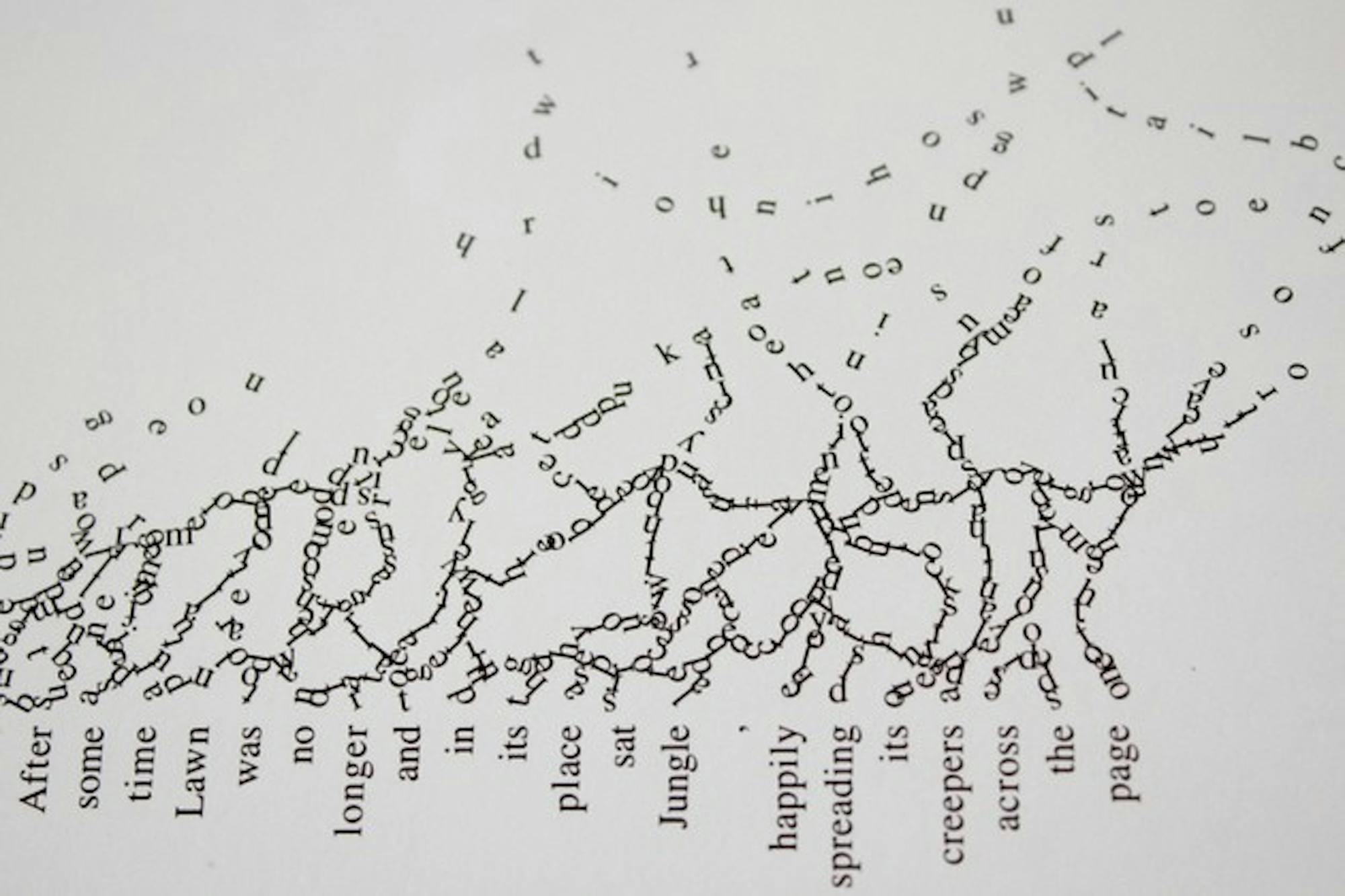
Thanks to alumni endowment funds, Dartmouth has accrued an impressive collection of both old and new artists' books over the years, according to Special Collections librarian Jay Satterfield. The works that are considered artists' books defy neat categorization, but they can be defined simply as art that uses the physical book as a form of expression, in addition to text. In this manner, artists' books work to challenge our preconceptions regarding book form and function.
The Book Arts program first came to the College in the 1930s, when it was established by Dartmouth professor and renowned graphic designer and calligraphy expert Ray Nash. Nash's guidance along with the installation of the Vandercook printing presses in the basement of Baker-Berry Library in the 1940s quickly allowed Dartmouth to become one of the leading collectors of fine print materials among its peer institutions.
According to English professor Alex Halasz, who teaches classes in both book history and book arts, the program thrived even more in the 1970s as more scholars nationwide became interested in studying the history and the idea of the book.
"In the 1970s, you saw a shift in teaching the history of the book," Halasz said in an interview with The Dartmouth. "More interest in the book as a form of art was generated, with emphasis placed on relating the structure of text to image."
With this new interest in the study of the book, artists began to explore innovative ways to use the form. The days of focusing solely on fine printing were over, as accordion books centering on tactile experiences forged in the helm of artist collectives and cooperatives heralded a new age of artistic ingenuity and creativity.
Today, artists' books continue to defy convention, as the books contained in Dartmouth's collection demonstrate. "Ipso Facto: The Oracle Lies Within" (1995) by Matthew Liddle, for example, opens like a hinged greeting card box and is covered in a purplish colored fabric. Inside the box, 100 colorful, individually rolled fortunes await the reader's perusal. Julie Chen's "True to Life" (2004) is even more unconventional, operating as an unfolding book with multi-colored layers that can be viewed through a Plexiglas panel and operated by a system of levers.
When selecting additions for the library's artist's book collections, Satterfield and visual arts librarian Laura Graveline use a number of factors to narrow their choices. Graveline said she tries to collect books from the same author, showcasing the breadth and variance of his or her portfolio.
"We have a pretty extensive Latin American, Latino and Caribbean collection of artists' books because of book cooperatives based in both Cuba and Mexico," Graveline told The Dartmouth.
Of these Latin American artists' books, the "Portable Mayan Altar: Pocket Books of Mayan Spells" (2007) by the women's book cooperative Taller Lenateros is particularly enchanting. Written in ancient Mayan with an accompanying English translation, the slim, black volumes function as a representation of the culture that produced them.
In contrast to Graveline's approach, Satterfield said that in choosing acquisitions, he focuses on finding materials that will most benefit the students and professors of the over 25 academic departments that use Rauner for course work. While these books may seem narrow in their focus, they actually provide an alternative perspective on a wide range of topics, making them valuable to students in all disciplines.
"When Shakespeare classes come into Rauner, I like to showcase different works and artist books that play on Shakespeare," Satterfield said. "Asking the students to determine, At what point does a Shakespearean adaptation become a performance in and of itself?' and what it means in terms of understanding Shakespeare more fully."
Whether thumbing through Daniel Webster's incomplete collection of Audubon prints or examining Angelo Lorenz's board game adaptation of John Bunyan's "Pilgrim's Progress," one can gain a new perspective on academic pursuits and enhance research by paying a visit to the Rauner or Sherman collections.