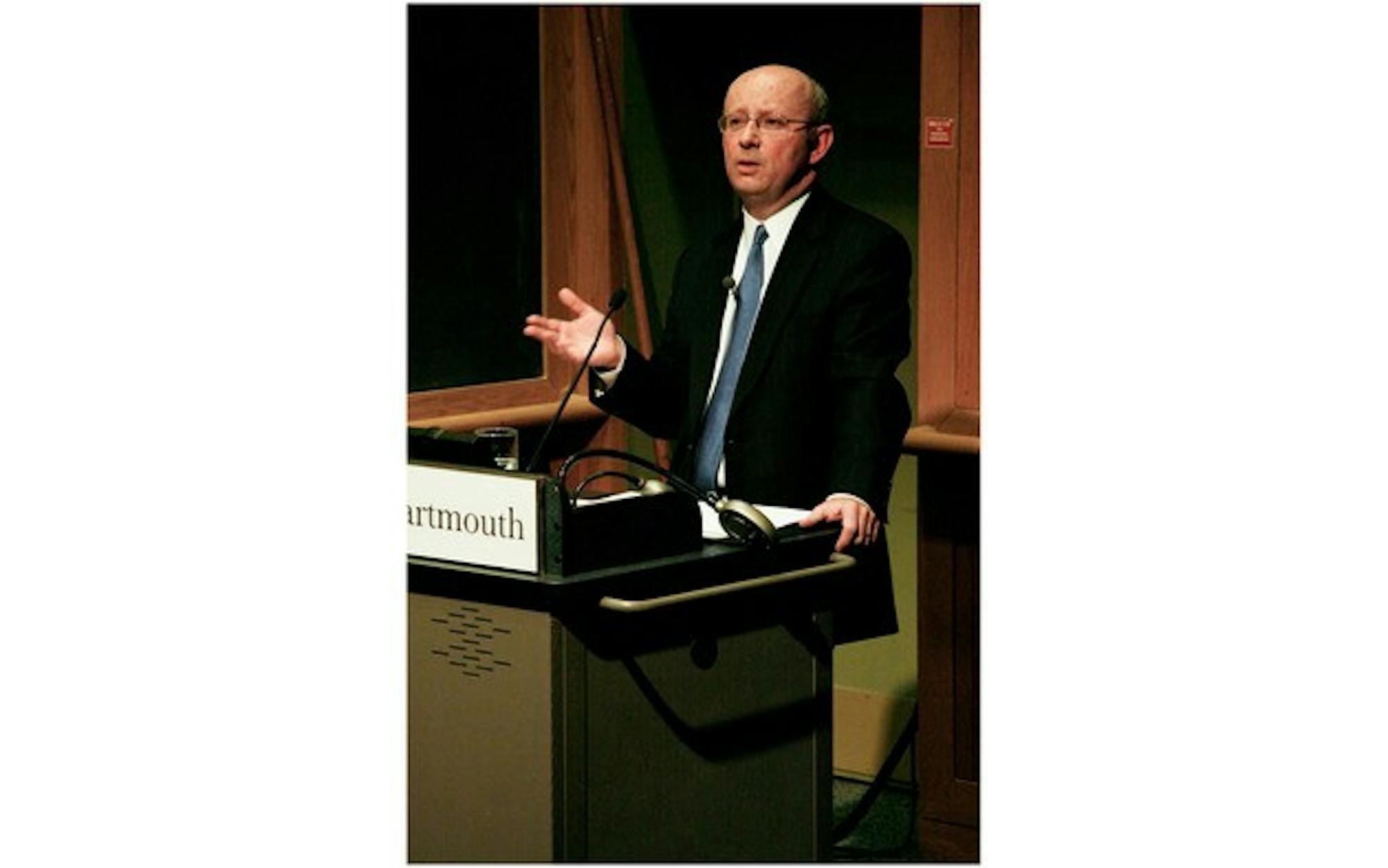
Although the current conflict between states and the federal government on international trade organizations and agreements is not an imminent constitutional crisis, it has gone unresolved for many years and will grow in importance as the American economy becomes more integrated with the world's, Barnico said.
"In some ways, I'm talking about the part of the iceberg that is still below water," Barnico said in an interview with The Dartmouth. "The tip is 15 years' worth of sporadic complaints and commentary, and lectures like this. People are wondering what all this means for the future and for our domestic constitutional structures."
International organizations and trade agreements are altering the balance between state and federal power in favor of the latter, although there has been tension between the two since American independence from England, he said.
"As that movement occurs, we need to think about the impact on state lawmaking powers," Barnico said in the interview. "We have studied, for a long time, the impact of the Constitution and federal laws on state lawmaking. What is new is international trade agreements."
The Founding Fathers were forward-thinking in worrying how states would independently interact with foreign countries, he said. Barnico spoke about the "Treaty Clause" in the Constitution, which gives the president and the Senate the ability to enter into treaties. The clause does not give the same power to individual states, and many of the trade agreements and international trade organizations the United States is party to have bypassed the protections that official treaty status offers states, he said.
By requiring two-thirds of the Senate in which all states have equal representation to approve a treaty for it to pass, the Founding Fathers may have tried to ensure states have a stronger voice in international trade policy, since such policy affects state law and commerce, he added.
"If the purpose of the two-thirds vote is supposed to provide more protection for the states as states, it could be that there is a procedural check here that is in the Constitution," Barnico said.
International trade issues and their associated legal questions can affect individuals on a very local level, Barnico said in the interview.
"Oregon may have a law [Oregonians] like that Japan doesn't," he said in the interview. "Maybe [Oregonians] even hit the streets to pass it, and now it is subject to a trade complaint by a foreign country. That is relatively new."
International trade agreements may give too much power to the federal government at the expense of states, Barnico said.
"When a foreign country complains about a state law, the foreign country can lobby the United States to repeal the state law," he said. "That's not litigated, that's all lobbying."
If the federal government does not relent, however, the foreign nation can go further, Barnico said. Countries can invoke trade agreement provisions that would ask the World Trade Organization to arbitrate between the foreign nation and the state, which would be represented by a lawyer at the U.S. Department of State as the U.S. trade representative, he said.
"That poses some questions for political science," he said. "The U.S. trade representative's main interest is promoting trade, not the state law."
Barnico provided recent examples of conflict between state law and foreign firms that have raised legal questions, including foreign Internet gambling companies' claims that state laws banning gambling were illegal. The World Trade Organization struck down the gambling laws, he said.
"Of course Congress can pass a law to nullify a state law," Barnico said in the interview. "What is new is for Congress and the president to enter into an agreement and have it be the vehicle for a challenge to a state law."
As the U.S. and world economy integrate, the question of trade and states' rights will become even more prominent, he said.
"That's the worry more agreements, more transnational bodies, more issues as to the effect on states laws," Barnico said in the interview.
Barnico's talk did not represent the views of the Massachusetts Office of the Attorney General, he said.