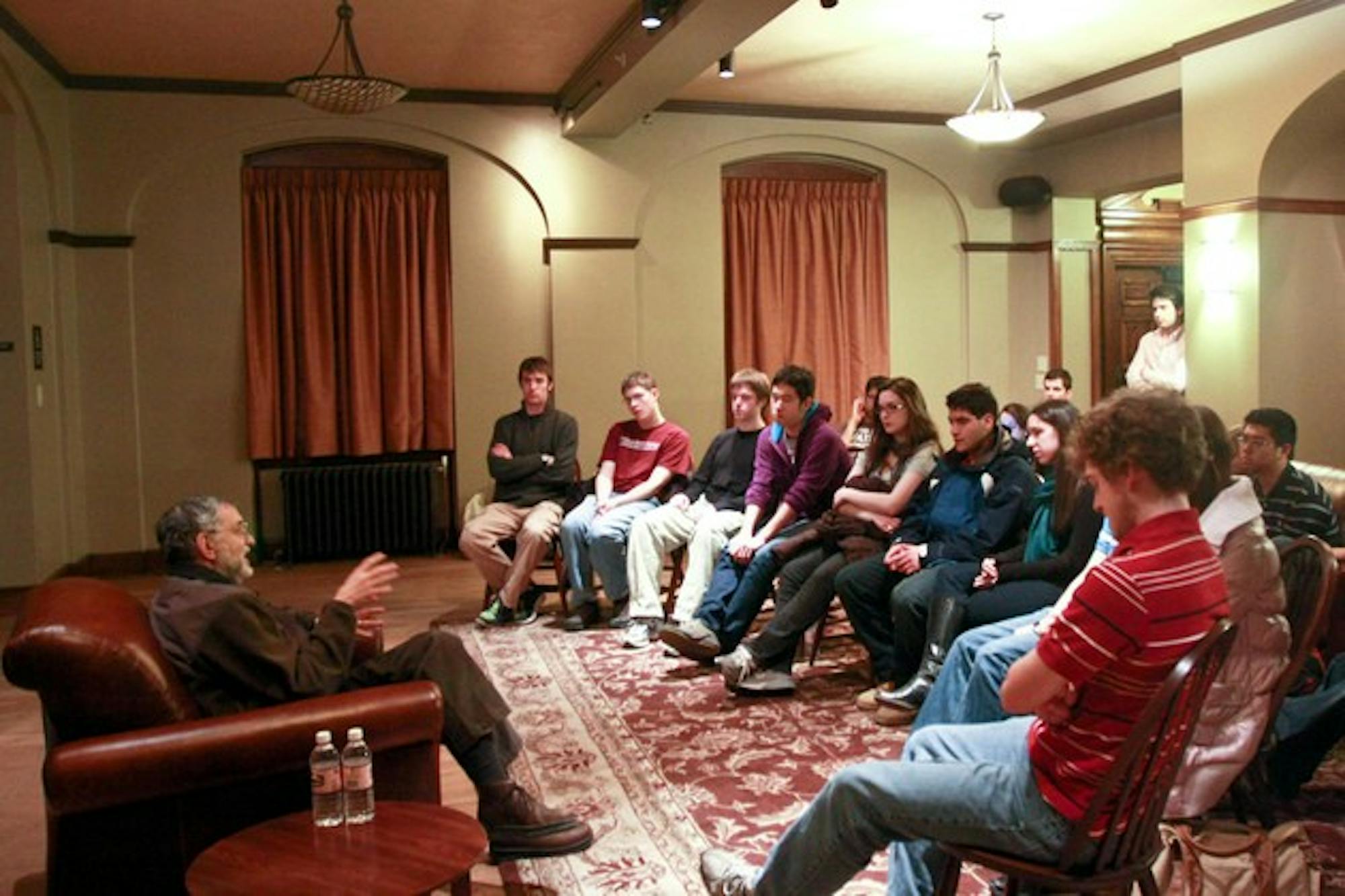
Yalowitz described how the two countries formed in the aftermath of the Soviet Union's dissolution.
"Belarus, since its independence, never really developed a strong national identity," he said. "The Belarusians, of all the countries of the former Soviet Union, outside of Russia, longed for the Soviet Union and were sorry to see it break up."
Belarus President Aleksandr Lukashenko's subsequent authoritarian government created difficulties for Yalowitz during his time there as an ambassador in the mid-1990s, he said.
"I was trying to work in getting them to move towards democracy, economic reform and civil rights," he said. "I often tangled with President Lukashenko because that is not what he wanted."
Georgia, however, maintained a strong national identity upon gaining its independence, according to Yalowitz, who served as ambassador there from 1998 to 2001.
"The problem that they had then was that there were minority groups in Georgia that did not like all the Georgian nationalism and they tried to secede," he said. "My task in Georgia was not so much trying to promote democracy the key task was working with a country that was divided."
When violence erupted in the neighboring Russian region of Chechnya in 1999, Georgians feared a Russian invasion into their country, Yalowitz said. The nation looked to the United States for support, and ultimately diplomacy prevailed.
"The United States did a number of things," Yalowitz said. "We helped prevent the Chechen War from coming to Georgia. We kept the Russians on their side of the border."
Yalowitz's proximity to the conflict distinguished his role in the crisis from that of officials in Washington, D.C., he said.
"Washington is observing it, but we're right there on the spot," Yalowitz said.
The opportunity for Yalowitz to obtain an ambassador position opened when the former Soviet Union broke up, forming 12 new countries, he said.
"There were people needed at that time that spoke Russian and knew something of the new countries of the former Soviet Union," Yalowitz said. "My ending up as ambassador to each of those countries was a recognition to my expertise and experience in that part of the world."
The title came with the responsibility of being a primary U.S. representative to the leaders of Belarus and Georgia, according to Yalowitz.
"As the United States ambassador, you are the personal representative of the President of the United States of America," Yalowitz said in an interview with The Dartmouth. "You are the President of the United States in the particular country to which you are accredited."
Thorough knowledge of U.S. foreign policy is necessary to serve as an American ambassador, according to Yalowitz.
"The way to keep up is reading voluminously," he said. "As an ambassador you're really on 24/7 you really must be aware of what's going on all around you. You're always liable to get called."
After 36 years of foreign service, Yalowitz retired.
He accepted his current position at Dartmouth after teaching stints at Georgetown University and American University.
"I've been able to pursue my interests in foreign affairs and develop a whole series of new interests like global health issues surrounding climate change, and also war and peace," he said.
This Spring, Yalowitz will teach a government and linguistics course, "Survival of the Fittest in the South Caucasus: Language and Politics."
"What we're doing is we're studying the interplay of language and politics in the Caucasus region," he said. "What we're examining is how some of these languages survived and strengthened. But why in other places have these languages died out or remained minorities? What kind of conflicts has this given rise to?"
The course is scheduled to be co-taught with linguistics professor Ioana Chitoran.