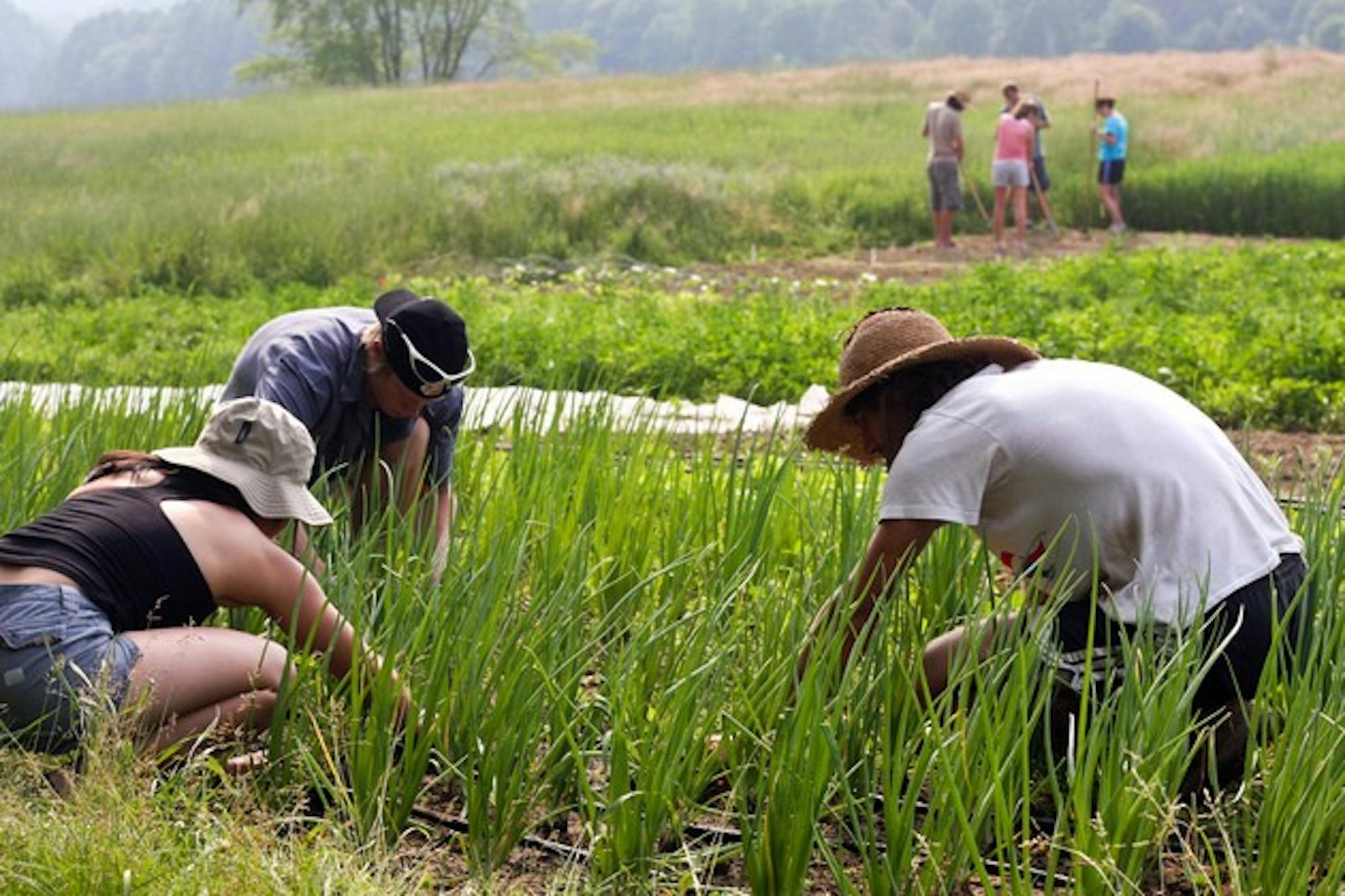
Harvesting peanuts and feeding fish with worms may not be the first images that come to mind when one thinks of a farm, but Dartmouth's Organic Farm has been a venue for such sustainable experimentation since its creation in 1994.
All of the Farm's practices and products are certified organic, according to Dan Susman '10, who lived at the Farm during the summer after his freshman year.
"The label organic' means you don't use any synthetic pesticides or chemicals," Susman said. "There's a certification the farm goes through [for] the state of New Hampshire."
The Farm uses composting and aquaculture systems to minimize nutrient waste and organically fertilize crops, according to Alexander Lee '10, who has also lived at the Farm.
Coffee grounds provided by Dartmouth Dining Services and scrap vegetables from the Farm are composted by worms in a "permaculture" system, Susman said, providing a mostly closed and sustainable nutrient cycle.
The rich organic material that results from composting is used as organic fertilizer for the crops, Lee said. Some of the composting worms are then fed to tilapia, which were moved this summer to the Farm for a project led by environmental studies professor Anne Kapuscinski, Lee said. The project will create a stream of nutrient cycling, in which organic matter from the fish tanks, including algae and fish waste, will soon also be used as fertilizer, he said.
"We're working on having a truly sustainable farm," Lee said.
The greenhouse at the Farm is Dartmouth's only building heated entirely by solar power and uses tanks of water as heat sinks, which release heat absorbed during the day to warm crops at night, according to Susman.
This process is effective in maximizing the temperature of the greenhouse, Brian Kunz, deputy director of the Outdoor Programs Office, said. In the summer, heat is let out from the greenhouse as it gets too hot, he said.
The greenhouse provides a more amicable environment for growing crops than the outdoors, Lee said.
"The greenhouse has a longer growing season," said Lee. "Since this is a controlled system, crops grow faster and bigger in the greenhouse. There's also not as much of a pest problem."
Chris Polashenski '07, now a student at the Thayer School of Engineering, designed the Farm's greenhouse as part of his engineering work when he was an undergraduate student, Kunz said. The U.S. Army Cold Regions Research and Engineering Laboratory provided the materials for the greenhouse, but Polashenski worked with the structure to make the building energy neutral.
Students involved in the Farm are now in the process of developing a "night curtain" to insulate the greenhouse and minimize heat loss after the sun sets, Kunz said.
Organic Farm manager Scott Stokoe leads both administrative and hands-on field work associated with the organic farm, which includes the sugar production operation at the Farm, according to Kunz.
The Farm sells its crops at a farmer's market in front of the Collis Center during the summer and fall, Kunz said. The Farm also sells a small amount of food to Dartmouth Dining Services, according to Lee.
The Farm does not actively sell to the community to avoid competition with local organic farmers, since the student farm does not have to pay for its property and has lower overhead costs, Kunz said. The Farm receives funding from OPO and endowments, but has never made a profit off its sales, according to Kunz.
"The goal is to educate students it's to get people out there playing in the dirt," Susman said.
Plans for the Organic Farm were first drafted in a report by students in 1988 in an environmental studies course, according to the Dartmouth Outing Club's web site. Students in another course were instructed to explore the logistics of and student support for a student farm in 1991.
Although the administration did not create a farm in response to the 1991 report, students from the Environmental Studies Division of the DOC began a small organic vegetable plot on their own in 1994 on land that was previously used as the College-owned dairy farm, the Fullington Farm, according to the web site. The success of the garden led to administrative approval for an early version of the Organic Farm to begin operation at the site.
The Farm now has two acres of agricultural production, according to the Farm's web site. The organic farm's first growing season was in 1996.
Lee said that while the Farm harvests many traditional New England vegetables, students have experimented with crops not native to the region. In one such project, students tried to grow peanuts at the Farm, Lee said.
"There's a focus on experimentation and seeing what can be grown," he said.
Students also get involved at the Farm through workshops and tours, he said.
"There's a core group of about a dozen people, but there's a lot of people that show up now and again or come to a potluck event at the Farm," Lee said.
The Class of 1983 has agreed to sponsor an internship position starting this spring or summer for a student to greet and educate visitors at the Farm, according to Kunz.
"This educational intern would give tours of the greenhouse, the fields and the sugar house to educate the public about what an organic farm does," he said.
Like many students who become involved in the Farm, Lee did not have experience with farming prior to working at the Farm.
"I guess I had a background of environmentalism and I think the idea of learning where food really comes from interested me," he said.
Ecological Agriculture, an Environmental Studies course offered during the Summer, uses the farm as an extension of its classroom, Susman said.
Student volunteers at the Farm will soon participate in a project to peel and notch logs that will be used to build the structure of a new log cabin, Kunz said. The cabin will replace Titcomb Cabin on Gilman Island, which burned down in May 2009.