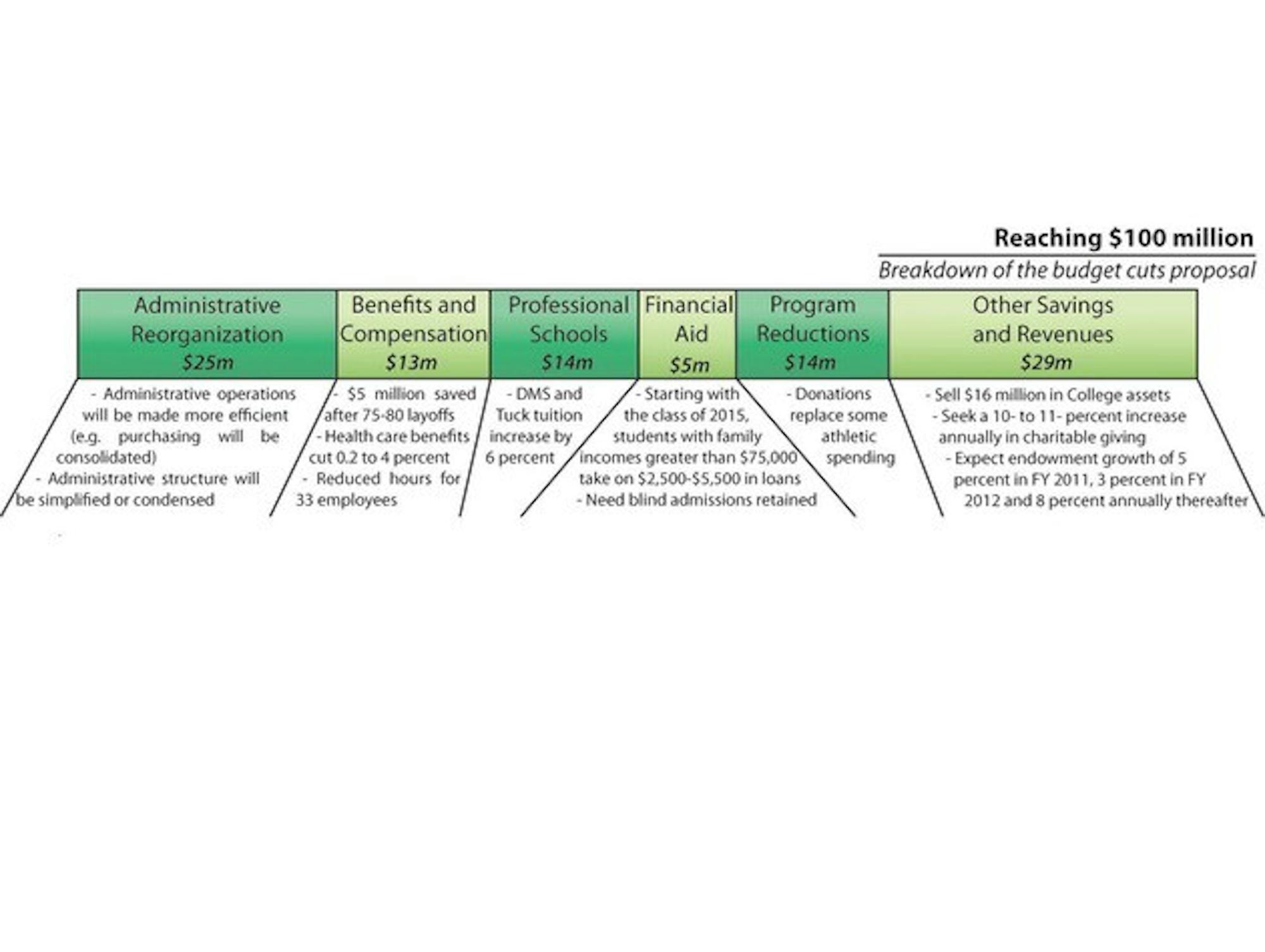
Thirty-eight current employees will be laid off and full student grants for families with incomes over $75,000 will be will be eliminated as the first steps toward mitigating the College's $100-million budget shortfall, College President Jim Yong Kim announced at a press conference Monday afternoon. The announcement follows the College Board of Trustees' approval of a budget plan for the next two fiscal years at its meeting over the weekend.
LAYOFFS
Administrators will go forward with 38 involuntary layoffs beginning today. These will be followed by a second round of layoffs that will reduce the workforce by a "comparable number" by the end of April, when the "most intensive phase of the budget-reduction process" draws to a close, according to a College press release.
"We have worked very hard to treat the entire community with fairness and compassion, and to that end we've taken a number of measures to avoid layoffs, including offering voluntary retirement, decreasing hours, eliminating unfilled positions and freezing salaries," Kim said.
The layoff phases are separated because administrators need time to determine which positions will be cut, Kim said.
"The reason we're not able to do it all right now is that we've had to look exhaustively at every part of the College and we just haven't been able to get to all parts of the College in that time," Kim said.
The total number of laid-off employees will represent about 2 percent of the College's non-teaching workforce, Kim said.
Affected workers will receive layoff packages which include "four weeks working notice, a lump sum payment equivalent to between four and 52 weeks of pay depending on length of service and a health care subsidy," Kim said.
Laid-off employees will also retain their current internal status when applying for College jobs, giving them preference in future hiring decisions, Kim said.
Sixty percent of the laid-off employees will be from the professional-managerial sector, while the remaining 40 percent will be "hourly workers," Kim said.
In addition to the layoffs, 33 employees will be asked to work reduced hours, according to the press release.
Kim, acting Provost and Dean of the Faculty Carol Folt and Senior Vice President Steven Kadish will each donate 10 percent of their salaries, putting $50,000 into a hardship fund for the relief of laid-off workers and the remainder of the sum into the Dartmouth College Fund, they announced at the press conference.
"Our hope is that by example, we'll encourage other administrators and other faculty members to donate to this fund so that we will lessen the impact [of the budget cuts]," Kim said.
One hundred and five employees have voluntarily consented to layoffs through the retirement incentive program, Kim said in a meeting with faculty members Monday.
While faculty will not be affected by the layoffs, jobs will be eliminated at "all levels" of employment and will affect both union and non-union employees. the press release states.
Because the College has already slowed the process of filling vacant faculty positions, additional faculty layoffs would compromise the educational experience the College offers, Kim said. The large number of tenured faculty members also reduces the College's ability to lay off faculty without their consent, Kim noted.
FINANCIAL AID AND TUITION
The new budget will also revert to the financial aid policy in place prior to 2008, requiring students with family incomes over $75,000 to take out loans of $2,500 to $5,500 each academic year, the release said.
As a result of the loans, affected students will graduate with a debt between $10,000 and $22,000, Kim said during the press conference.
"Just as a point of information, $22,000 is about half of what I graduated with," he added.
The financial aid policy will take effect starting with members of the Class of 2015, according to the release.
Financial aid packages for current students will not be affected by the change in policy, Kim said.
Tuition, room and board and other fees will be increased 4.6 percent, to $52,275 per year, according to the press release. The change is the smallest percentage increase since 2005.
Despite these cuts, the College budget for financial aid will be increased by 10 percent in the coming year, to ensure that current Dartmouth students will not be forced to leave due to financial constraints following the increase in tuition, Kim said.
ENDOWMENT
For the purposes of the budget reduction process, administrators have assumed that the endowment will grow 5 percent in the 2011 fiscal year beginning July 2010, 3 percent in the following year and 8 percent in each following year, Kim said.
"That, we think, is as close to a realistic perception of what the economy holds for us and we have some very, very brilliant people who know the economy," Kim said.
The College brought in outside business experts to help plan the budget restructuring, Kim said in the press conference.
To aid with the development of a budget plan, College administrators hired a consultant from Deloitte & Touche who specializes in streamlining business and companies, Kim said. The consultant applied business practices and innovations from several fields to the processes of higher education at Dartmouth, he said.
Kim highlighted the competence of the College's investment team, explaining that Dartmouth's holdings have dramatically outperformed the market.
"While so-called public equity the publicly traded stock has grown 0 percent or maybe 1 percent over the past ten years, we're well over 7 percent and closer to 8 percent, so we're way off the corner of the market even after the drop," Kim said.
ADDITIONAL CHANGES
Benefits packages for College employees are also under review, although specific details of changes in benefits will not be announced until April, according to the release. Administrators expect to find $13 million in savings from projected changes to benefits and salaries.
The budget also calls for the sale of College properties that are "not core to the College's mission or strategic plan" as a way to raise revenue, according to the e-mail Kim sent to the student body.