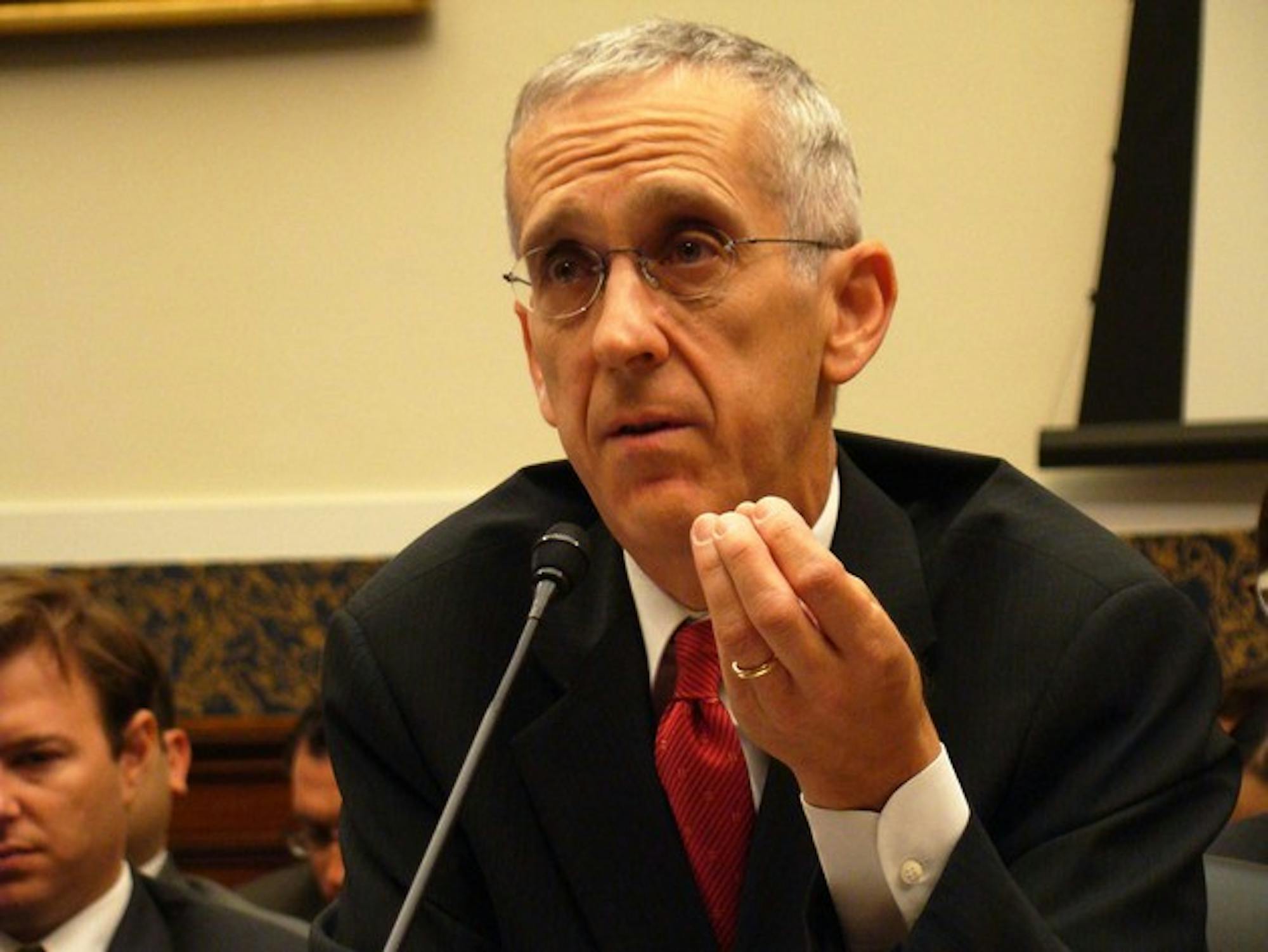
A climate simulator developed by a team of Dartmouth alumni played a key role in negotiations at the 15th United Nations Climate Change Conference held in Copenhagen last month. The Climate Rapid Overview and Decision-support Simulator, known as C-ROADS, provided real-time analysis used to inform negotiators during the talks.
The Dartmouth alumni involved in the development of C-ROADS include Beth Sawin '88 and Drew Jones '90 of the Sustainability Institute, Tom Fiddaman '87 of Ventana Systems and John Sterman '77, director of the Massachusetts Institute of Technology System Dynamics Group and a management professor at the MIT Sloan School of Management.
C-ROADS is a "decision-maker-oriented" simulation that provides information on how greenhouse gas emission reductions will affect the global climate climate, according to the C-ROADS web site. The model allows users to calculate potential climate changes, including variations in atmospheric greenhouse gas concentrations, global surface temperature and sea levels.
Although climate models have been available for some time, C-ROADS changed the nature of negotiations at COP15, because C-ROADS made it possible to perform climate analyses quickly enough to provide immediate feedback to negotiators, according to Sterman.
"C-ROADS is closing a big feedback loop between people's actions and their consequences," Jones said in an interview with The Dartmouth.
According to Sterman, the advantage of C-ROADS lies in both its scientific reliability and its simple user interface.
"C-ROADS is both grounded in and consistent with the best available climate science, as well as transparent, fast and easy to use," he added.
Seven members of the C-ROADS team attended COP15. Jones and Sawin were present for the entire duration of the talks, according to Sawin.
C-ROADS was more successful in Copenhagen than the team had anticipated, Sawin said. The group's web site, ClimateInteractive.org, received approximately 300,000 hits during the conference. The team's data was also published in major media outlets including the International Herald Tribune.
Prominent political leaders, including U.S. Special Envoy for Climate Change Todd Stern '73 and Sen. John Kerry D-Mass., have also recognized the advantages of using C-ROADS, according to Sterman.
"[Kerry] has taken a keen interest in C-ROADS and is a very strong advocate of its use," Sterman said.
Currently, only the United States and China are officially using C-ROADS, but other countries have approached the developers and are considering the possibility of using the simulator, according to Jones.
"C-ROADS is a tool for supporting joint conversation," Sawin said. "We can see the possibility of greater cooperation."
The developers are now adapting the program to provide decision makers with more information about climate impact, including its effects on biodiversity, soil respiration, permafrost exposure and agricultural conditions.
Jones and Sawin are meeting with top climate advisors from China's National Development and Reform Commission this week to develop a version of C-ROADS for the Chinese.
"We want to empower not just the U.S. State Department, but other equivalents of the State Department around the world to do this kind of analysis themselves," Sawin said.
C-ROADS was originally based on Fiddaman's doctoral dissertation at MIT. Later, in collaboration with the Sustainability Institute, the model gained momentum as developers realized there was an "appetite" for the technology, Fiddaman said in an interview with The Dartmouth.
All the alumni involved in C-ROADS trace their initial interest in sustainability to the influence of late environmental studies professor Donella Meadows.
"Dana Meadows taught us to make simulations relevant to decision making," Jones said.
Although simulations provide political leaders with valuable information, they still have to gain public support to make progress in combating climate change, Fiddaman said.
"President Obama wasn't able to promise more than he thinks the Senate can deliver, and the Senate can't go further than what they think the voters will support," Sawin said.
The C-ROADS team has created several versions of the program to increase its usage. C-ROADS "Common Platform," a version that can run on a laptop, was designed for use by climate analysts during COP15 negotiations, Sawin said. Additionally, C-LEARN simplified version of the program is available to the public online through ClimateInteractive.org.
Sawin added that the team aims to expand access to the simulation model to members of civil society, not just political leaders.
"The real challenge is getting these concepts understood by members of the business community, educational world and the public at large," Sterman said.