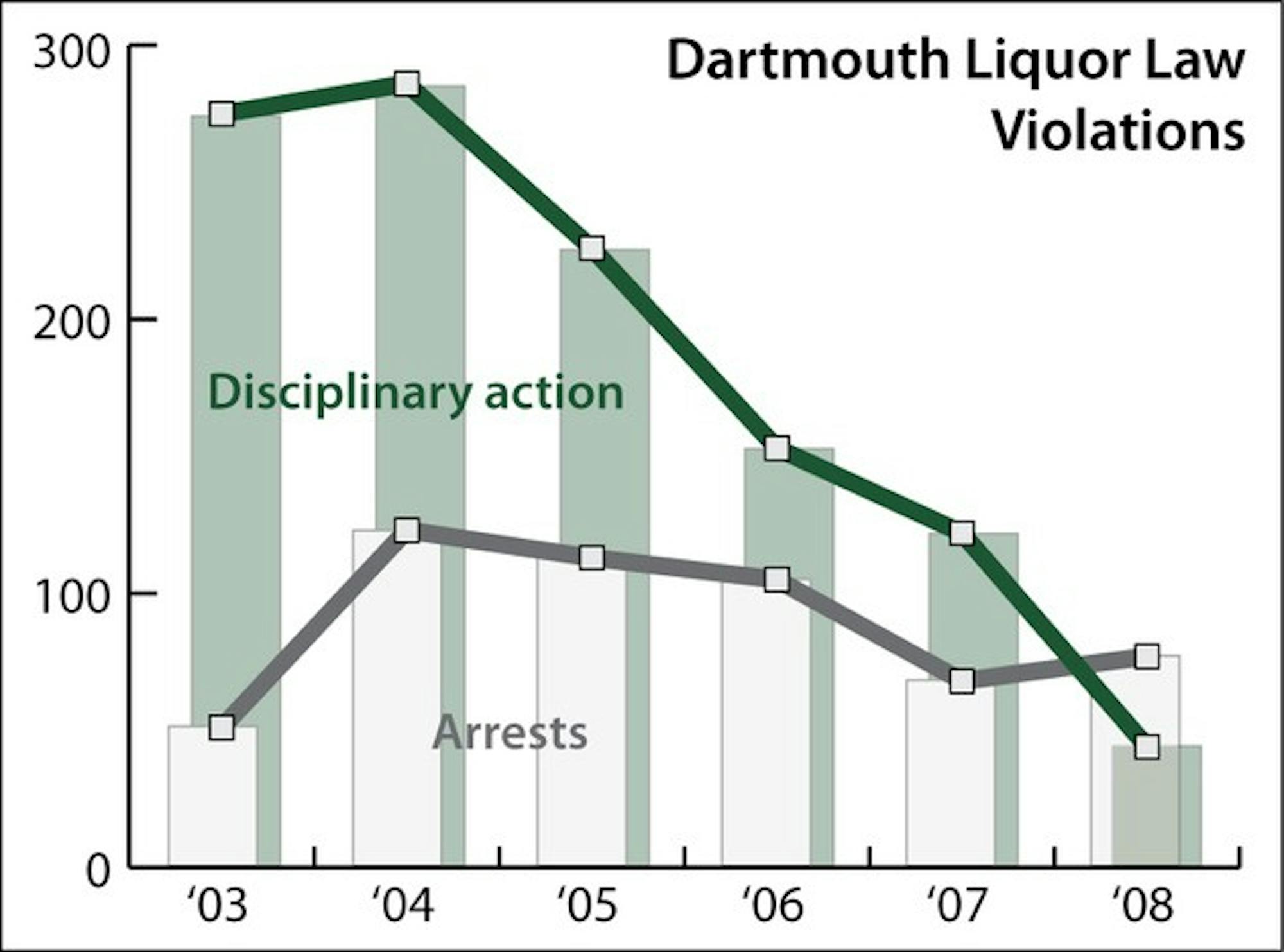
Liquor law arrests increased from 68 in 2007 to 77 in 2008, despite the significant decline in the number of students referred for disciplinary action, according to the report. The number of arrests in 2008 was about 25 percent lower than the number in 2006.
The decline in the number of students referred for College disciplinary action as a result of liquor law violations might also correspond with an increase in Good Samaritan calls over the past three years, Kinne said. That increase is "a very good thing," Kinne said, because the policy helps protect students' health.
"In August of 2008, the College made a change in policy where people who violated the alcohol policy for the first time were referred to the College's alcohol educational program rather than disciplinary action," Kinne said. "So the reduction in that number is due to the change in policy."
The increase in alcohol-related arrests was most likely due to a single incident in which approximately eight students were arrested in a residence hall, Kinne said.
"Had it not been for that one instance, I think the number would have remained the same," he said.
Many students arrested for liquor law violations in 2008 were cited by Hanover Police after the students were transported by ambulance from Dick's House to Dartmouth-Hitchcock Medical Center, Kinne said. It is Hanover Police's policy to escort all ambulances.
"I would estimate that about half of the arrests were related to ambulance calls, roughly," Kinne said.
Hanover Police Chief Nicholas Giaccone agreed that Kinne's estimate was "pretty accurate."
Giaccone added that in 2008, 58 Dartmouth students attended Hanover Police's Alcohol Diversions Program, an educational program that prevents attendees' arrests from being included in their permanent record.
Not all of the 77 arrested individuals were Dartmouth students, Kinne said.
"Some of these statistics are people unrelated to the College," he explained. "[The report] is based on the incidents that occurred it's geographically based. If someone who's not affiliated with the College at all comes on campus and gets arrested for possession by consumption, we take that into the statistics."
Burglaries at the College also decreased by more than 50 percent, from 44 in 2007 to 21 in 2008, according to the report.
"We saw a pretty significant reduction in the number of burglaries," Kinne said. "I'll put a caveat on that most people think of a burglary as breaking and entering, but in the case of the report, it's not. If someone leaves their door unlocked and something is taken, it's a burglary."
The decrease in reported burglaries was likely the result of students locking their doors more frequently, a habit Safety and Security has been asking undergraduate advisors to encourage, Kinne said.
The number of reported forcible sex offenses increased by four, from 19 in 2007 to 23 in 2008. Of the reported offenses, 22 took place in residential facilities, and one occurred in a non-campus property, or those non-residential buildings "owned or controlled by student organizations recognized by the College and those buildings or properties owned or controlled by the College."
Sexual assault is "tremendously under-reported, both in society and on campuses," Kinne said, adding that 90 percent of assaults go unreported nationwide.
"But we hope that we've developed an environment where people are coming forward and feeling comfortable and supported," he added.
While the number of drug law arrests increased from three in 2007 to six in 2008, Kinne said he does not think the increase is a cause for concern.
"I don't think we've seen increased drug activity or anything like that," he said.
Keiselim Montas, interim director of Safety and Security, also said the report contained "no alarming numbers."
Incidents of crime, particularly burglary and car theft, are less frequent at Dartmouth than on other Ivy League campuses, Kinne said.
"We're concerned about any crime, but we're glad those statistics are as low as they are," he said.
The annual report is mandated by the federal Clery Act.