From a young age, Feiffer was attracted to newspaper cartoons because he had a knack for drawing. Although boys in his neighborhood were expected to play baseball as a hobby, Feiffer said his artistic skills made up for his lack of talent in the sport and saved him from ridicule.
"It was my passage into the politics of young manhood," Feiffer said. "If you could draw a Popeye and they can't, they will not beat your ass."
The comic strip, which emerged in the late 19th century, was still developing as an art form when Feiffer was growing up in the Bronx. He studied the art of comics and, by the time he was six, became a self-proclaimed "scholar," according to Feiffer.
"It's almost unimaginable how integral a part of the culture then it was," he said.
While showing some of his own work his mother had saved when he was seven years old, Feiffer said that he was most interested in how cartoonists develop their characters within the small space of a few panels.
He also discussed his own development as an artist and the influence that other cartoonists had on his style.
"I was doing what so many comic book artists at the time were doing I was stealing," he said. "You learn by stealing, you learn by swiping and, God willing, you emerge into your own style."
Artists that have inspired Feiffer's drawings include Milton Caniff, whose work taught Feiffer about the interplay of dialogue and pictures, and Winsor McCay, who is famous for his strip "Little Nemo in Slumberland" and who "remains the best cartoonist in the world," according to Feiffer.
At the age of 17, Feiffer became an assistant or a hired groupie, according to Feiffer to Will Eisner, the creator of "The Spirit" and a fellow Bronx native. Feiffer was then was drafted into the army during the Korean War, a formative experience in his career, he said. His story "Munro" is about a four-year-old boy who is drafted into the military. The story was adapted into a 1961 short animated film, which won an Academy Award.
"[Being] in the army changed the direction of my career, and I was no longer interested in a traditional comics career but was moving into social and political satire," he said in an interview with The Dartmouth. "I wanted to use the form to point out the excesses of authority in the American political system."
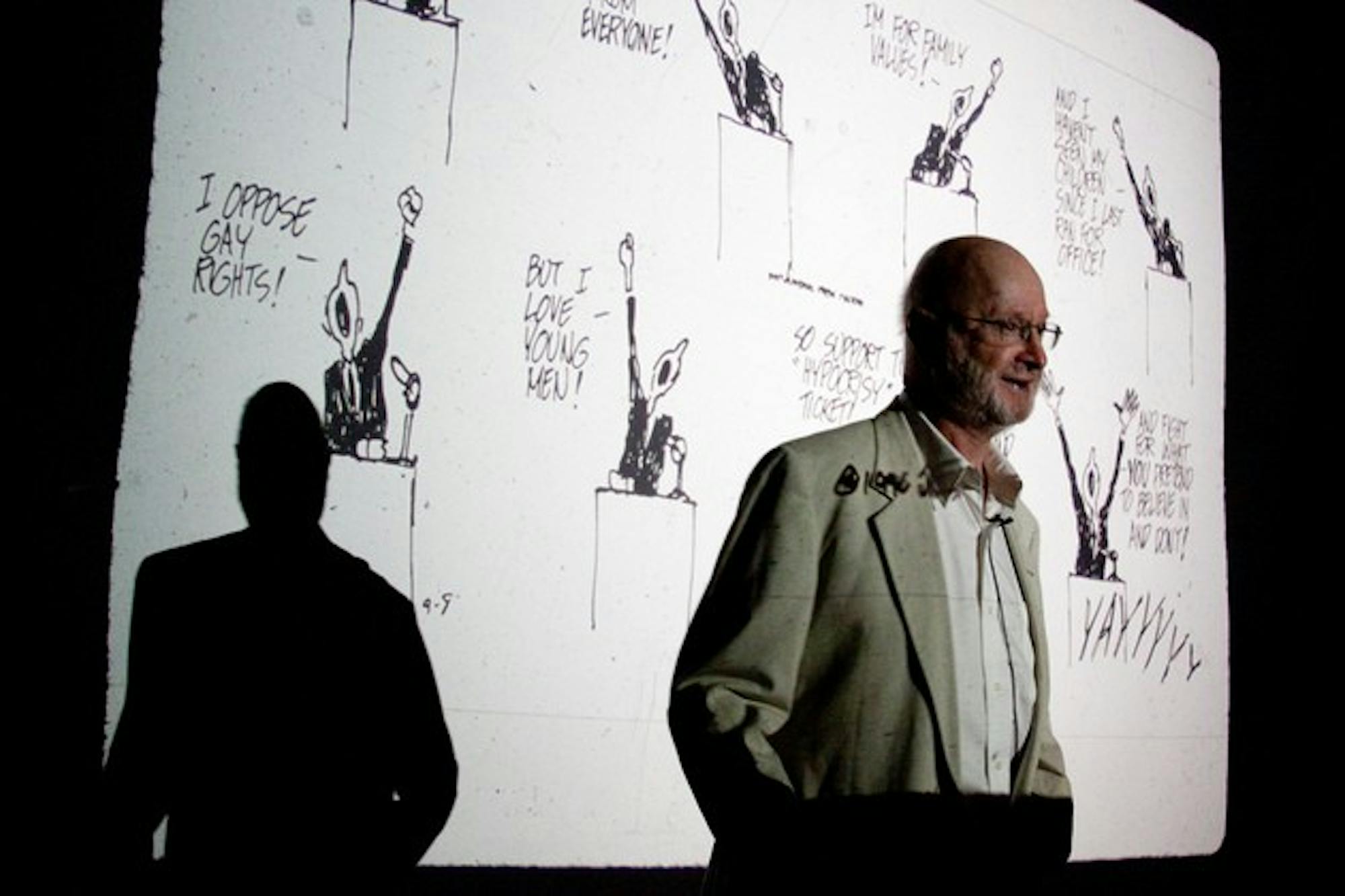
At the lecture, Feiffer presented a slideshow of many of his political cartoons, imitating and mocking almost every one of the U.S. presidents from the latter half of the 20th century. Former president George W. Bush, however, was noticeably missing from the presentation.
Feiffer has worked in several other art forms as well, authoring plays, screenplays and children's books. He is well known for the darkly funny play "Little Murders" and the film "Carnal Knowledge" (1971). Feiffer cited children's books, theater and comics as his favorite media, adding that he finds children's books especially enjoyable because they remind him of the work he did when he was young.
"One of the great pleasures in a day is when I can work on all three forms in the same day, going from one to the other because I've got deadlines in all of them and I've got to do some work," he told The Dartmouth. "It gives me a great pleasure and sense of accomplishment."
During his residence at the College, Feiffer is teaching a comparative literature course titled "Graphic Humor and 20th Century America." He will also participate in a panel discussion with fellow cartoonists Edward Koren, Edward Sorel and Jeff Danziger on politics in cartooning on August 12.