
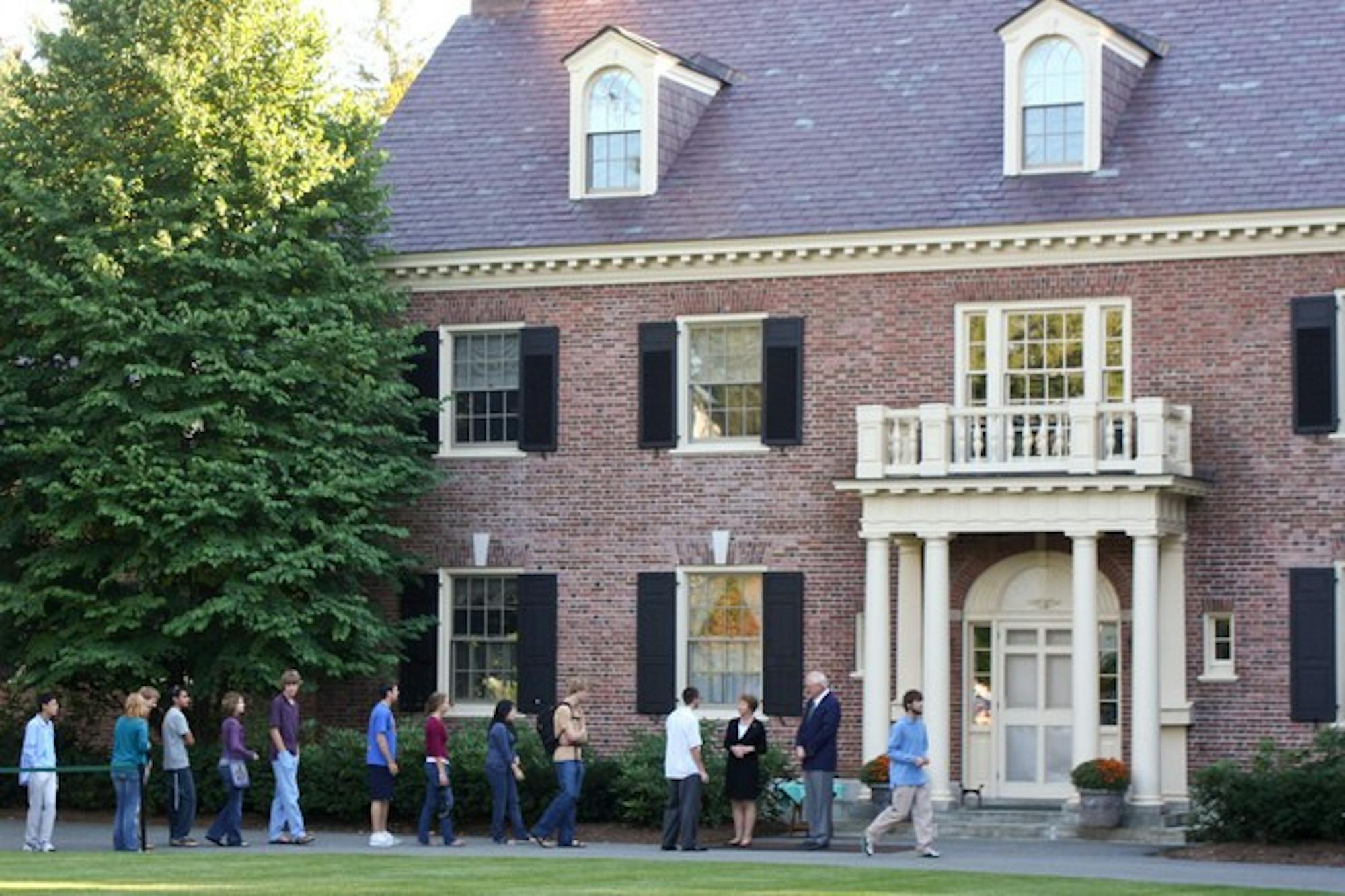
As the renovations will require the partial demolition of nearly all of the walls, the house will be uninhabitable during construction, according to associate Provost Mary Gorman, who is overseeing the project.
"I enjoyed living here. People have asked if it's noisy, and I say, 'Sure it is'," Wright said in an interview with The Dartmouth. "I used to threaten some of the fraternity members on Webster Avenue that some Sunday morning, I was going to put our speakers on the window at 6 a.m. and put Wagner on. Of course, they say, 'Oh do it.'"
The construction -- which is scheduled to begin in July after Wright moves out in June -- is projected to cost $2.8 million and take six months. During the renovation, Kim and his family will live at 6 Rope Ferry Rd., Gorman said. If construction remains on schedule, Kim will be able to move in to the house for the 2010 Winter term.
"It is one of the few really gracious places on campus where you can entertain, whether it's students or faculty or dignitaries or scholars, in a way that doesn't feel very institutional," Adam Keller, executive vice president for finance and administration, said in an interview.
When Wright and his wife Susan first moved into the house in 1998, Wright said he chose to delay renovations to the heating, water and plumbing systems due to the invasiveness of the project.
Wright said he later regretted the postponement and wrote a letter to Keller suggesting that the renovations be completed before the next president moves in.
"We live in a wonderful, historic house, but it is an embarrassment for an institution like Dartmouth to have a house in this condition, and it is not taking proper care of what I think is one of the jewels of the campus, so I am pleased the Board is more than willing to go ahead with some of these renovations," Wright said.
The house's original heating and plumbing systems are still in place, but are now severely outdated, Gorman said. All the heating pipes will be replaced, and the heating system will be converted from steam to forced water, Gorman said. The steam system has resulted in significant heat loss, leaks and damage.
Heat controls will be installed in each room to further improve energy efficiency, Gorman said.
"[The current system] is not only uncomfortable, it's wasteful," Wright said. "It's not efficient, and Dartmouth should do better."
Drainage problems associated with the foundation are a major safety concern, since many functions are held in the lower level of the house, Gorman said. The plumbing will be replaced to solve this problem, Gorman explained.
"We're going to miss living in the house immensely, but we certainly won't miss the heating system in the house, and we won't miss the other problems," Wright said. "There is water in the basement oftentimes. There are issues of mold down there, which really can be a health issue, and there is seepage coming in from the foundation."
The renovation will also improve handicap accessibility to the house. The new accessible entrance, which will be on the side of the house, will lead directly to the main foyer, Gorman said.
"We are not required to do this, but the spirit of the [Americans with Disabilities Act] is something we think is important to adopt in this house so that everyone can enter the house in a gracious way," she said.
Visitors with physical disabilities currently use temporary ramps, or enter the house through the garage, Wright said.
An elevator will also be installed, and handicap accessible bathrooms will be built. The path leading to the garden -- often a location for reunions and events for new students and faculty -- will be landscaped to allow all guests to enter using the same path, Gorman said.
"We've been able to accommodate people in most cases, but accommodation should not make somebody feel like a second-class citizen," Wright said.
The renovations will also make accommodations for Kim's family, including his two young children, Thomas and Nicholas, Gorman said.
"The last president to come in with a baby was John Sloan Dickey, and that was in 1945," Gorman said. "There have been teenagers who have lived in the house, but no young kids."
Kim has requested modest changes to make the house safer for the children, Gorman said, which include adding banisters to the stairs, removing obstructions in the kitchen so that the children can be seen while playing, and constructing a playroom.
Wright said the renovations are necessary, despite the College's current budget cuts.
"Institutions like Dartmouth should not let a place like that deteriorate because of times of economic difficulty," Wright said.
The team overseeing the project is working to reduce costs wherever possible, Gorman said.
"[The Kims] have been very clear that they are very conscious of the budget climate, and they want us to look very hard at every dollar," Gorman said.
Wright said he and Susan plan to move to a house in Sunapee, N.H., 30 minutes away from campus after his retirement.


