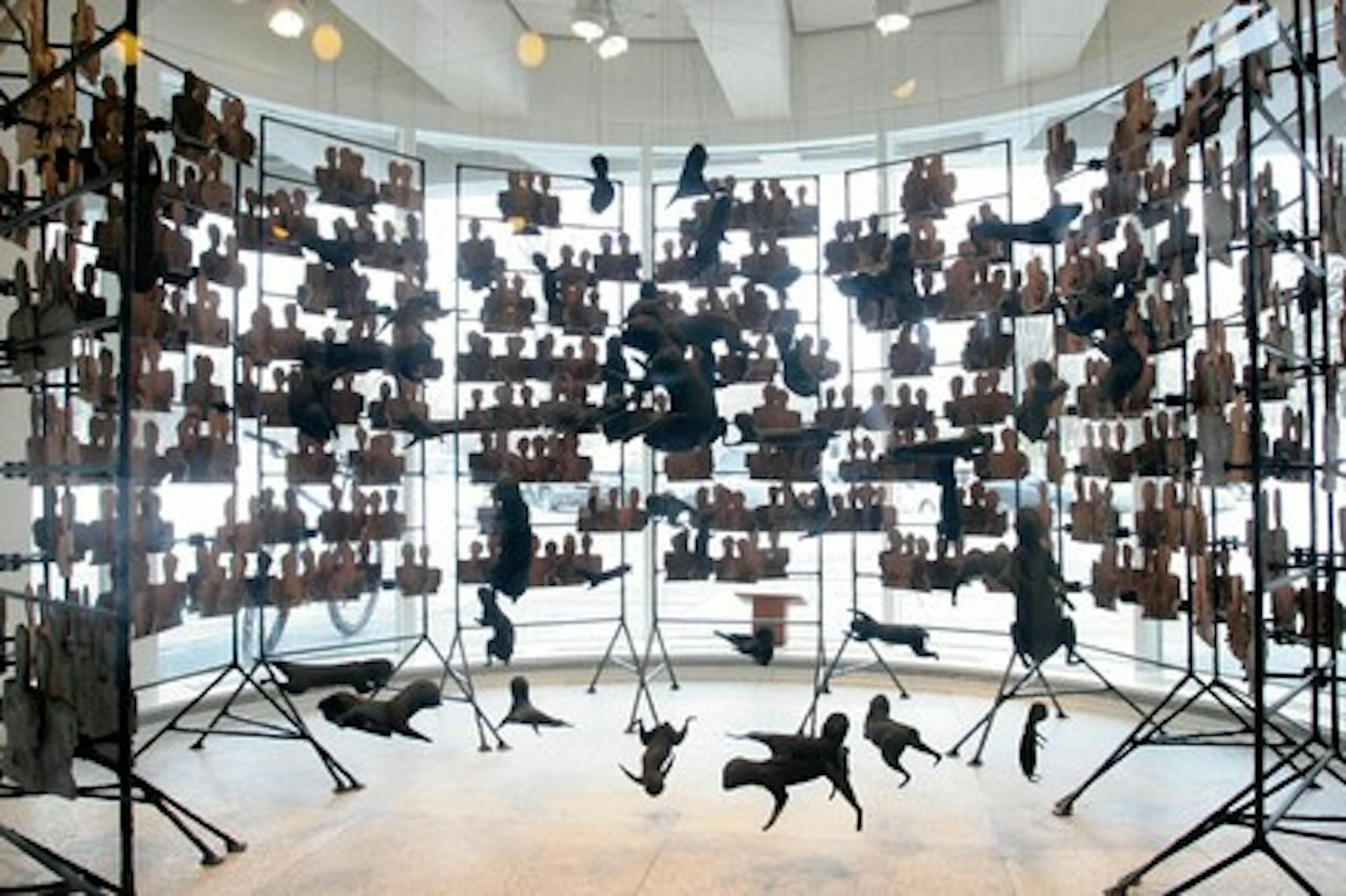
Hopkins Center visitors who have trouble making sense of the art installation in the Barrows Rotunda may be comforted by the knowledge that the artist intentionally made the work difficult to understand. The piece, "Insomnia," by visiting professor and local artist Stina Kohnke, consists of ambiguous, animal-like sculptures dangling from the ceiling on fishing line, surrounded by wooden cut-outs that resemble silhouettes of people from the shoulders up.
"I think she brings a level of questioning to what it is that you're looking at," studio art department chair Brenda Garand said. "It looks like there are creatures, or animals, that are floating and hanging in space, but they're metamorphic and changing into something else, almost before your eyes."
The title of the piece, however, brings some clarity to an otherwise mystifying work of art.
"I usually get up in the middle of the night and work, so it's [about] the push and pull with sleeping and being inspired," Kohnke said. "I chose the squirrel forms because I think of them in the attic as something that kind of gnaws away at you when you're trying to find them and you can't."
Indeed, closely examining the cut-outs, the viewer notices that their edges have a rough texture, as though they have been chewed. This minute detail serves a figurative purpose, calling to mind the way in which thoughts can gnaw away at the mind.
"I purposefully made it ambiguous," Kohnke said. "There aren't any features on the figures or the squirrels because I really like people to have their own associations."
In "Insomnia," as well as many of her other works, Kohnke uses what she calls "found objects" -- such as scraps of wood and wire -- to further encourage viewers to form their own connections to the piece of art.
"I always use found objects so they begin the narrative, and everyone has different associations with found objects," she said.
Kohnke said that she's been collecting various items since she was five years old, amassing a vast variety of materials to use in her art.
Another one of her works, "Animation," is a wall of old stuffed animals supported by chairs and aluminum, while other of her pieces incorporate surgical stainless steel and other wide-ranging materials.
Through her own experimentation, Kohnke has developed a complex and intriguing work of art with "Insomnia," whose meaning is by no means static.
During daylight hours, the viewer can notice the details and intricacies of the work -- the texture of the cut-outs, the odd shape of the creatures and the leveling of these objects as they hang in suspension. Nighttime, however, gives "Insomnia" a whole new dimension.
The street lamps reflecting on the snow outside eerily illuminate the piece, invoking images of an insomniac's world.
Changes in perspective can also dramatically change the viewer's impression of the work. From outside of the Hop looking in, the viewer cannot get a good look at the hanging creatures, as they are obscured by the wall of cut-out forms.
Once inside the building, however, the viewer can see the sculptures clearly through a large space between the walls of cut-outs.
"I created it because it's such an unusual space and I wanted something to be different from the outside and inside, and it could wrap around," Kohnke said of the piece. "There's the reflection of the glass, and it's snowy out, so I wanted the figures I cut out to reflect and interact with the snow."
With "Insomnia," Kohnke has created a work that masterfully exploits the features of its environment. Though, at first, the piece appears inscrutable, a closer look reveals a rich piece filling the Barrows Rotunda's otherwise empty glass cylinder.