
While some schools, including Harvard University, are working to decrease their investment in illiquid assets in light of the economic downturn, Dartmouth is moving to do the opposite, according to Chief Investment Officer David Russ. The 18-percent decline in Dartmouth's investment returns could have been more severe but for the College's decision to avoid investing in traditional commodities, like gold and corn, he said in an interview with The Dartmouth.
Dartmouth's investment team and the Board of Trustees strongly believe that investing in illiquid assets, holdings like private equity that cannot easily be converted into cash, will be rewarding in the long run, Russ said.
Russ' office is moving towards increasing Dartmouth's investments in private equity, including venture capital, leveraged buyouts and other products.
"If you look back at the very long history of the endowment, returns that have accrued from the venture capital and private equity portfolio are the highest of any of the asset classes, but it takes patience," Russ said.
William Jarvis, managing director of the non-profit Commonfund Institute, which studies endowments, said that institutions and non-profits often keep their holdings in illiquid markets, if possible, because investments in such markets have higher potential returns.
Illiquid investments have been more risky since last October, because it is more difficult or impossible for firms to exit investments during an economic downturn. Institutions with large commitments in illiquid assets that are not receiving their expected returns must find other ways to support operating expenses, he said.
"The liquidity question is intimately concerned with the question of, 'Where will the cash come from to do those things?'" Jarvis said.
Institutions with illiquid holdings can attempt to sell these assets in the so-called "secondary market," as Harvard University is currently attempting to do, Jarvis said. The secondary market, however, is inefficient and closed, he said.
Institutions can also be driven to sell their more liquid assets or to borrow, which is equally difficult since many of the traditional lending avenues have "dried up," he added.
"The real question is when will we see some return to reasonable liquidity in the market, because right now there are no buyers for almost anything and it's very hard to borrow," Jarvis said.
The current economic crisis has caused investors to question whether fixed income should have a greater role in the investment portfolio, Jarvis said.
"People are looking at fixed income now and in the immediate market going forward because of this lack of borrowing capacity," he added.
Because of the College's decision to invest in oil and gas partnerships, timber, natural resources and alternative energy, Dartmouth has experienced smaller losses in the economic downturn than did "others," Russ said. Russ declined to make comparisons between Dartmouth and other institutions, citing differing institutional priorities and the incompatibility of return time frames.
"Things we didn't do helped us just as much as things we did do," Russ said.
Russ and the other members of the Investment Office staff manage all of the College's assets. The Investment Office oversees and coordinates external managers, who work with specific investments.
Since he was hired in 2005, Russ has worked with the Board of Trustees' investment committee to restructure the College's policy portfolio, the investment classes in which the College intends to invest its assets over the long term.
The CIO and investment committee formulate a new policy portfolio every three to seven years. The team re-evaluates the portfolio quarterly, discussing asset allocation, the returns on investments and each asset class.
"We don't manage returns, we manage risk and returns are the outcome," Russ said.
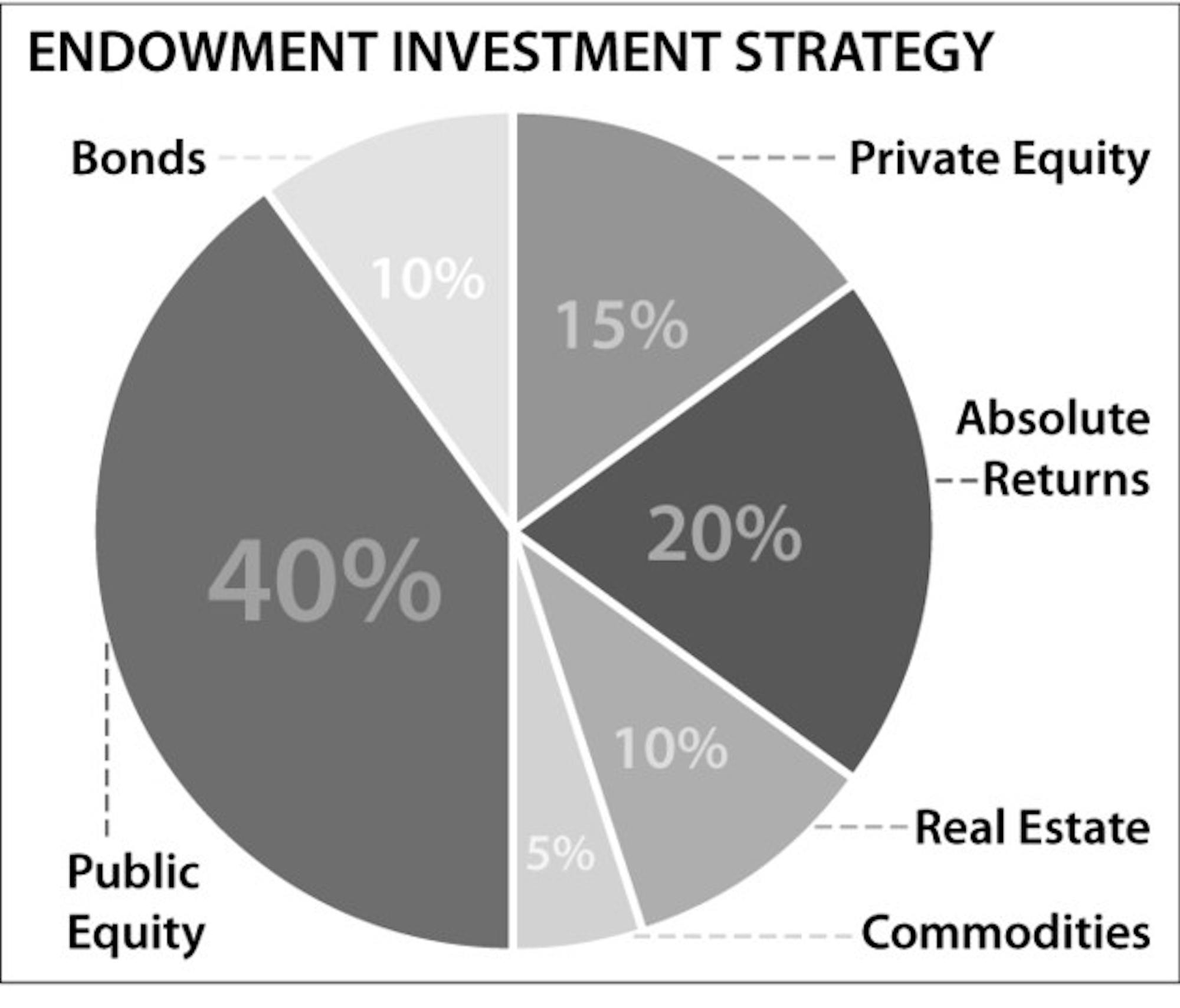
In Dartmouth's current "neutral" policy portfolio, 40 percent of the College's assets are allocated for investment in public equities, 20 percent in domestic equity, 15 percent in international equity, five percent in emerging markets, five percent in U.S. bonds, five percent in Treasury Inflation Protected Securities, 15 percent in private equity, 20 percent in absolute returns, 10 percent in real estate and 5 percent in commodities, Russ said. The portfolio, Russ said, matches the percentage by which some of these assets are expected to outperform those percentages, with the percentage by which other assets are expected to underperform relative to that same standard.
The College has deviated slightly from the planned portfolio due to the current economic situation and is currently holding 4 percent of the endowment in cash for to maintain liquidity, Russ said.
At the end of the 2008 fiscal year, Harvard had 11 percent of its assets in private equity, 9 percent in commodities like timber and agriculture, 22 percent in foreign equities, 12 percent in domestic stocks and 10 percent in emerging markets, and a comparable amount in real estate, according to The New York Times. Because of the current downturn in private equity, Harvard has reported as much as a 30 percent loss to its endowment and has put $1.5 billion, about 38 percent of its private equity holdings, up for sale.
Yale University's endowment has had similar difficulty, according to The Times, with liquid assets declining by 13.4 percent for the first quarter of the university's fiscal year. Including illiquid assets like real estate and private equity, the Yale endowment is down by 25 percent.
Dartmouth's endowment lost six percent in the first quarter of this fiscal year, a loss Russ called "slight," and has lost 18 percent overall.
"We don't believe all economic principals have to be thrown out of the window because we are in a recession," he said. "That's really the trustee view as well."
Russ, who has worked in the field for 22 years and experienced several recessions, added that "things always feel worse in the middle of the recession than when you're in the boom times."
"I think that helps temper an understanding of the markets that is key," he said.
The endowment is a long-term investment in perpetuity, Russ added, and must be managed for eternal growth because of "inter-generational equity."
"We have to balance between providing for current generation of students and donors and future generations," he said. "That's the fine line."
The original version of this article incorrectly defined the College's "neutral" portfolio as having net zero risk, rather than balancing expected performance of assets relative to the neutral position. In addition, the article incorrectly stated that the College's Chief Investment Officer David Russ called the College's recent endowment decline "slight." In fact, that comment was meant to reference the College's first quarter losses of six percent, not the total 18 percent loss.


