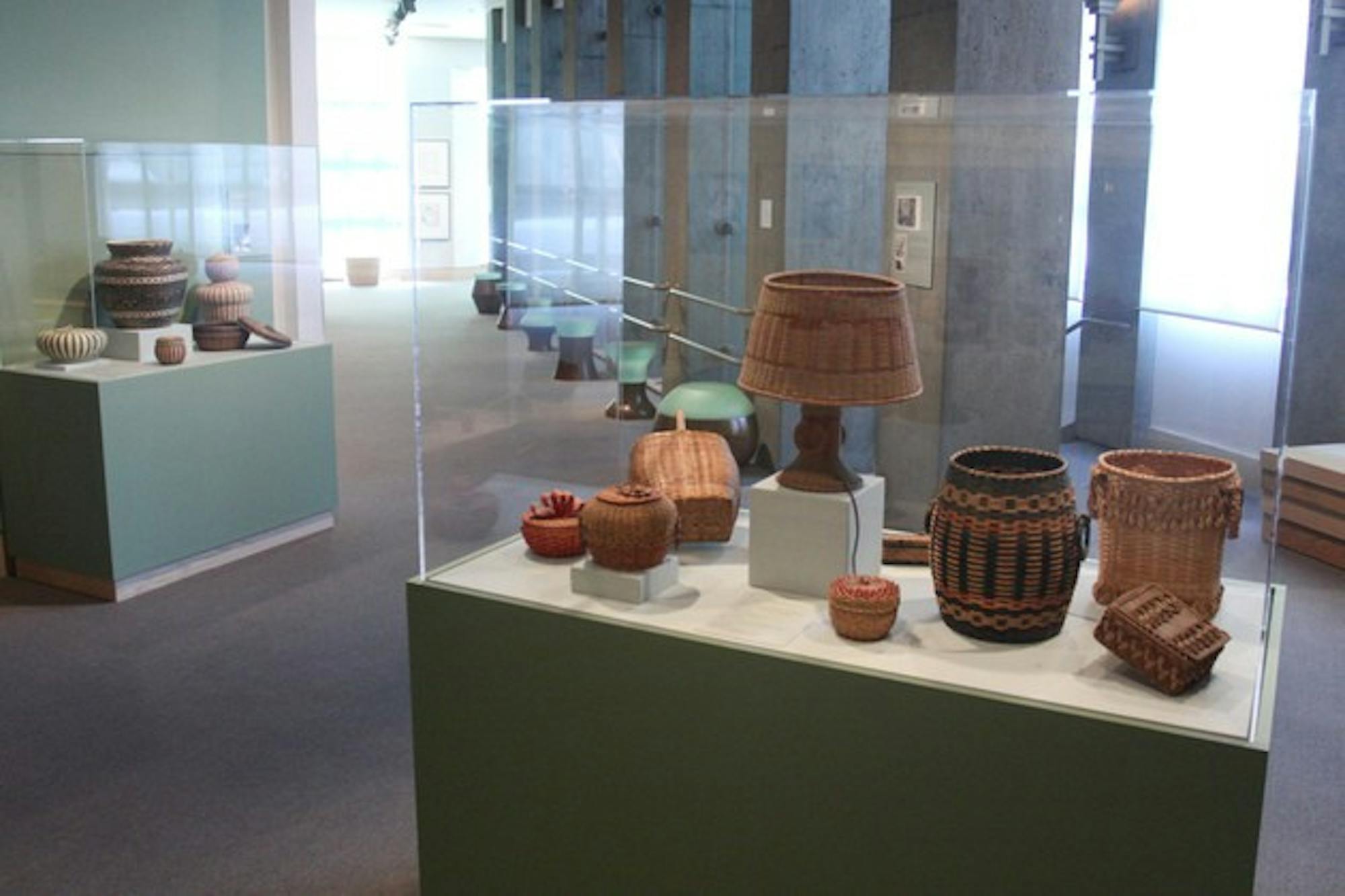
The exhibit, "Spirit of the Basket Tree: Wabanaki Ash Splint Baskets From Maine," features a variety of new and antique baskets made by the Wabanaki people -- a federation of five Native American tribes from the northeastern United States and southeastern part of Canada. Many of the baskets on display have long been a part of Dartmouth's extensive collection of Native American art and artifacts, while others are recent acquisitions. This exhibit, however, marks the first time that most of the collection has been put on display.
"Unfortunately, it's just an area that hasn't received a lot of exposure up to this point," said Alex Bortolot, assistant curator for special projects at the Hood. "This is really the first time that we've put many of these baskets out on display, so its very exciting for us -- to have this part of the collection really be put in the spotlight."
The exhibit also includes an assortment of archival photographs, documentary film clips and various historical documents, which help viewers understand the art of basketry, gives faces to the basket makers, and places the production in a historical context.
The Wabanaki, or "People of the Dawn" as they are sometimes called, have been making baskets since at least the 18th century. The craft originated among the Wabanaki as a means of survival: tribe members sold their baskets to the non-Native settlers of the region. According to Bortolot, settlers valued the baskets both for their utility and their aesthetic qualities.
As more settlers expressed interest in decorative baskets, the Wabanaki began to make impractical "show-off" pieces categorized as "fancy baskets," which make use of intricate weaving techniques and natural dyes, Bortolot said.
By the 19th century, individual basket makers began to establish reputations and signature styles, advertising their skill with printed cards.
The Hood's exhibit includes several examples of these cards, including a 1934 postcard featuring a photograph of basket maker Camilla Sockalexis selling her wares in full Wabanaki costume, complete with a feather in her hair.
Bortolot explained that he sees the sale of these baskets between Native Americans and European Americans as a rare moment of cooperation in the history of relations between the two groups.
"What develops, really, is this relationship of mutual respect and mutual appreciation," Bortolot said. "Native Americans were able to develop their baskets in ways that made them very useful and desirable to European settlers who would support Native Americans in what they were doing, which allowed Native Americans to [sustain] their own traditions."
According to Bortolot, this Native-colonial exchange is all the more remarkable given the primary material used in the making of the baskets: splints of wood from black and brown ash trees, which hold great spiritual significance for the Wabanaki people.
Wabanaki creation myths attribute the origin of their people to a divine moment when their creator, Glooskap, shot an arrow at an ash tree. Out of the bark of these trees emerged the Wabanaki people. Thus, according to Bortolot, the wood of the "basket trees" is an important part of Wabanaki identity.
"The materials from which the baskets are made actually factor into their world view -- how they understand their world and their places in it," Bortolot explained. "The baskets are important not only for what they do, that is, carry stuff, but for what they are made from."
In her essay on the exhibit, guest curator Jennifer Sapiel Neptune cites this spiritual tie to the craft as a distinguishing factor of Wabanaki basketry.
Neptune explains that the tendency of Americans to view the baskets as mere souvenirs detracts from the value of the work.
Dismissing the basketry in this manner, Neptune argues, marginalizes Native American world views, people and art forms.
The exhibit, however, stands up against this marginalization, presenting each basket as an impressive work of art.
Because Wabanaki families often pass the tradition of basket making from one generation to the next, a section of the exhibit is dedicated to displaying the signature craftsmanship of three basket-making Wabanaki families -- the Neptunes, the Gabriels and the Shays.
"Spirit of the Basket Tree" balances contemporary pieces, such as Jeremy Frey's green and white "Sea Urchin Basket," against more traditional forms, providing viewers with a rich sampling of the Wabanaki legacy.
The exhibit opened in December 2008 and will remain on display at the Hood Museum through June.