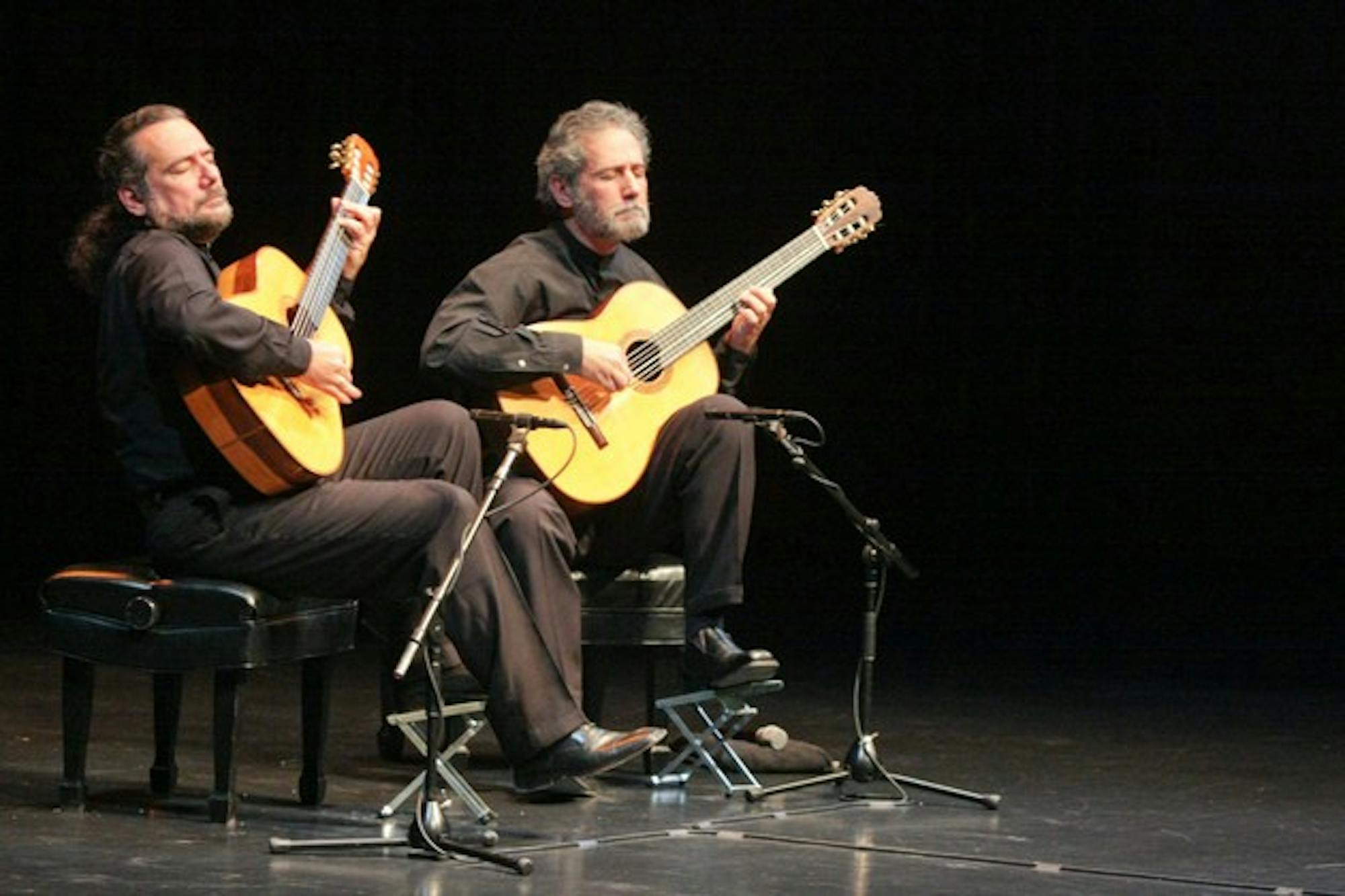
"From the beginning, our teacher told us to play as a duo," Sergio said. "Always."
This imperative may account for the uncanny synchronicity which characterized the Assad brothers' performance on Friday night at Spaulding Auditorium in the Hopkins Center. Sergio and his brother Odair seemed to be a single guitar-playing entity, following each other through tempo and dynamic changes with ease.
Friday's performance marked the Assad brothers' second visit to Dartmouth, following their Hopkins debut in 1998. Since that time, the guitar duo has gained accolades and international recognition, winning Latin Grammys in 2002 and 2008, inspiring compositions by Argentinian composer Astor Piazzolla, and working with acclaimed artists such as cellist Yo-Yo Ma and soprano Dawn Upshaw.
In addition to the concert Friday evening, the Assads also taught a master class earlier that afternoon in Faulkner Auditorium, coaching two classical guitar students in turn in front of an audience of nearly 50. Rene Zelaya '11, one of the selected students, opened with "Etude, No. 1" by Cuban guitarist Leo Brouwer -- a composer with whom the Assad brothers, and in particular Odair, have a working relationship.
Friday night, no elaborate setup was necessary in order to capture the artistry of the Assads' playing in Spaulding, a space which Hop programming director Margaret Lawrence said is built for intimate classical music of this nature. Two benches sat slightly angled toward each other, with one small microphone in front of each.
The opening piece, Isaac Albeniz's "Cordoba from Cantos de Espana," dramatically heralded a sense of arrival, with Odair's bell-like chords serving as a pedal for Sergio's ascending melody. From the outset, the brothers displayed that they indeed had "learn[ed] to play really good notes," Odair's way of describing a strong foundation in the technique and theory of guitar playing.
The variety of sounds and tones the brothers were able to produce with their instruments contributed to an impressive dynamic performance. The use of tap and natural harmonics, palm-muting and alternate tunings ran through every song in their set, which was mostly comprised of Brazilian pieces. Coming from a strong musical background (both parents and all but one sibling -- "the only bright one," according to the brothers -- are musicians), Sergio and Odair said they were raised on Brazilian music before studying Renaissance and Baroque guitar with Monina Tvora, a student of Spanish classical guitarist Andrs Segovia.
The most remarkable thing about the Assads' playing was their nearly perfect synchronization. Sergio and Odair's movements seemed almost choreographed as they strummed out the layered chords that end "Cordoba from Canots de Espana," or the playful, almost conversational passages that highlight Gismonti's "Palhaco." The two kept up a constant non-verbal dialogue through a series of gestures and eye contact during each song.
After the intermission, only Odair returned to the stage, where he, after waxing philosophical on the implications of a guitar duettist playing solo, plunged into a medley of pieces written especially for him by Brouwer. A tour-de-force of technical skill, these songs exercised not only Odair's speed and chops, but also his interpretive clout, as he transformed a passage comprised entirely of one note into a vibrant melodic line.
The most fascinating piece of the night, however, was the last song, "Tahiya li Ossoulina," which was composed by Sergio and won the Latin Grammy for Best Classical Contemporary Composition in 2008. The song incorporated Middle Eastern scales, drumming on the bodies of the guitars, and a playing style that invoked a sarod's sound.
Sergio said the positive critical reaction that "Tahiya li Ossoulina" received inspired the Assads' new direction: a push to examine their heretofore-unexplored Lebanese heritage. In a project titled "Back to Our Roots," Sergio and Odair -- in collaboration with their sister Badi, Sergio's daughter Clarice, vocalist Christiane Karam and percussionist Jamey Haddad -- said they will write and record music that combines both their Middle Eastern and Brazilian influences.
"Tahiya li Ossoulina" was met with a similar enthusiastic response Friday, when the audience's standing ovation prompted the Assad brothers to return to stage for an encore. Compared with the complexities of the earlier pieces, "Farewell," composed by Sergio for the 1994 Japanese film "Natsu No Niwa," was very straightforward and tuneful. Simple, sad and beautiful, the piece was a fitting cap on an evening of virtuosic and innovative guitar playing.