Weeks, a visiting professor at the College, teaches Photography I. He was brought to Dartmouth on the recommendation of senior lecturer Brian Miller.
"Right from the get-go, he's been someone who's been very approachable, and he's been enthusiastic about the Dartmouth students," studio art chair Brenda Garand said. "I think that's so important because he's welcomed the students into his class, and I've heard nothing but rave reviews."
Weeks' Photography I class may focus on the basics of photography technique, but his own photographs have many layers of meaning.
"There is, throughout the work, a kind of narrative arc," Weeks said.
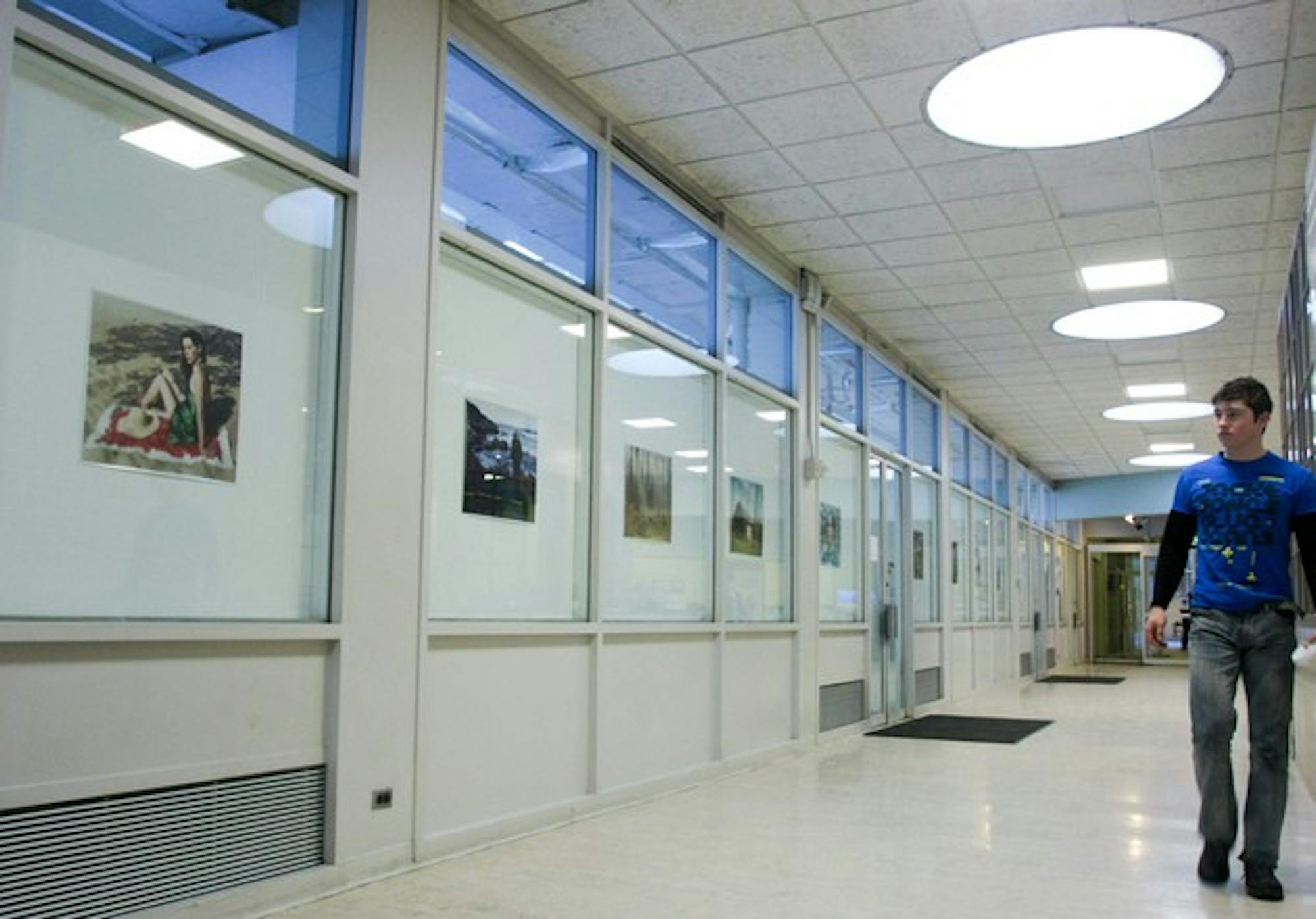
Starting at the entrance of the Courtyard Cafe, and moving through the corridor to the door of the Strauss Gallery, the exhibit follows the images of Weeks' wife, Stacy, from what he called the "interior space" of a house through many scenes of nature and suburban life. Finally, the viewer finds Stacy surrounded by blurred New York City skyscrapers, or alongside a wire fence beneath a busy underpass. Weeks said this story parallels the history of the American migration from rural to urban, and expressed his hope of eventually expanding the series to include scenes of the American West.
"There are a lot of things in the photographs that are not readily apparent -- a lot of references to earlier photography and history and culture," Weeks said.
Though these references may elude all but the most observant viewers, anyone can appreciate Weeks' inclusion of color in his series.
In one photograph, Stacy leans against a brick wall painted a striking aqua. Rather than drawing the attention away from her, however, the bright background makes Stacy's pale skin all the more salient. Stacy's image would be all but lost in another photograph, as she stands in the shadow of a low building, but for the bright red coat she wears.
In fact, Weeks said that his ideas often develop from the discovery of a great costume.
"We have a lot of fun with a sort of collaboration when we get on eBay," Weeks said. "And Stacy's really, really good at finding interesting clothes."
Poetry also inspires specific settings for his photographs, Weeks said. His exhibit's title, for example, comes from the first line of a 20th-century poem by Rainer Maria Rilke. Weeks used the same title for his book of photographs, which was published in Oct. 2007.
While Weeks may have his own meaning in mind when he shoots the photos, he said he hopes his work will provoke something personal in the viewer.
"If I can just get people to start thinking about their own experiences, that would be the next layer," Weeks said. "It starts with a visual, then starts with an imagination, then goes to the viewer's experience, and then lastly a more esoteric conversation about art history or photography's history."
Most importantly, however, Weeks said he wants viewers to enjoy his work.
"The number one thing I want is some visual enjoyment, he explained. "There's a lot of color relationships and formal aspects in the photographs, and I feel that in order to have any other conversation, that's the number one thing that has to happen with a visual image. They reach the viewer."
Although the exhibit includes only a sampling of his photographs -- his other works include series on "Nature" and "Guys" -- the variety and unexpected splashes of color make for a well-rounded show. Weeks' photos hold a wide-reaching appeal, thanks to the sense of familiarity they invoke in the viewer. Weeks said he hopes that everyone viewing his show will find at least one element they can connect with, whether it be an ice cream shop, or the backdrop of New York City buildings behind his wife.
So the next time your snow boots are making tracks along the Hop's halls, take a minute to notice "World Was in the Face of the Beloved." In the photos, you'll find a sense of enjoyment, thanks to a story that feels satisfyingly personal.