
"It's really touching; I think it's going to change how the black community looks at itself and help instill a sense of pride within the black community," master of ceremonies and president of the Afro-American Society Anna Bofa '09 said of the overlap between the celebration and Obama's inauguration. "There was a lot of negativity about America's past, but this shows we have the capability of overcoming it."
The first event in the College's commemoration, the Community Faith Celebration, which was held Sunday afternoon, featured the Rev. James Lawson, a leader during the civil rights movement. On Monday night, author, poet and screenwriter Sherman Alexie delivered the celebration's keynote address following speeches by Bofa and College President James Wright.
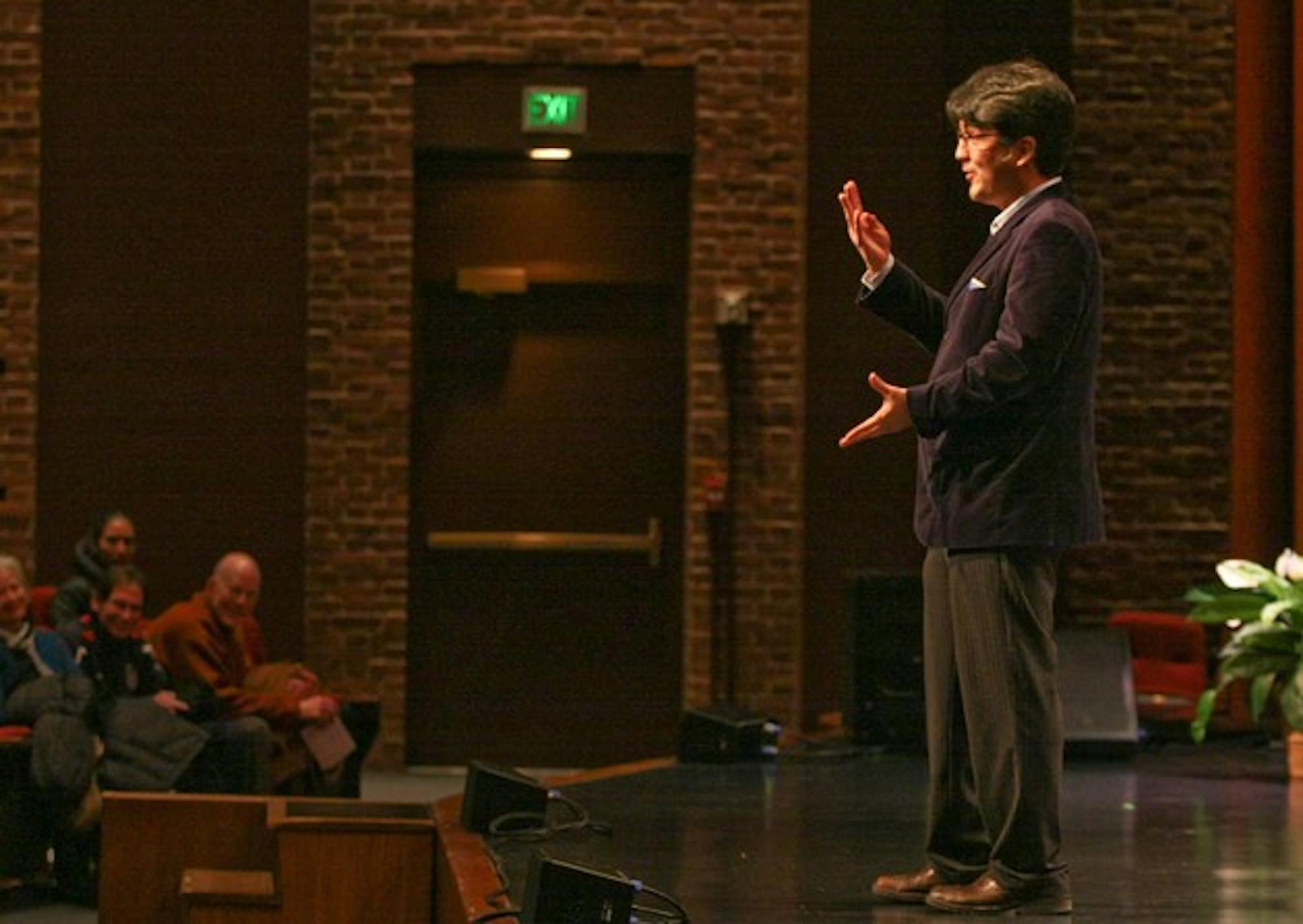
Alexie's speech was filled with personal anecdotes and humor regarding his own Native American ancestry and the experiences of minorities in the United States. Throughout the speech, he moved around the stage, did impressions and pointed to specific audience members.
"The amazing pressure put on minority groups today," he said. "It's exhausting."
Alexie then marched around the stage in a hunched over position.
"That's me conveying the burdens of my race," he explained.
Alexie also devoted a portion of his presentation to today's inauguration.
"Have you heard -- there's going to be a black president?" he asked, drawing laughs from audience members.
He concluded his speech with a story about his relationship with his father.
"I'm funny; my father was funny; because we had to be," he said. "That's the only way for us to make our way toward any sort of reconciliation."
Audience member Tashzna Jones '12 said she liked Alexie's use of comedy in dealing with serious issues.
"I think we can learn and absorb more this way," Jones said.
Lawson's presentation had a more serious tone that largely served to reflect on and honor King's life. He began his address with an apology to the audience that, despite the efforts of his generation, he believes Americans today are unaware of the hurdles facing the nation.
"The generation of Martin Luther King, myself and many other civil rights leaders who you have never heard of, expected to bequeath to you a better world, one that was less violent and less tortuous, with greater access to a greater number of people," Lawson said. "No matter the uniqueness of this day, we have not yet bequeathed you such a world."
He said that the current generation must "fight for equality, liberty and justice for all."
"I thought his speech was really inspirational," audience member Chris Randall '12 said. "I really liked how he talked about the connections between the two generations and how we have the responsibility to carry on the torch."
In an interview with The Dartmouth, Lawson said that he hopes students and community members who heard his speech understand the "importance of non-violence" in achieving a better world.
In light of Obama's inauguration, Lawson said that individuals should shy away from equating Obama and King, although he added that he believes the importance of the recent election cannot and should not be diminished.
"Dr. King is the prophet for the United States and Western civilization, and by prophet, I mean someone who is trying to demonstrate what God expects of his people," he said in the interview. "This moral, spiritual and intellectual vision must continue to come from King. Obama represents achievement, but he doesn't embody the vision of King. We must not make the mistake of confusing the role of a president with the role of a prophet."
Lawson worked closely with King throughout the civil rights movement and described their relationship as one of mutual respect and mentorship.
"The day certainly has a lot of personal significance given my relationship with King," he said during the interview. "We need to celebrate the day as a day on which we are willing to understand that we have not yet become the people God wants us to be. It needs to be a day of thoughtful evaluation of the message behind the preamble of the Constitution and Declaration of Independence."
If King were alive today, Lawson said, he would be proud of the progress that the country has made, but would also recognize that there is still much to be accomplished.
"He would probably say that we have abolished many of the overt signs of segregation, racism and inequality, but we still have a lot of work to do in dismantling certain systems that are in place," Lawson said.
Dierre Upshaw '09, who played the organ at the celebration, said Lawson exemplifies the civil rights movement ideals of non-violence and love.
"It's a privilege to have him on campus," Upshaw said. "More than anything, I hope to gain a greater appreciation for people like Reverend Lawson, who struggled and fought hard to pave the way to a more just world. Surely, what he and others fought for were not simply civil rights for blacks but equality, justice and the hope for peace for all of us. I know I am indebted greatly to him and to his lifelong efforts."
Bofa said in an interview with The Dartmouth that she hopes students will use the celebration to reflect on historical events and to look at where the country is today.
"Especially given the fact that we have a black president for the first time, it shows how far we've come, while also definitely reminding us that we still have a long way to go," Bofa said. "I hope people remember that Martin Luther King and Sherman Alexie and other people who were involved in the civil rights movement were just individual people like you or me, and that we can all leave our mark in some way."
Vice president for Institutional Diversity and Equity Holly Sateia, who co-chaired the MLK Celebration Committee along with special assistant to the College president Nelson Armstrong, said the celebration aims to bring people together by engaging all segments of the community and encouraging students to have difficult conversations about the responsibilities people have to one another.
"The beauty of this celebration is that individuals can engage in it through any avenue they want to," Sateia said. "There are so many different ways that students can get involved and honor King's principles in terms of what it means to be a community that truly celebrates the diversity of its members."
Prior to the keynote address, Alpha Phi Alpha fraternity hosted a candlelight vigil, which included a march across campus, in honor of King's life and work.
Events planned for later this week include a dinner discussion hosted by Alpha Kappa Alpha Sorority focusing on what King would say about the current state of the nation, a panel discussion about gay rights, and a student performance.


