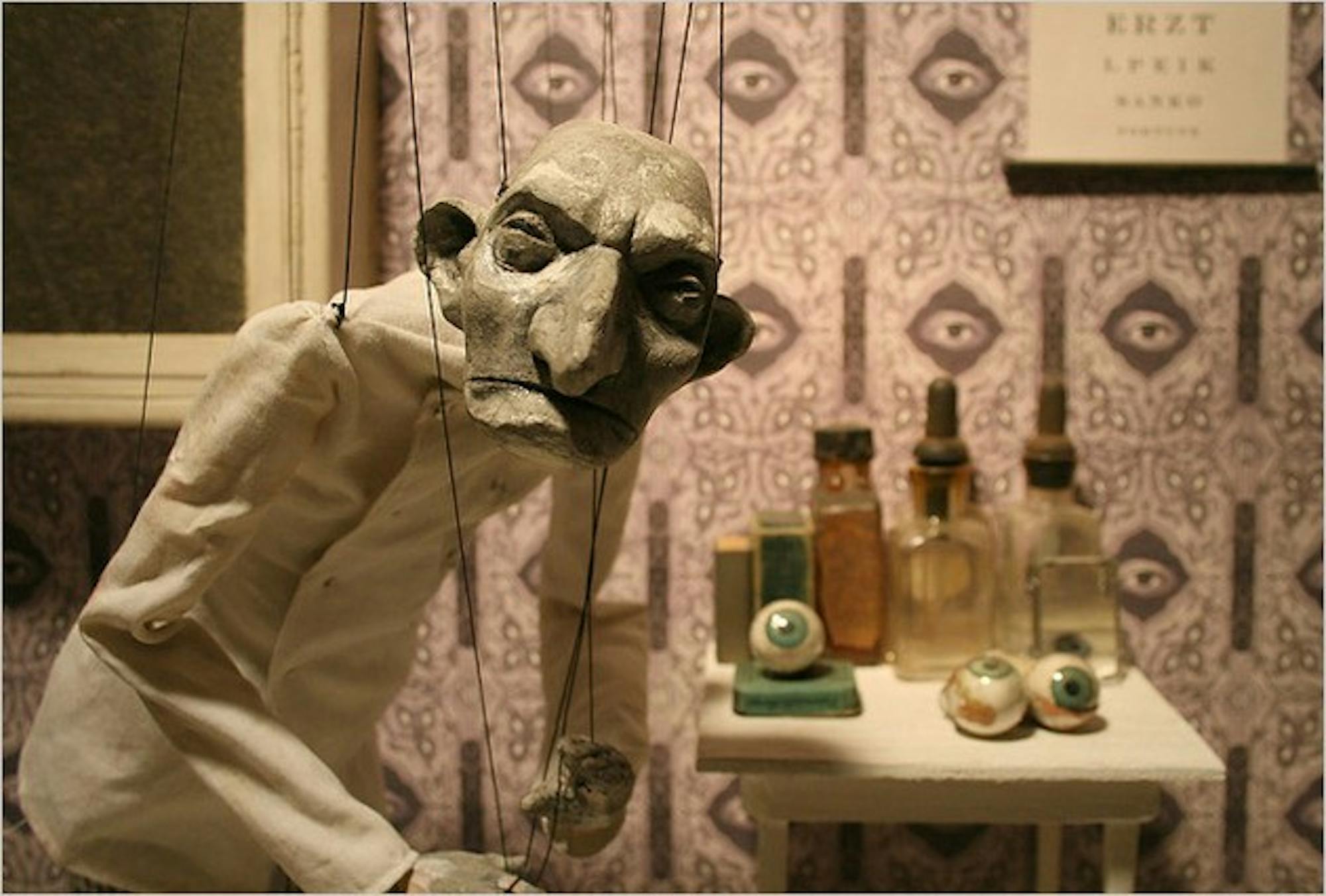
The show, "The Fortune Teller," will undoubtedly have audiences dangling in anticipation when it is performed at the Hopkins Center this weekend.
"The Fortune Teller" is a tale about seven men, each representing one of the seven deadly sins, who gather at a wealthy eccentric's home during the late Victorian-Edwardian era to hear the reading of a will. Although the seven deadly sins represent a rather familiar concept, Sanko had unusual inspirations for the show.
Sanko first came up with the story years ago, when the head of a CD-ROM company who was familiar with his work in puppetry and music asked him to design a role-playing computer game with different outcomes, Sanko said in an interview with The Dartmouth.
"I created a game with several scenarios in which you could be a character, and you could get your fortune told by tea leaves, tarot cards or crystal balls," Sanko said. "Based on the player's decisions and several different parameters, you would get a fortune -- in some cases awful futures or really good ones."
Later in the game design process, Sanko came up with the idea of having "seven plus one" characters in the story. The motif is often used in art, as in "Snow White and the Seven Dwarves" and even "Harry Potter and the Deathly Hallows."
Sanko, however, said he learned about the concept of "seven plus one" from dabbling in astronomy and astrology. He read about the pre-Gregorian calendar once used in Europe, which had 13 lunar months each consisting of 28 days. The last week in each year had "seven plus one days" such that there would still be 365 days in the year. "The Fortune Teller" reflects this structure by featuring eight main characters, the seven men and the fortune teller, the title character who propels the plot forward.
The production's artistic design was also influenced by macabre books illustrated by the American writer and artist Edward Gorey, Sanko said.
Sanko and his wife, Jessica Grindstaff, designed the set by looking at pictures from the time period in which the story takes place. For instance, the characters are dressed in period costumes stained with tea and aged to look authentic, and the set is a large, movable dollhouse meant to resemble a Gregorian mansion.
"I describe it as a very thorough aesthetic," Sanko said. "It is most remarkable for the amount of detail that we brought in. There are custom-designed, hanging pieces of furniture."
Sanko gave the puppets gruesome papier-mache faces because he wanted to enhance the terror that he claims is inherent in his medium and the story, given the amount of death in the plot.
Audiences will sit on the stage for a more intimate setting, as the puppets are approximately two feet tall, which Sanko said is his favorite scale to work with.
The work's score, written by Sanko and longtime friend Danny Elfman, also ups the fear factor. Elfman is well known for his scores to many of Tim Burton's films -- including "Beetlejuice," "Edward Scissorhands," "The Nightmare Before Christmas" and "Corpse Bride" -- which exude the same Victorian Gothic mood that emanates from Sanko's work. Elfman, who came over to Sanko's home to play with the puppets, was inspired by Sanko's creations.
"It is very 'Danny music'; Danny at his purest," Sanko said. "I was not leaning over his shoulder, so it is his unadulterated, unmolested work."
Sanko, who contributed a few of the songs in the show, said he felt more comfortable writing music, as puppetry is still a relatively new art form for him. He first began his career as a musical performer in the bands "The Lounge Lizards" and "Skeleton Key," which used unconventional percussion and some antique instruments to create a more vintage sound. The songs in "The Fortune Teller," however, are very different from his past work. Sanko likens this score to the music of The Residents, a subculture, surrealist music and visual arts group that has been active for more than 40 years.
The "Fortune Teller" first ran at a small theater in New York City for a three-month limited engagement and has since exceeded expectations.
"We never thought ['The Fortune Teller'] would have a life much beyond the initial production, so whenever we do it, we try to recreate the original stage," he said.
Despite the morbid overtones, Sanko does not describe the show as particularly graphic and urged families to come as well.
"When I wrote this story, I did not have an audience in mind, though I thought only weirdos and adults with a macabre sense of humor like me might enjoy it," Sanko admitted. "It wasn't really designed for children, but it's puppets -- how bad could it be? I just hope that people don't think it's a happy, Christian play."
"The Fortune Teller" will be playing Friday at 7 p.m. and 9 p.m., and Saturday at 2 p.m. and 7 p.m at the Moore Theater.
A free behind-the-scenes look at the production and a demonstration by Sanko will be held on Saturday at 4:30, also at Moore.