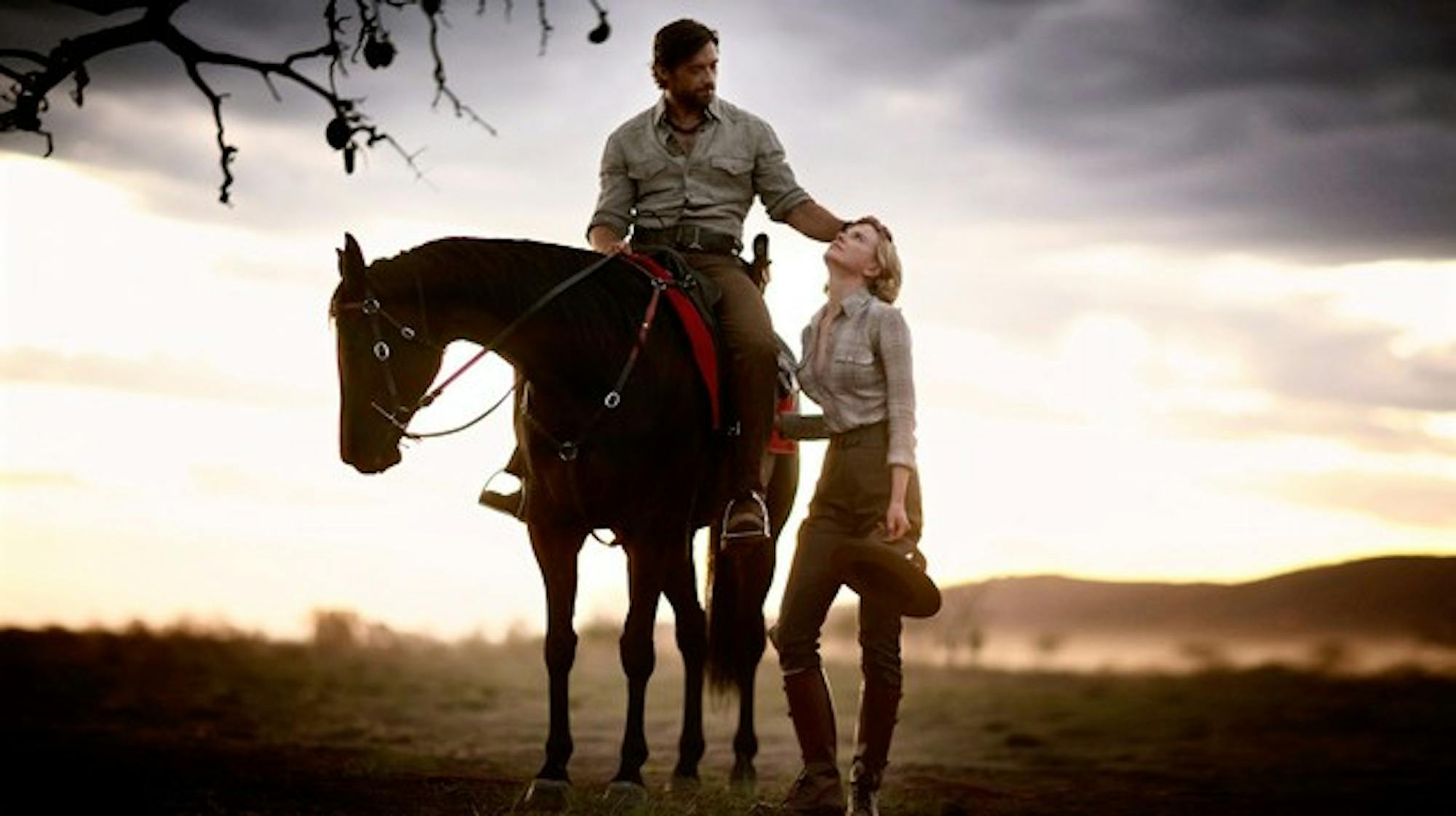
The film, at its most simplified level, tells the story of British aristocrat Sarah Ashley (Kidman) who, following her husband's death, must leave her life of luxury behind to take over a ranch. Rather than sticking to this original premise, however, the film frenetically skips among genres: Starting with a brief stint in comedy, it veers off into Western, then takes a dip in romance, and comes out a World War II epic. The only constant is the camera itself, as it perpetually reminds the audience of its presence with wacky zooms and obtrusive tracking shots. Top it all off with a bizarre and misguided attempt to claim that Australia is the land of Oz -- and director Baz Luhrmann the wizard conjuring the magic -- and what you have is an incoherent and confusing mess.
Despite the film's shortcomings, it's easy to appreciate the scope of Luhrmann's project. Capturing the personality of an entire country in three hours is quite an undertaking. Unfortunately, Australia's personality, according to Luhrmann, seems to be that of a manic-depressive after neglecting his medication for a few days.
To be fair, the film has some high points. Luhrmann's cinematography finds some opportunities for success, especially during the Western-inspired sections of the movie. He perfectly captures the wild and carefree outback with sweeping landscape shots and engaging chase scenes.
Hugh Jackman nails his role as the Drover, a rugged and frisky ranch type who makes women (or maybe just Kidman) swoon every time he says, "Crikey." You could say that he was made for the role; he, as well as Kidman, are Aussies.
When Kidman isn't trying so hard to appear like a snob, she can be quite convincing as the aristocrat Sarah Ashley, a character reminiscent of her previous role as southern-belle-turned-farm-girl Ada in "Cold Mountain" (2003). Although the script itself doesn't make her transformation into hardcore frontierswoman very convincing, she does as much as she can with the role. Still, she occasionally falls into a drab imitation of class snobbery and uptightness. Thankfully, she relinquishes this act during the film's romantic turns, which makes for some memorable sequences. A dance scene with Kidman and Jackman calls to mind old-time Hollywood, when the sex lives of stars were still mysteries and the glow behind female leads resulted from backlighting instead of CGI.
Not surprisingly, the best parts of the movie occur when the country takes center stage, pushing the Drover and his airbrushed biceps aside. In one unforgettable scene, the camera pans over at least 10 different landscapes in under 30 seconds, simultaneously showcasing the country's beauty and putting the film in the running for a Cinematography Oscar nod (its best -- and only -- shot at Oscar gold). Compared to this beautiful montage, the highly digitized Japanese warplane attack that occurs later seems trite and misplaced.
Beneath the mismatched filming techniques and unfocused plot lies a feel-good, although somewhat contrived, storyline. There's the classic romance between the Drover and Sarah Ashley, but there's also a subplot about a young Aboriginal boy Miss Ashley takes under her wing and eventually adopts as her own son. I won't give anything away, but these two elements come together to form a very satisfying conclusion. I advise you, however, to leave the theater after this "conclusion" because at least three more "conclusions" are on the way.
Whether you end up liking "Australia" or not, you will certainly find yourself talking about it after leaving the theater -- even if just to marvel at how many times Luhrmann fits "Over the Rainbow" into the movie's score. A word of advice, though: If you're a fan of epic romances and can stomach the three-hour run time, then go see this movie. If, however, you simply want to see Hugh Jackman's abs, wait until "X-Men Origins: Wolverine" comes out in theaters this spring. Until then, you will have to satisfy yourself with clips of the bathtub scene from 2006's "The Fountain."