
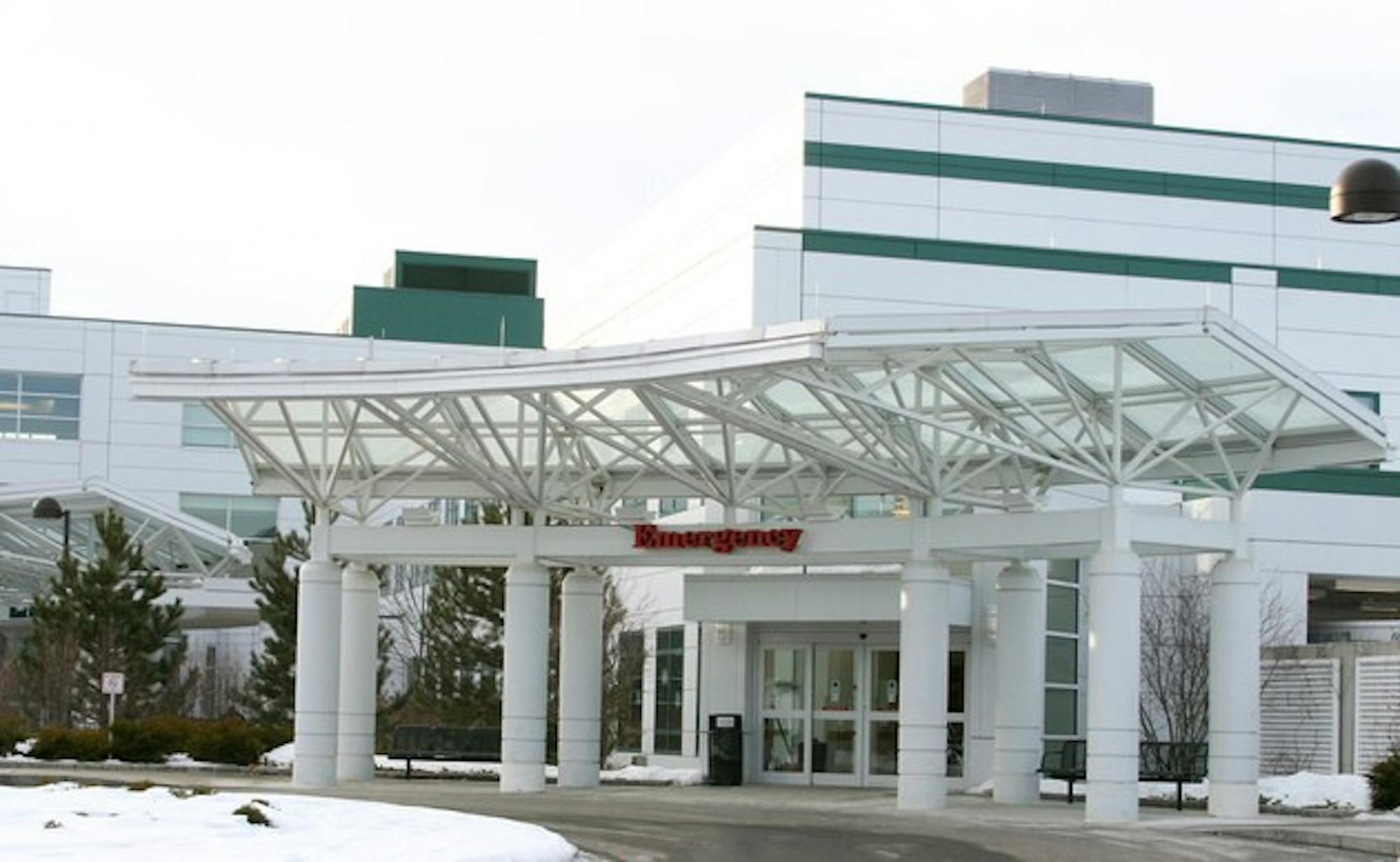
While the national economic crisis has prompted Dartmouth's undergraduate and professional schools to slash their budgets, Dartmouth-Hitchcock Medical Center continued to offer salary increases as late as October and November 2008 and recently began construction on a new outpatient center.
DHMC already had funding in place for both initiatives prior to the stock market crash, according to DHMC spokesperson Jason Aldous. After re-evaluating the hospital's position during the economic downturn, Aldous said, it was decided no change in plans was warranted.
In early November, the hospital decided to move forward with construction on a new $31-million, 41,000-square-foot Outpatient Surgery Center.
"As quickly as things declined, we didn't just go ahead without saying, 'Is this the right time? Should we be doing this?'" he said. "There was a real process there, but we still decided to go ahead."
At the same time, Aldous said, DHMC planned for the project to be completed in several phases so that the hospital could halt construction in response to any financial difficulty.
"We can extract ourselves at any time," he said.
The salary increases, which were offered near the beginning of October, were market-rate adjustments that allow the medical center to remain competitive with the broader market, Aldous said.
The hospital employs roughly 8,000 full- and part-time physicians and staff system-wide, according to numbers released by DHMC for all its campuses in the 2008 fiscal year.
"It impacted about 150 job descriptions and well over 2,000 employees, so it was pretty significant," Aldous said.
Aldous stressed that staff cuts and hiring freezes are not currently in the works for the hospital, even though the College and Dartmouth Medical School, which uses DHMC for teaching and research purposes, have instituted moratoriums on personnel increases.
Many of DHMC's funding sources are unlikely to be affected by changing markets, according to Aldous, a factor that has contributed to the hospital's ability to move forward with its planned projects. Insurance companies, for example, are locked into compensating the hospital for health-related procedures because of several-year-long contracts with DHMC.
"Economic cycles are part of the process," Aldous said. "[A multi-year contract] takes the risk and uncertainty out of it for both parties."
As long as patients don't lose their jobs, and, therefore, their health benefits, their insurance is obligated to cover DHMC's treatment expenses regardless of the economic climate, he added.
Although he hesitated to categorize DHMC as "recession-proof," Aldous said the hospital provides "essential services" to patients.
"If you break your leg, it's not something you can defer until the recession is over," he said, adding later, "Our [budget] strategy might have been different if we had seen a long, extended decline in patient volume."
DHMC functions as a "payer blind" hospital, meaning that patients without necessary funds or private insurers can still receive medical treatment.
Still, the hospital might have to account for budget shortfalls if New Hampshire looks to cut Medicare and Medicaid benefits from a tightening budget, Aldous said.
The hospital received nearly 70 percent of its revenue from payments made for patient services during the 2007 fiscal year, according to a DHMC annual report. Medicaid payments account for roughly half of this figure, Aldous said.
Currently, Vermont and New Hampshire typically meet only 50 percent of procedural costs for Medicaid patients, which means that DHMC is "always running a deficit in regard to Medicaid," according to Aldous.
"We're already losing money -- we can only lose more," he said. "If the federal government does not respond with assistance for states, one place [New Hampshire and Vermont are] looking to trim fat is Medicaid," referring to the incoming Obama administration's planned financial stimulus package.
When asked whether insufficient aid in the stimulus package would force the hospital to economize, Aldous responded that the hospital "very likely" would.
"If it's a cutback of a few dollars here and there, we can probably manage that in the short term," he said. "If it's a cutback of tens of millions of dollars, that's a completely different scenario."
He declined, however, to discuss what steps DHMC might take to tighten its belt.
"There are plans in place," Aldous said, but added that it was "really not appropriate to discuss" what they entail.
The hospital maintained a positive margin for 2008, coming in $28 million in the black. That number was slightly below the target operating margin for the 2008 fiscal year, which Aldous attributed to inclement weather conditions that resulted in procedure cancellations during the early months of 2007.
The original version of this article stated that DHMC employs roughly 8,000 full- and part-time physicians. In fact, that number refers to the number of physicians and staff employed by DHMC system-wide.


