
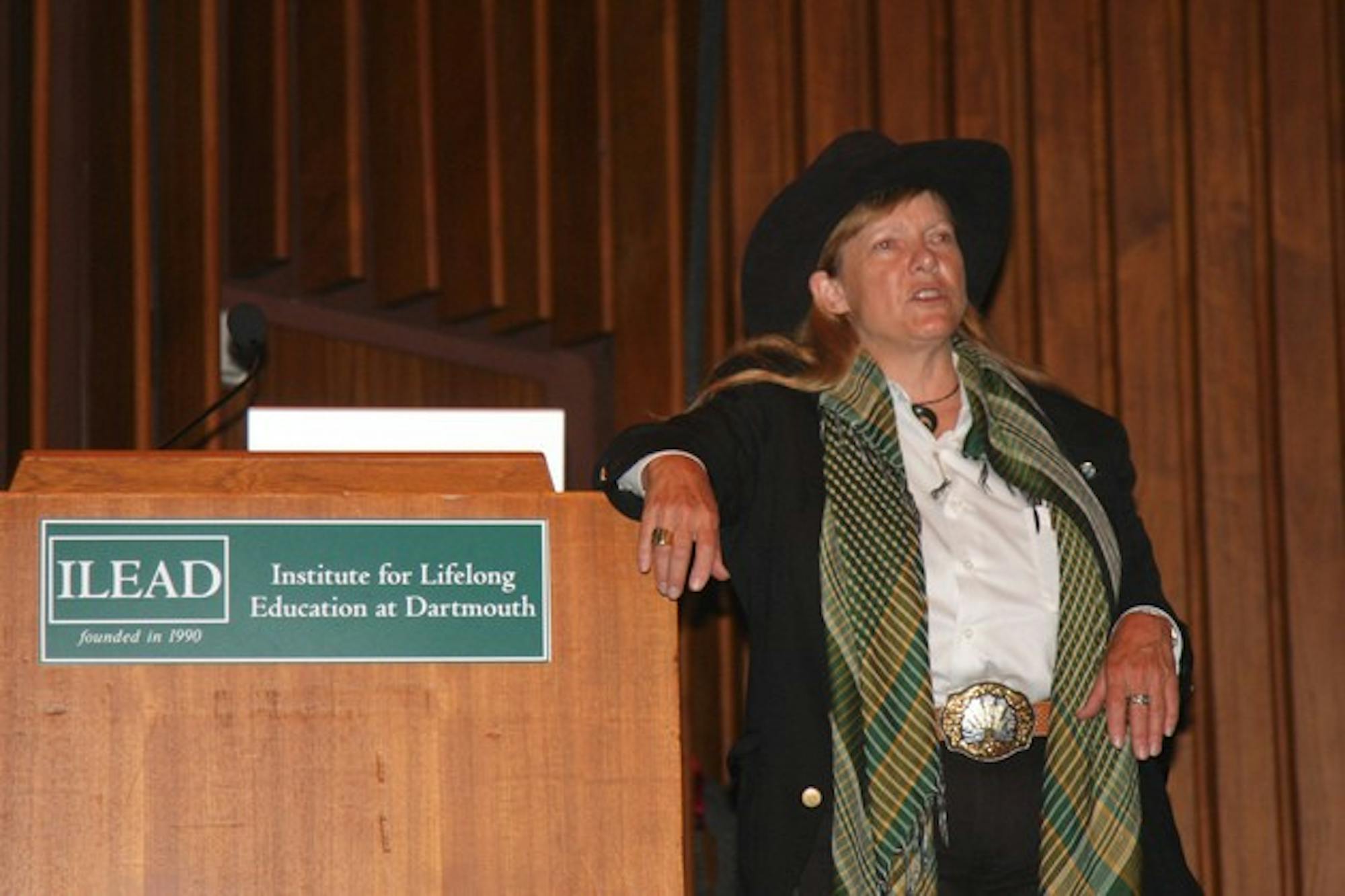
Companies are beginning to jump on the environmental bandwagon as they see the profit opportunities in adopting eco-friendly policies, Lovins said, adding that investors are now forcing companies to disclose their carbon footprint, and insurance companies are threatening not provide coverage to those who do not release that information.
"Corporations are beginning to ask, 'what's the business case for ending life on earth?'" she said.
These "green" policies not only help the environment, but also save money, Lovins said. Dupont, the world's second-largest chemical company, was recently able to cut its greenhouse gas emissions by 65 percent and in the process save $3 billion, Lovins said. Every megawatt of energy saved is equivalent to about $2 million in increased output and $500,000 in increased wages, Lovins explained.
"If all of you care about is being a profit maximizing capitalist, you'd be doing the same thing," she said. "We know how to protect the climate of a profit."
Much of this increase in energy efficiency comes from "greener" buildings, Lovins said, explaining that companies can now improve the energy efficiency of their buildings by three to four times. She expressed her hope that by 2030, new buildings will have net zero emissions.
These environmentally-friendly buildings are also great for business, Lovins said, citing an example of a Wal-Mart store where half of the building was built to "green" standards. The environmentally-friendly half had 40 percent higher sales than the other section, she said.
Lovins also said workers in these buildings are less likely to get sick and are 15 percent more productive.
It is crucial that governments immediately adopt "green" policies in order to avoid serious consequences, Lovins said. If China were to reach our standard of living, it would need three Earth's worth of resources, she said. At the current rate of resource consumption, the world is rapidly heading to "peak everything," Lovins explained.
Lovins also stressed the importance of preventing climate change.
"Some people say they don't believe in climate change," she said. "Frankly, the world doesn't care what you think."
While the U.S. government has done little to address climate change, local communities are beginning to act, Lovins said. About 830 mayors have formed the Mayors Climate Protection Agreement, pledging to follow the Kyoto Protocol, and the town of Berkeley, Calif. now allows home owners to pay for energy efficiency improvements through their property taxes, she said.
Combatting climate change is not just a matter of government policy, it is something everyone must commit to do, Lovins said. She urged the audience to take time every day to look into the mirror and ask, "What can I do to help the environment today?"
"Every time when you buy, you're voting with a dollar," she said. "Whatever your value structure is, your dollar affects it."
Lovin's lecture was the first of ILEAD's eight-part summer series on "Positive Solutions," which aims to bring to the forefront topics that the series' organizers believe the presidential campaign's may be ignoring.
"During an election year people will be negative," Summer Series chair Bruce Macdonald said. "We wanted something a little more upbeat."
Macdonald attributed the success of ILEAD to its proximity to Dartmouth and large retiree population.
"We have an older group, politically aware of things." Macdonald said. "They're very well-traveled, well-read and know what's going on. They ask a lot of questions."


