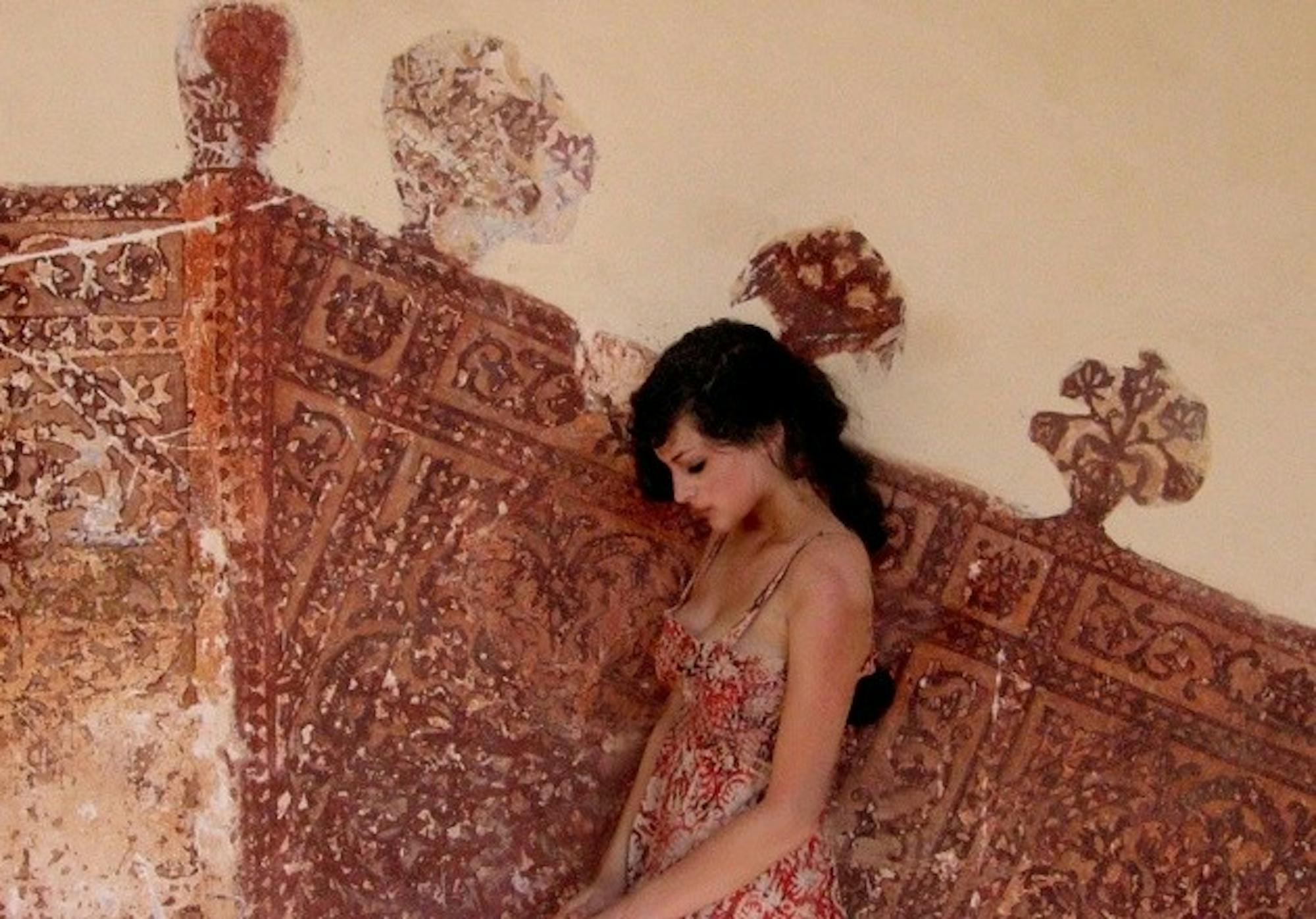
"See these hands?"she says, in her soft-spoken voice. "I may be a small woman, but these -- these are a teenage boy's hands. They're useful hands. They're not an artist's, they're an artisan's."
Though she prefers "artisan" to "artist," Ward has put her hands to magical work in a variety of media. As an English major with a concentration in creative writing, her most recent project is her honors thesis, a book of poems titled "For the Living One Who Sees Me" -- which earned the creative writing department's Jacobson-Laing Award for the best manuscript of original poems. But Ward has also done significant work with film and screenwriting, travelling to India in the process.
"For the Living One Who Sees Me" draws its title from Hagar's name for the well in Genesis 16:14. Ward's poem of the same name imagines Hagar seeing her descendants -- the women to come -- reflected at the bottom of the well.
"Many of my poems, especially in this book, deal with themes of religious devotion," said Ward. "I see this devotion as a love story between a person and his or her god or gods."
Ward's life-long fascination with the Bible and what she perceives to be a love story -- that of David and the Lord in the book of Samuel -- drew her to writing poems with religious undertones. Her writing often seeks the experiences of the tent-dwelling women of the Hebrew bible, such as Hagar and Jael, but also looks at contemporary religious devotion.
"Some of these pieces lament the consequences of evangelism, when people are made into objects," Ward said. "Still others lament what I lose myself, in attempting to define or describe others in poetry."
"Mission Children" is a perfect example of Ward's tendency to discuss serious issues with an innocent or reserved tone rather than a preaching one. "Children" laments the assimilation of native peoples by Christian missionaries, but focuses on the innocent play and unconsciousness of the missionary's children: "In the sun that parched the settlement, / Brother Rose gave his tongue-hanging sermons / while the children played war / with tin soldiers on the hour lines / of the sundial."
When reading her poetry, Ward's voice becomes relaxed and soothing -- almost like a lullaby.
In addition to writing poetry, Ward also uses film as a medium to elaborate upon her favorite themes of religious devotion and the effects of evangelism. After a visit to Andhra Pradesh, a state in southern India, she wrote a fictional screenplay about an Indian Christian evangelist suffering from a terminal illness, as seen through the eyes of his 13-year-old daughter. The screenplay, "Smile, Mermaid" went on to win the Alexander Laing Memorial Award for screenwriting. She later shot the film in India during the summer of 2007.
"Seeing through the eyes of a child is so important to this film," Ward said. "It shows how this small girl can appropriate religious language and lessons that are usually taught by men, who are often dominant in religious culture."
Ward is currently working on a film for a non-governmental organization based in Dharamsala, India. Filming in Dharamsala led her to speak to Ama Adhe, a Tibetan who had been imprisoned by the Chinese for 27 years.
"Adhe told me that film is the best way to support truth and a good way to be of service, so I felt very encouraged by that," she said.
After graduating this year, Ward will travel to Kathmandu, Nepal in September to shoot a documentary with Sophie Kunga Cary '08. The pair won a Reynolds Scholarship to complete the project, which will narrate Sophie's return to her Tibetan biological family in Nepal and discuss Tibetan identity in exile today -- from the female perspective.
Ward also plans to continue writing poetry.
"Poetry is an ongoing obsession for me," she said. "My poems are about the unknown. That's where the drive to write comes from in the first place."