
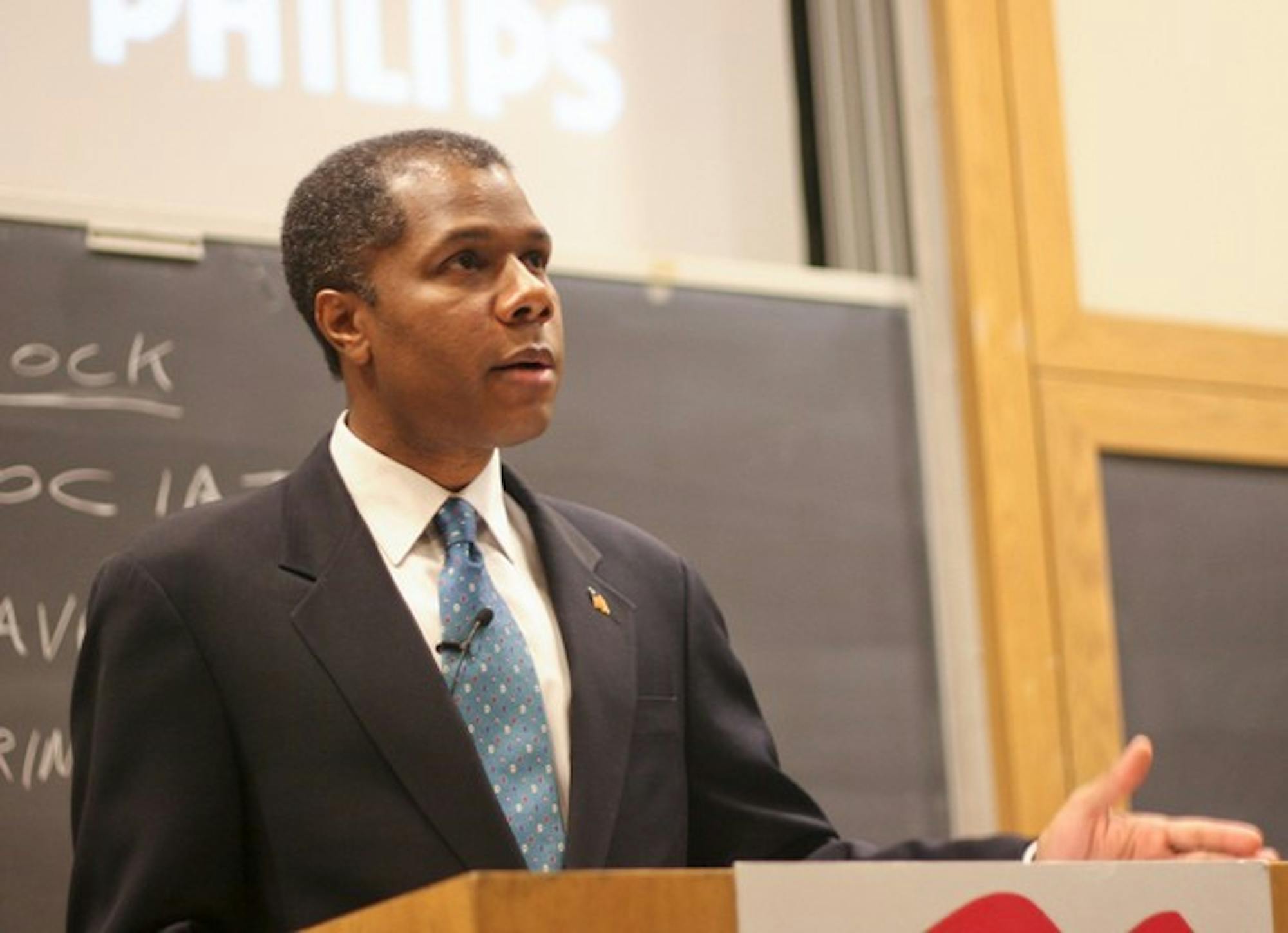
The question of whether Americans should be able to discriminate has a long history in U.S. political thought, Murdock said.
"I did not come here tonight to speak of new ideas," Murdock, a popular guest on FOX, CNBC and C-SPAN, said. "In fact, it's quite an old idea -- old as the American republic itself. And it deserves to be resurrected."
Freedom of association is rooted in the Bill of Rights, Murdock said, specifically in the First Amendment's guarantee of "the right of the people peaceably to assemble" and the Ninth Amendment's clarification that "the enumeration in the Constitution, of certain rights, shall not be construed to deny or disparage others retained by the people."
Discrimination in this context is not used solely to identify racial prejudice, Murdock said, but to describe decisions that Americans make on a daily basis. This discrimination can include anything from the selection of a mate to a prospective student's decision to attend a particular college.
"Discrimination is an act of choice," he said. "Really, it's a fact of life."
Jennifer Bandy '09, president of the Dartmouth College Republicans, which co-sponsored the lecture, said in an interview that the talk was intended to prompt discussion about discrimination in a context outside of its racist connotation.
"We wanted to present an opinion without being offensive," Bandy said. "It's an intellectual discourse, and it's based in the Constitution. I think anyone who attended the program could see that a lot of thought went into the position."
Bandy is a former member of The Dartmouth Staff.
Murdock, who is black and gay, supports the right of American businesses to discriminate in the private sector, he said, but added that the government should guarantee all rights to the best of its ability, ensuring equal protection under law. It is when the federal government interferes in the practices of private businesses that problems begin, especially when no form of discrimination has actually taken place, he said.
For example, the Equal Employment Opportunity Commission intervened when it determined that the hiring practices of Joe's Stone Crab, a seafood restaurant in Miami Beach, Fla., did not have enough female waitresses. The female owner of the restaurant claimed that few women applied for serving positions because the serving trays were often too heavy to lift and the restaurant was located in an unsafe part of town. The EEOC framed the lack of female applicants, however, as "unintentional discrimination," saying that the restaurant had a reputation for hiring male servers. As a result, the restaurant was forced to have a psychologist on hand during the interview process and film videos about workplace sensitivity.
Additionally, government interference can result in unequal treatment of races, he said, citing the case of an Indian-American student who was denied admission to a private school because the minority quotas at the school inflated the necessary test scores to gain acceptance. The girl's scores would have qualified her for admission had she been white, Murdock said.
"I find this thing pernicious, disgusting and highly demeaning," he said, stating that raising or lowering workplace or academic standards to meet race quotas does not benefit minority groups.
Forced acts of integration in the workplace are similarly ineffective, Murdock said, because organizations that represent unique demographics may be forced to homogenize their workplace populations.
In the end, governments will have to determine suitable standards for regulating discrimination in the public sector, he said.
"At some point, you have to say that we live in a state with a limited government," Murdock said. "At some point, we become like Cuba, a very expensive Cuba."
The lecture, which was sponsored by the College Republicans and Young America's Foundation, is part of a larger attempt to bring conservative speakers to campus, Bandy said.
"It's our goal to promote balance in the intellectual discourse at Dartmouth," she said.


