
"It's pretty nasty," she said, "But it makes me want to make less garbage and not leave it on the ground and stuff."
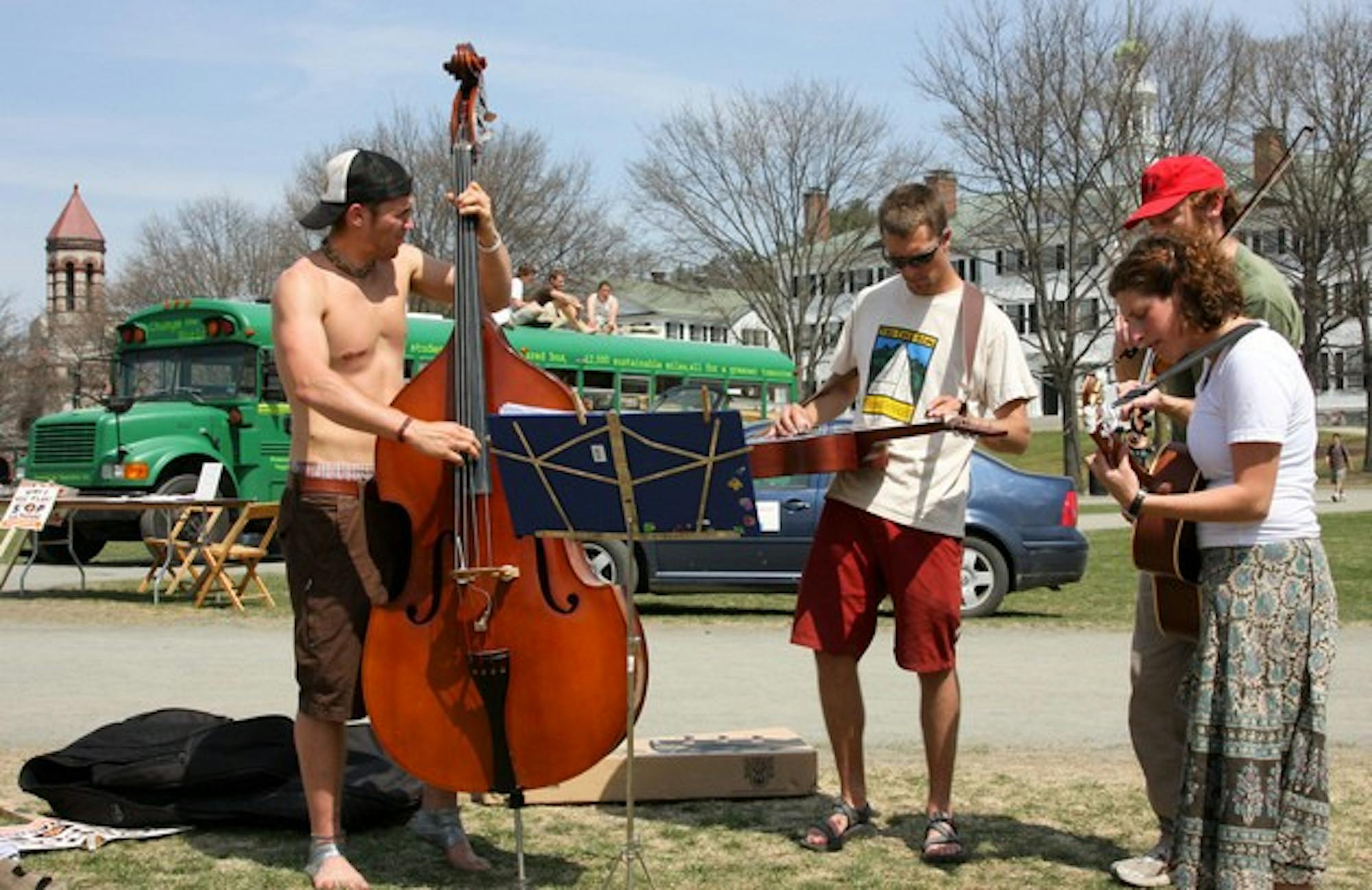
The display was part of several Earth Day celebrations organized by environmental organizations on campus, including the Environmental Conservation Organization and Sustainable Dartmouth. Tables set up on the Green sold reusable water bottles and T-shirts and offered information about several environmental issues and opportunities to get involved.
While the display of trash garnered the most attention, not all students were pleased with the exhibition.
"I think the big pile of trash is kind of gross," Jonathan Panzl '11 said.
Panzl's opinion was echoed by many students sunbathing and reading in the surrounding area.
The display was intended to create awareness about the volume of trash produced at the College, Sarah Frostenson '11, a member of ECO, said. Frostenson is a member of The Dartmouth staff.
One of the tables set up by ECO invited students to participate in the "Tap Water Challenge." Participants were given two identical plastic cups, one filled with tap water and the other with bottled water. The vast majority of the participants were unable to tell the difference.
"I sometimes buy bottled water -- now I feel bad," Sarah Feldman '11 said after taking the challenge.
Drinking tap water is also an economical choice, Emily Jones '08, co-coordinator of ECO, said. While tap water costs four tenths of a cent per gallon, bottled water costs nine dollars for the same amount, she said.
"The whole point is for people to opt for tap water," Jones said. "Dartmouth's tap water is good and well filtered."
The majority of the activities on campus lobbied for legislative change in environmental policies. While past Earth Day celebrations focused on lifestyle changes like recycling, there has been a shift in recent years, said Ruth Hupart '08, co-chair of Sustainable Dartmouth.
"There is a much larger emphasis on pushing for strong legislative action to fight global climate change," she said.
At one table, students were encouraged to call Senators Judd Gregg, R-N.H., and John Sununu R-N.H., who are potential swing votes on any climate legislation that passes through the Senate, according to Hupart.
Organizers provided cell phones and talking points for students to voice their support for the Lieberman-Warner Climate Security Act, she added.
"When students call them, it's a big deal" Tom Glazer '08, co-chair of Sustainable Dartmouth, said.
Students were also encouraged to sign a state-wide petition by Power Shift, a non-partisan voter education group, pledging to support the candidate with the most environmental awareness, especially in issues surrounding carbon emission.
"The goal is to convince the candidates that their stance on these issues is very important since we are a large voting bloc," Kaili Lambe '09 said.
Organizers also encouraged students to sign a petition to bring James Hansen to campus. Hansen is a prominent researcher in the field of climatology and best known for his testimony on climate change to congressional committees in the 1980s.
Derek Walton, a junior at a Chicago high school, was touring the campus and participated in the Earth Day activities.
"I work with environmental groups in my high school, and I heard that Dartmouth has a reputation for being very green and involved in environmental issues," he said. "This is cool. So many people participate, and I definitely want to come here."
Amnesty International, the Carbon Coalition and the Sierra Club also tabled on the Green. The Sierra Club collaborated with Dartmouth groups to hand out free energy-efficient lightbulbs.
Later in the day there were screenings of environmental films and educational displays in Thayer Dining Hall.
Organizers hoped the enthusiasm of participants would last past Earth Day.
"We are always looking for new ways to reach a larger portion of the community," Jones said. "For instance, this term we will be creating YouTube videos with our new mascot, the Lorax, using comedy to raise environmental awareness."


