
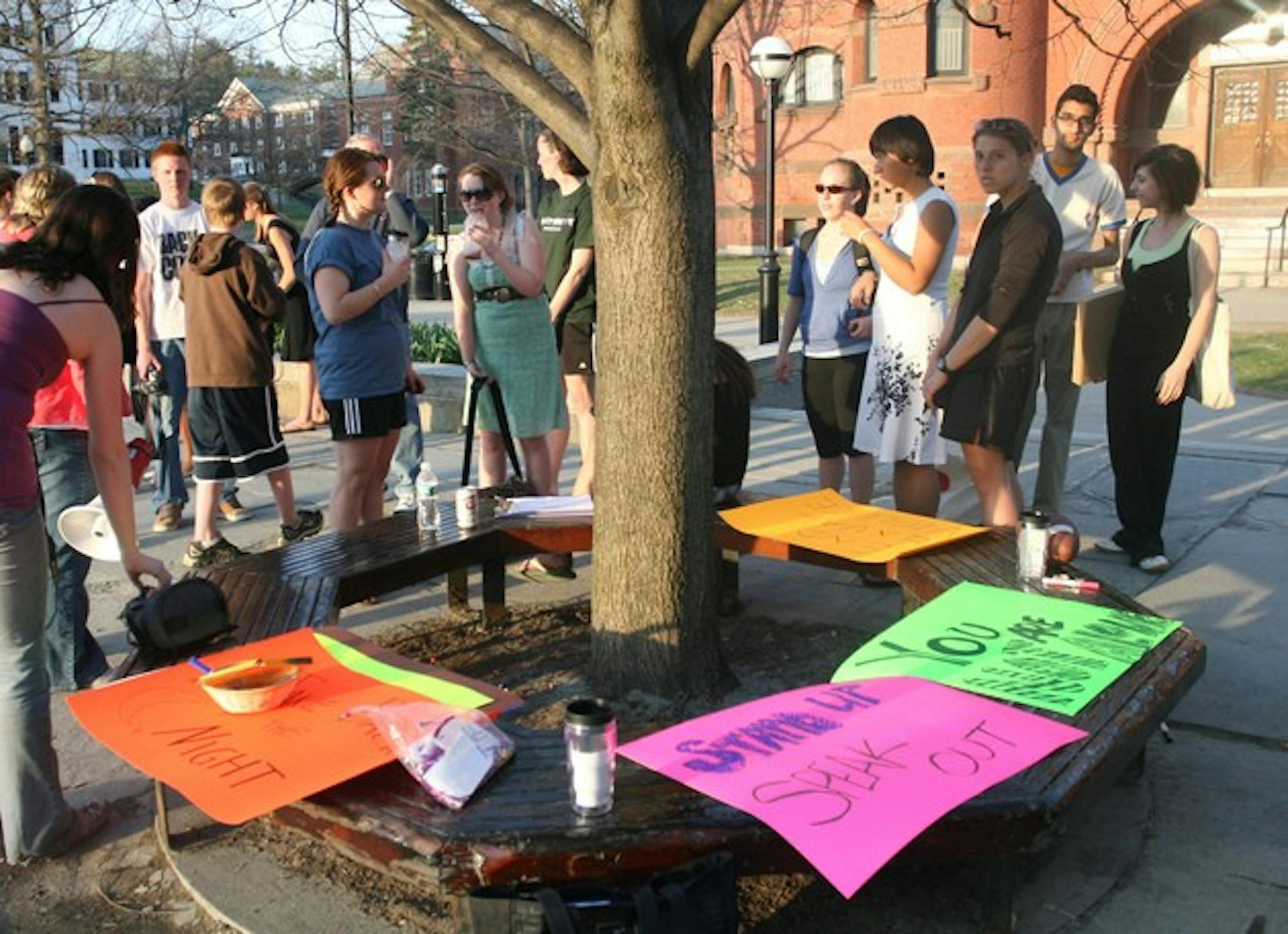
A Collis Center administrator, who wished to remain anonymous, shared her experience of being attacked by an ex-boyfriend and his friends.
"I'm here to thank Steve who stopped my rape," she said. "He has four daughters, and sometimes I wished he had four sons so there were more great men."
Listening to her story, event participants held lit candles to symbolize the effect sexual assault has on its victims.
"Some candles stay lit, and some go out," she said. "Some people stay here and try to fight. There are others who have left and that we have lost."
Participants carried signs denouncing sexual violence as Rebel Roberts, interim coordinator of the Sexual Awareness Program, led them on the march across campus. As participants walked, they chanted "Sexual assault affects us all" and "Take back the night, the time is here, we will not be controlled by fear," among other phrases.
"A friend was assaulted and it has been difficult this term," said a female member of the Class of 2009, who wished to remain anonymous. "My way to deal is by bringing awareness. It is an issue that needs to stop being ignored."
After learning about the assault on her friend, the woman decided to become involved with the Sexual Assault Peer Advisor program, she said.
The Collis administrator was disappointed by the turnout of approximately 30 at the event and challenged attendees to bring twice as many participants to the event next year, she said.
"I think we should ask people in the end 'Where were you?'" she said. "There were times when this march has hundreds of people including the fraternity brothers in their letters."
Participants gave a wide variety of reasons for coming to the march -- for example, a male member of the class of 2011 said he "thought it was the right thing to do," and a Dartmouth employee said she went in honor of the Petit women "who couldn't be a part of the community." Jennifer Hawke-Petit and her daughters Hayley and Michaela Petit were murdered last summer.Hayley planned to matriculate as a member of Dartmouth's Class of 2011. Reports allege that Jennifer and Michaela were sexually assaulted before they were murdered.
"It is a healing thing," the member of the Class of 2009 said. "Anything anyone can do helps. A lot of acts like these take away power, and anything to get it back helps."
A female member of the Class of 2010, who wished to remain anonymous, said Take Back the Night was the first event addressing sexual assault that she had attended and added she came to support assault victims.
"I'm here because it hasn't happened to me, but it could happen to me," she said. "I want to be here to support everyone else."
Roberts, who organized this year's event, emphasized the significance of her role in the fight to end sexual assault at Dartmouth.
"I'm here for personal as well as professional reasons," Roberts said in an interview. "We need to reduce and eliminate violence against all genders. It happens on campus a great deal, and a lot of people feel like there is no where to turn. As a part of the Dartmouth community, I want to reach out and help as much as I can."
Roberts stressed the importance of building a strong support community for survivors, as well as the role the SAPA program has in providing this support.
"We need more students willing to become SAPAs for peer-to-peer help and support," she said.
Take Back the Night is an international event that was first established in Belgium in 1976 to stop violence against women. The event was organized by the International Tribunal on Crimes against Women, a support group for women around the world.


