
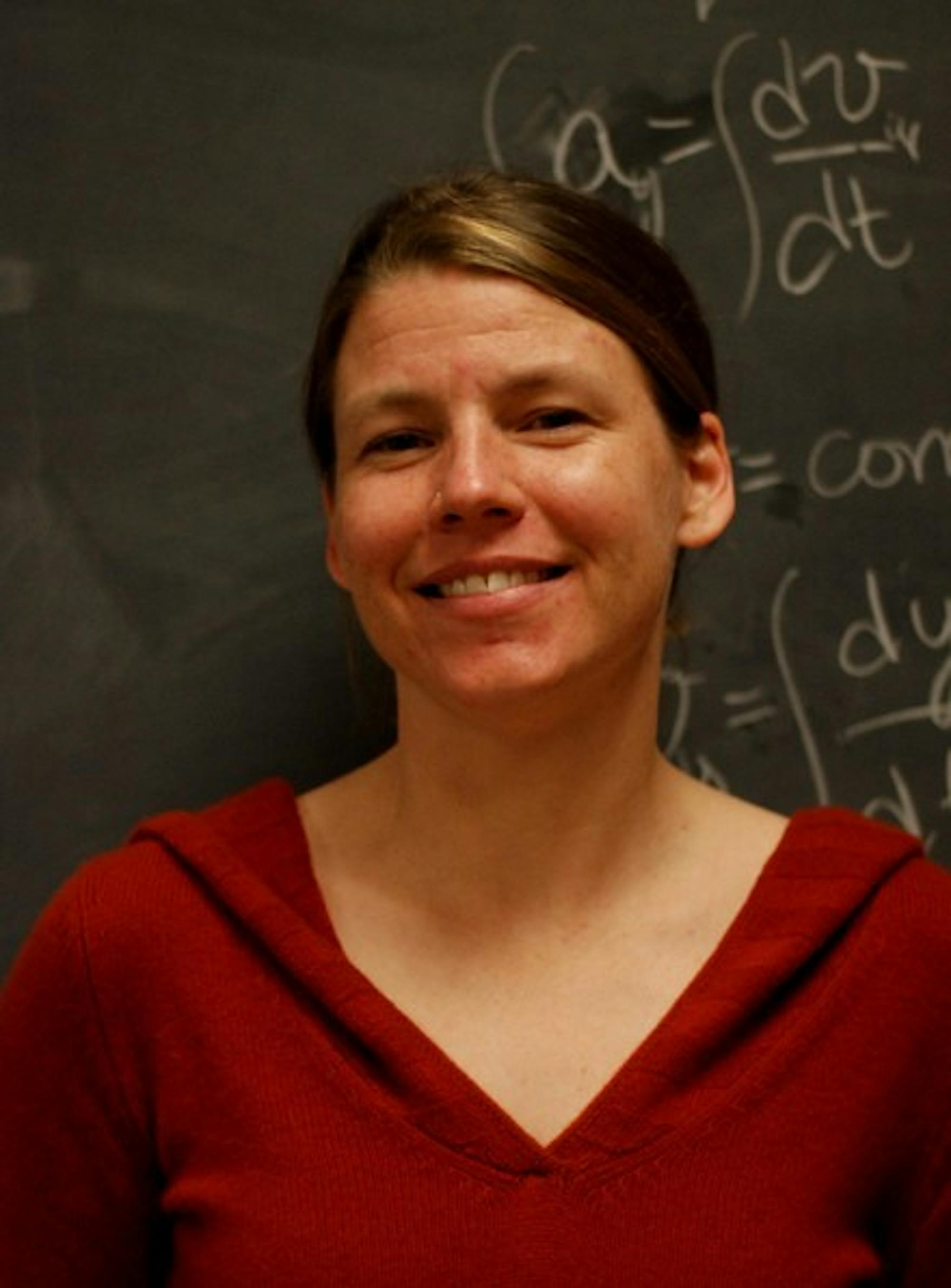
Millan's project, Balloon Array for RBSP Relativistic Electron Losses, will launch high altitude balloons suited to monitor change in radiation levels into the belts, which consist of charged electrons released from solar activity. The project will augment NASA's Radiation Belt Storm Probes project, which will also launch two satellites into the belts in 2012. These satellites study the accumulation of radiation and examine how radiation levels change during space storms.
"The equatorial satellites can't measure the [particles] that come into the atmosphere," Millan said. "Because we're launching simultaneously, we're going to have lots more information."
Projects like Millan's will allow Dartmouth's reputation as a research institution to grow, according to Martin Wybourne, vice-provost for research.
"Space weather modeling and research into space weather has been an area of focus on campus for many years, and I think this really makes Dartmouth one of the national and international leaders in this field," Wybourne said.
In November 2005, NASA announced a Geospace Mission of Opportunity inviting researchers and teams to submit proposals for projects related to NASA's Living With A Star program. Dartmouth and two other teams underwent an extensive application process, including an on-site review this past November to verify that the mission could be completed within the proposed budget.
Millan chose researchers at University of California, Berkeley and University of Washington to join Dartmouth in the effort. Each institution will work on a different part of the project, from the physical launch to how to retrieve the data from the balloons.
BARREL will offer undergraduate and graduate students the opportunity to participate in all aspects of the project. Robin Meyers '10, who has worked with Millan since this summer, has designed and computed models for the balloons' payloads and instruments.
"For the small department we are, we have a lot of people doing space physics" Millan said. "This gives us the opportunity to educate students doing the research and starting their own careers."
Physics and astronomy professor Mary Hudson, who is providing theoretical modeling for the project, views Millan as a role model for women considering studying the sciences.
"In my day, I was the only woman in my freshman physics class," Hudson said. "If you see there are more women doing it, then it seems like something you ought to at least try.
"When you change the boundary of the magnetic bottle the earth's magnetic field creates and move it in, you cause large currents carried by low energy charged particles to flow down into the ionosphere," said physics and astronomy professor Mary Hudson, who is providing the theoretical modeling side of the project.
This flow causes disruptions with satellites in the earth's orbit, and can have direct effects on communication, Global Positioning System and power grids.


