
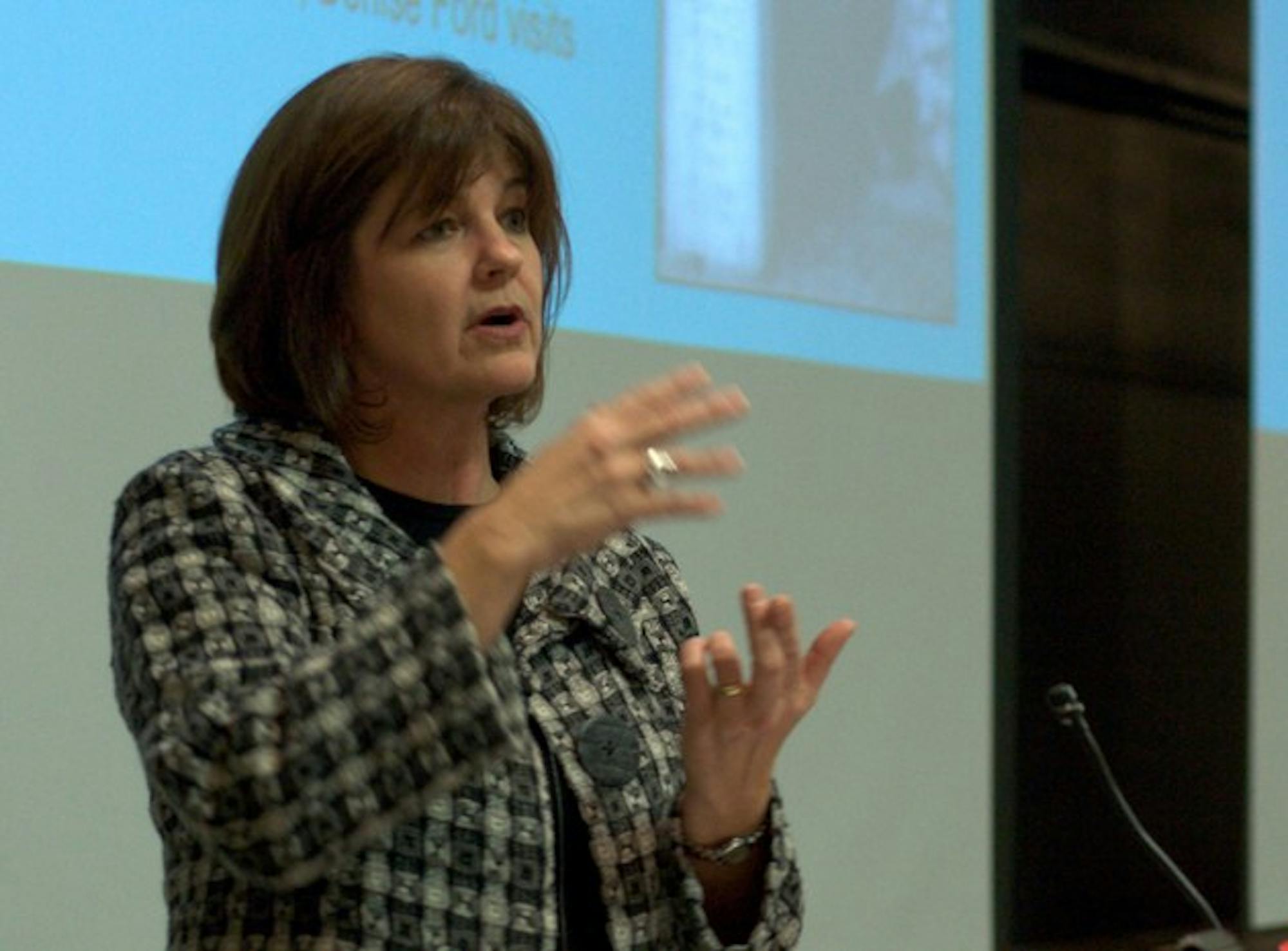
Nancy MacLean, a history professor at Northwestern University, spoke about the battle of social activists against employment discrimination in a speech given to Dartmouth students and community members in Filene Auditorium on Monday afternoon.
The lecture, titled "Freedom is Not Enough: The Struggle to Open American Workplaces to All," stressed the importance of Title 7 of the Civil Rights Act of 1964 in overcoming job segregation. The Title encouraged African-Americans, women and Hispanic-Americans to create coalitions, and was opposed by the conservative movement.
The feminist movement and the Mexican American civil rights movement "took off over job issues and over their anger that they were being ignored," MacLean said. "[Title 7] created potential for alliances between the various groups."
MacLean told the stories of individuals who suffered hardships because of segregation in the 1960s but subsequently benefited from Title 7.
Corine Canon, a textile worker in South Carolina, said that mill jobs provided a chance to be a "full-fledged citizen," which she called "the best thing to happen to black women in my lifetime, because you can't pretend to be free without money."
"Workplaces are the most integrated institutions in America today," MacLean said. "Workplaces are where people are learning to cooperate and build relationships over societal lines."
MacLean also described the social movements in the 1960s and 1970s, using research from her book.
"The story is about the struggle from below and action from above," MacLean said. "This helps us understand how social movements can use law and government power to create change."
Though legislation-aided social movements, groups of primarily white men formed to oppose them. Activists had to overcome the conservative movement that often impeded the advancement of minorities and women, MacLean said.
Although MacLean recognized the progress made by activists in support of these social movements, she said that "the glass is still only half full."
"The new battleground question is [one] of living wages and the right to health insurance," MacLean said. "Entering the labor force, you can work very hard at two jobs full-time and still live in poverty in the richest country in the world."
MacLean noted that her personal experiences with sexism helped to inspire her research on diversity in the workplace.
"I want [students] to take away a new sense for how important jobs are in the fight for equality and how central economic advance is to achieving equality," she said in an interview with The Dartmouth.
MacLean was the second speaker in a series of speeches addressing issues of class in American society, sponsored by the Rockefeller Center. The next event, "Class and Racial Divisions: Challenges and Opportunities," will take place on Wednesday, Jan. 30 at 4:30 p.m., in 28 Silsby Hall.


