
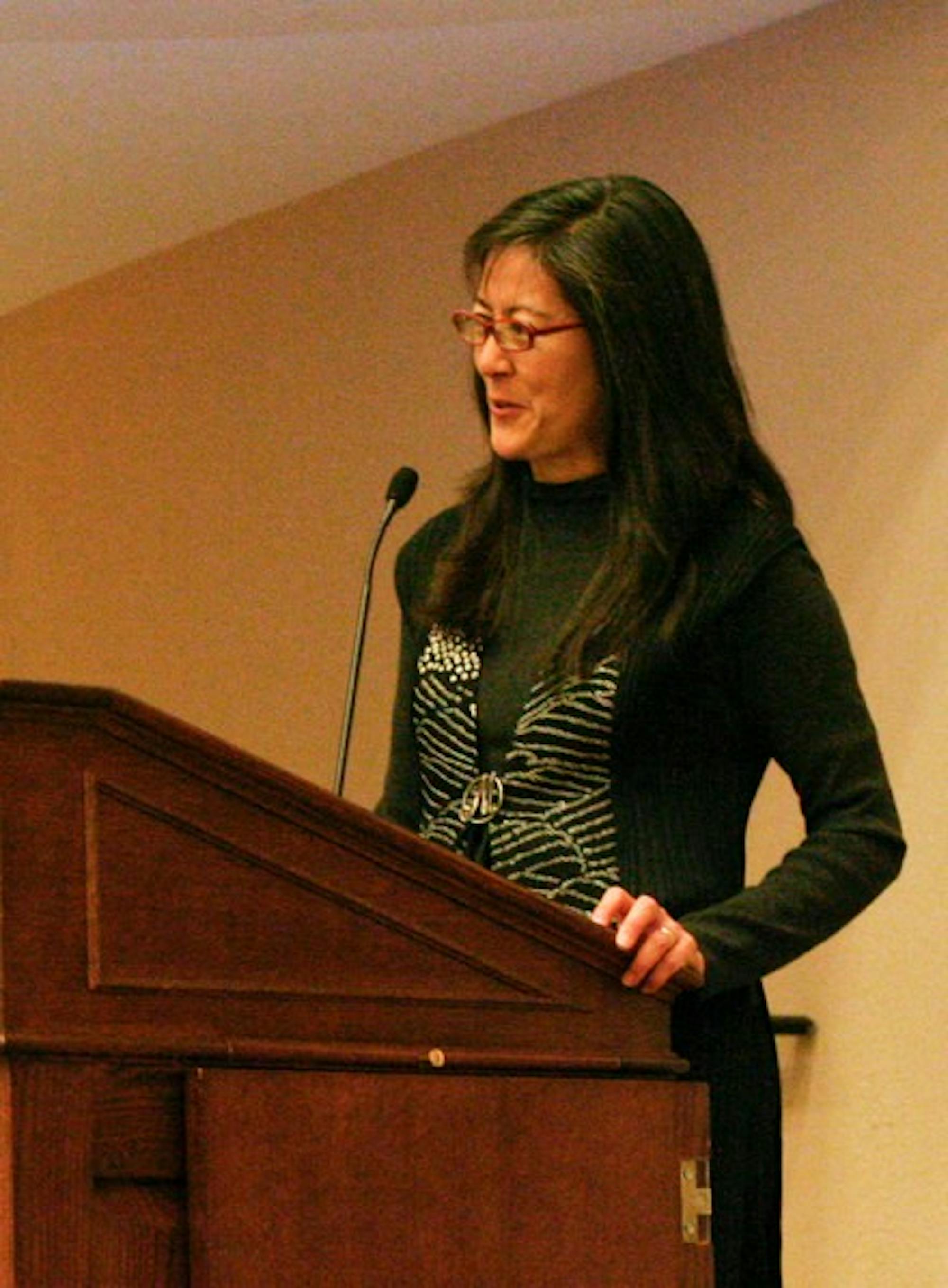
At public schools across the country, Matsuda said that everyday children go to school hungry because their parents are sleeping "in a haze of drug or alcohol abuse." She insisted that not enough is being done to fix this issue.
Matsuda, who is a professor at Georgetown University's law school, referred to her child's public school in Washington D.C., where, after five years of petitioning for new windows, the school received windows that were too small.
"These things don't happen at Dartmouth," Matsuda said. "Here, when we order windows, we get the right windows and if they aren't right, we send them back because we are Dartmouth."
According to Matsuda, in order to reach solutions, "organizers of social change" must believe in the intelligence of others, listen to the needs of the people they want to help, pick an attainable goal and find a powerful person to implement the change.
"Rules are useful if we understand that in interpreting, we can make rules work for us," she said. "We have to have a compass; the compass is a utopian vision. A better world is possible."
Referring to the College's nearly $4 billion endowment, Matsuda said that until colleges make a commitment to contribute to the local community, they are not helping to alleviate poverty.
"I just read that President Wright is working to make school more affordable," Matsuda said. "That's great. My wish list, however, is that [universities] drill downward and find a way to share their resources with the kids who don't have heat in the winter or are never read to. We need to bring them here so they can see what it's like to go to a university."
Matsuda said that her students are working to ameliorate negative social conditions. Her students' work, she said, has even affected her daily actions, saying that she now uses mugs instead of paper cups.
"The culture of our collective practice changes us because we are social," Matsuda said. "My student changed me and changed my culture."
Matsuda's speech, titled "Emancipation from Mental Slavery: Public Education & Social Change," is the first of a series of speeches and panels in support of the Dartmouth Centers Forum 2008 theme, "Class Divide" and co-sponsored by the Rockefeller Center.
"We try to have themes that fall into line with the mission of the school and the various departments," Judy Fothergill, events coordinator for the Rockefeller Center, said. "The people that we bring in are always of educational value. That is our primary goal."
The next speech in the series will be given by Nancy MacLean, a history professor at Northwestern University. Her lecture, titled "Freedom Is Not Enough: The Struggle to Open American Workplaces to All," will be given on Jan. 28 in Filene Auditorium.


