
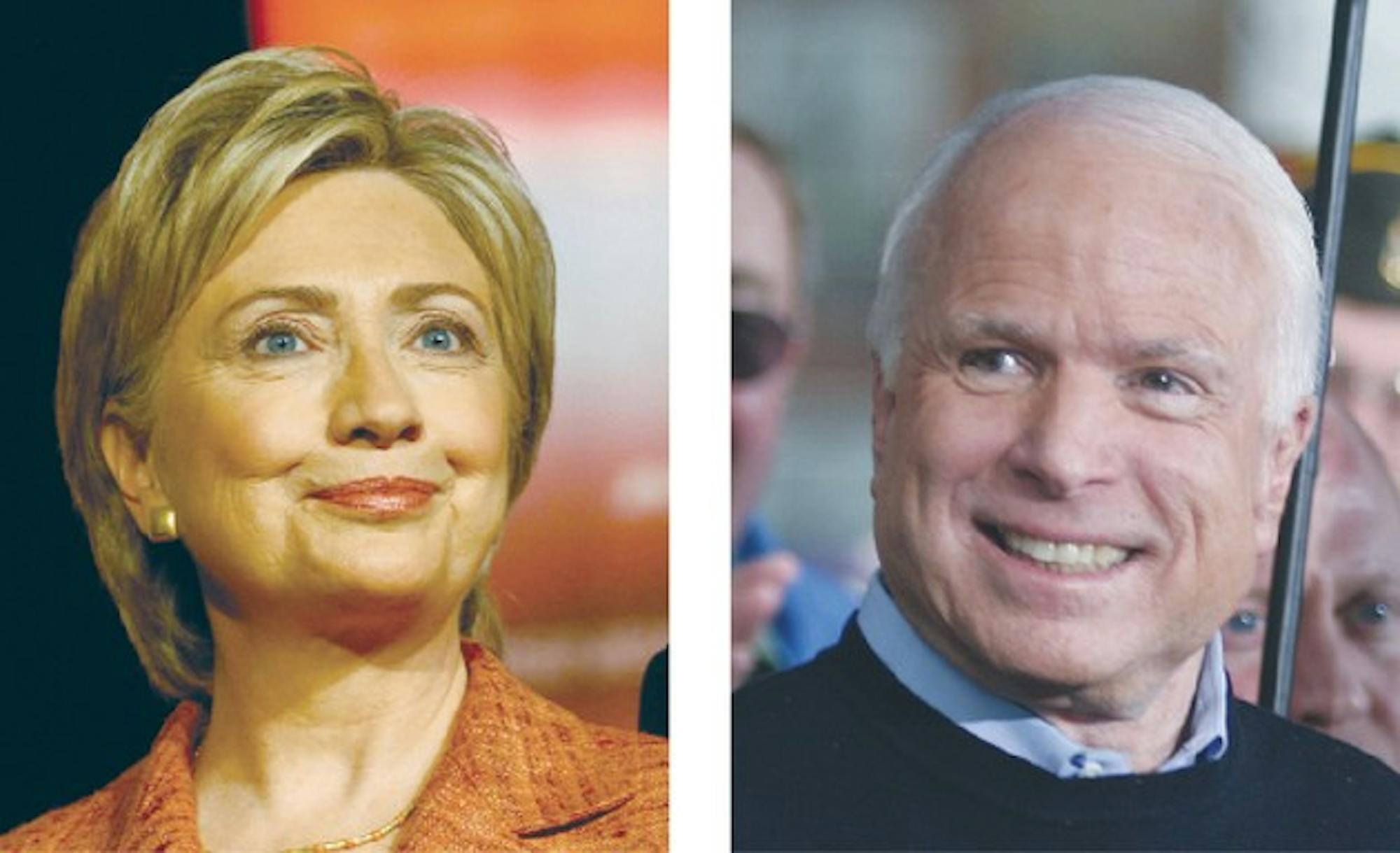
Clinton, who finished third in Iowa and was predicted to place behind Obama in New Hampshire, had similarly been written off by the mainstream media in recent days. On Tuesday, however, Clinton's popularity among female and older voters was enough to propel her to victory with 39 percent to Obama's 37 percent of the vote.
"Let's give America the kind of comeback New Hampshire has given me," Clinton said in her victory speech in Manchester on Tuesday night.
In her remarks to supporters, Clinton, speaking with a candor that some say her campaign has previously lacked, thanked the people of New Hampshire for their support.
"I come tonight with a very, very full heart and I want especially to thank New Hampshire. Over the last week I listened to you, and in the process I found my own voice," she said.
Though McCain's commanding New Hampshire start diminished slightly as additional precincts reported, the senator maintained his lead over former Gov. Mitt Romney, R-Mass., who finished with 32 percent of the vote.
"Tonight, we sure showed them what a comeback looks like," McCain told supporters.
McCain, who won the state's primary in 2000, swayed voters who placed an emphasis on the war in Iraq, exit polls reported by CNN.com suggest. Just as in 2000, Independent voters were a large factor in the McCain victory.
McCain told his supporters on Tuesday that his focus in the state was to speak to the independent minds of New Hampshire voters.
"When the pundits declared us finished, I told them, 'I'm going to New Hampshire, where the voters don't let you make their decisions for them," McCain said. "'I'm going to New Hampshire, and I'm going to tell people the truth.'"
For Romney, who pledged to remain in the contest, the New Hampshire defeat is his campaign's second downfall in a wee after a fourth place finish in Iowa.
"On to Michigan and South Carolina and Florida and Nevada," Romney, the winner of Saturday's Wyoming caucuses, said on Tuesday. "I'll fight to be back here in November in those states and others."
Former Gov. Mike Huckabee R-Ark., the winner of the Republican caucuses in Iowa, finished third on Tuesday with 11 percent of the vote.
Huckabee had earlier stated that finishing third in the state would be positive for his campaign.
"If there's any sadness, it's not where we finished, because frankly, we're pretty excited about that," Huckabee told supporters.
Former Sen. John Edwards, D-N.C., who came in second among the Democrats in the Iowa caucuses, finished a disappointing third in New Hampshire, with just 17 percent of the vote.
Speaking to his supporters after just over 60 percent of precincts had reported, Edwards congratulated both Obama and Clinton on their respective victories, but reminded his supporters of the long race which lies ahead.
"Two races down. Forty-eight states left to go," Edwards said.
Rehashing his commitment to fight for the nation's middle class, a central theme of the Edwards' campaign, the former senator called on his supporters to continue their assisstance in his campaign.
"I want to be clear to the 99 percent of Americans who have not yet had the chance to have their voices heard that I am in this race," Edwards said. "I intend to be the nominee of my party."
Obama played to his traditional campaign theme of change in his concession speech, which he gave with just over 70 percent of New Hampshire precincts reporting, pledging to move forward with a focus on hope.
"We will remember that there is something happening in America. That we are not as divisive as our politics suggest. That we are one nation," he said. "And together we will begin the next great chapter in the American story with three words that will ring from coast to coast and sea to shining sea: Yes we can."
Clinton's speech mirrored Obama's call for change, as she pledged to reach out to the nation's "invisible" citizens.
"This victory will serve notice that people across our country know what's really at stake: that we will all be called upon to deliver on the promise of America," Clinton said.
Clinton, whose lead hovered between two to four percentage points throughout the night, garnered attention this week for emotional campaign appearances, a distinct departure from her formally composed demeanor.
"We're going to take what we've learned in New Hampshire and we're going to rally on and make our case," Clinton said on Tuesday. "We are in it for the long run."
Among Hanover voters, exit polls conducted by both The Dartmouth and CNN suggest that Obama won the contest among local Democratic voters, perhaps reflecting the large student population.
The CNN polls report that Obama beat out Clinton with 58 percent of the vote to her 26 percent. Similarly, The Dartmouth's polling, which reached 351 voters leaving the Hanover polls, report Obama finishing with 62.3 percent to Clinton's 26.1 percent.
On the Republican side, CNN's polls posted McCain as the winner over Romney, with percentages of 57 percent to 20 percent. The Dartmouth's polls reported McCain beating out Rep. Ron Paul R-Texas by a percentage of 60.3 to 15.9. According to this data, Romney finished with 7.9 percent of the vote.
The Dartmouth's exit poll suggests that the war in Iraq and health care were the crucial issues in the election.
For candidates, the completion of Tuesday's primaries means looking ahead to Nevada and South Carolina in coming weeks.
"Tomorrow we're going to roll up our sleeves and keep going," Clinton said.
96 percent of precincts had been reported at press time.


