
"If you look at who had a bad day, it was definitely Obama because he relies on his spark as a change agent and we didn't see that," Nick Devonshire '11, a member of the group said.
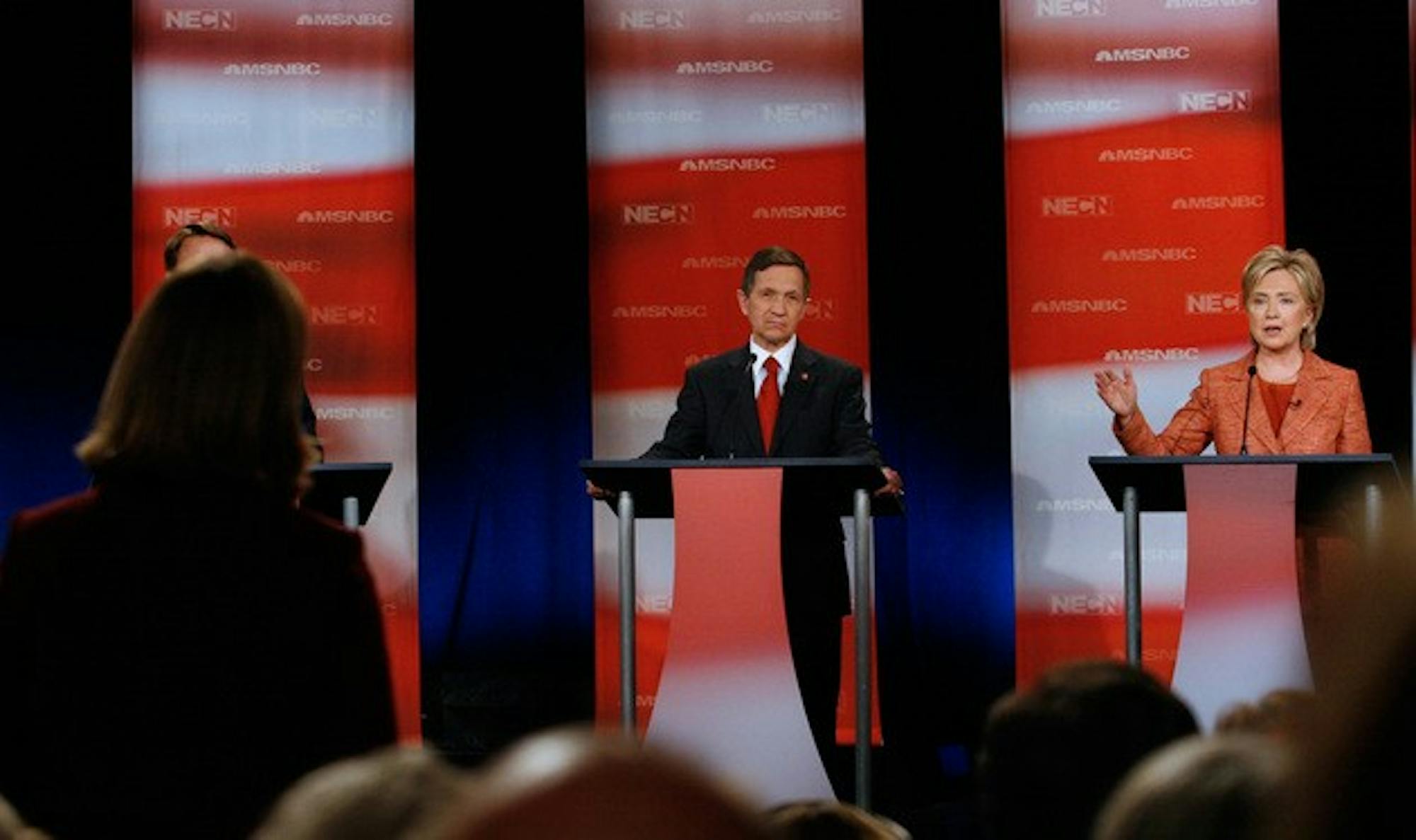
Students collectively criticized, however, the extent to which several of the candidates appeared overly scripted in their responses, most notably Obama, New York Sen. Hillary Clinton and Ohio Rep. Dennis Kucinich.
"It is very hard to get [the candidates] to commit to something they have not discussed with their advisers," Eric Lauritsen '09 said. "I would think a responsible candidate would be able to come to a decision on his or her own."
While admittedly viewing the performances of the second-tier candidates with low expectations, students identified Sen. Joe Biden of Delaware, Sen. Chris Dodd of Connecticut and Gov. Bill Richardson of New Mexico as honest and charismatic. The group was not impressed by the proverbial "self-calls" some of the candidates made about their past accomplishments.
"There were also the vestiges of Al Gore -- the 'I created the Internet,'" Shaiko said. "[The candidates] have to be careful not to take credit for everything."
The students, registered New Hampshire voters unsure of whom to support, were selected from those undergraduates who had indicated an interest in attending the Dartmouth-hosted Democratic debate. Of the 16 students, seven are registered as Democrats, four as Republicans and five did not declare a party affiliation. Independent voters in New Hampshire are allowed to vote in one of the two parties' primaries.
Shaiko initiated the group's discussion by asking students to recall their first memory of politics. Several of the students cited former President Bill Clinton's sex scandal, while others recalled the first Iraq war or past debates on affirmative action.
All of the participants in the focus group, held in the Hanover Inn, pointed to the Sept. 11, 2001 attack as a "transforming point" in their political consciousness.
"I was interested in politics from a game perspective, and I was in the eighth grade during 9/11 and then things started to become serious," Emily Mirengoff '10 said. "It stopped being a game and all of the decisions seemed more important."
The goal of the focus group was to develop a scorecard to judge the eight Democratic candidates' performance in the debate. The group created this scorecard following an analysis of the positive and negative characteristics of former President Bill Clinton's administration and that of current President Bush. Students listed a litany of issues by which they define the presidents. NAFTA, sex scandals, the "don't ask, don't tell" policy, healthcare and welfare reform were the defining issues for Clinton, with the war in Iraq being the defining event for Bush, students said.
"[Clinton's] need to please and be liked by everyone on the one hand will win you two elections, but on the other this slowed down the implementation of policy," Evan Meyerson '08 said. Meyerson is a member of The Dartmouth staff.
Students were also critical of President Bush.
"He thinks in a very black-or-white manner, which could be good or bad," Rebecca Boswell '10 said. "[It] could mean he sees things clearly or that he doesn't see any gray areas."
Students used this analysis and discussion to determine what criteria they would use to score the performance of the presidential candidates. They settled on the characteristics of leadership, experience, honesty and character, charisma, accountability, pragmatism and diplomacy, and electability to judge the candidates.
The focus group's analysis of the Democratic candidates and the debate was marked by the exclusion of any discussion of race and gender, two features that may define the next president of the United States.
"I certainly had it in my notes as something they would bring up " it [demonstrates] that it isn't an issue," Shaiko said in an interview with The Dartmouth. "Voting for Hillary [Clinton] is not a huge earth-shattering event, or voting for Barack Obama is not something that would create a tidal wave."
Shaiko was ultimately surprised, however, by the students' limited cynicism on the state of politics today.
"They still think honesty is an issue," he said, responding to a question from the media.


