
"We're actually very early in the process of the class actually enrolling," said Dean of Admissions Karl Furstenberg. In an interview with The Dartmouth on Tuesday, Furstenberg said he expects about 50 of the 1,153 members of the Class of 2011 to defer or otherwise change their decision over the summer, which would result in an incoming class of around 1,100 students, roughly 25 more than in a typical year.
Furstenberg estimated that at this point last year, the Class of 2010 had 1,130 prospective members, which eventually dropped down to 1,081.
"I'm not worried, but I think the class will be bigger than we expected," he said.
This year's high yield has eliminated the College's need to use its wait list and will likely reduce the number of accepted transfer students in an effort to compensate for the unusually large prospective freshman class.
Dimensions weekend, when the Admissions Office invites high school students admitted to the College via regular decision to visit campus, played a strong role in the increased yield.
"I think that was the main point," Furstenberg said, citing good weather, an increased turnout of admitted students and the quality of programming events over the weekend as factors prompting students to commit to Dartmouth.
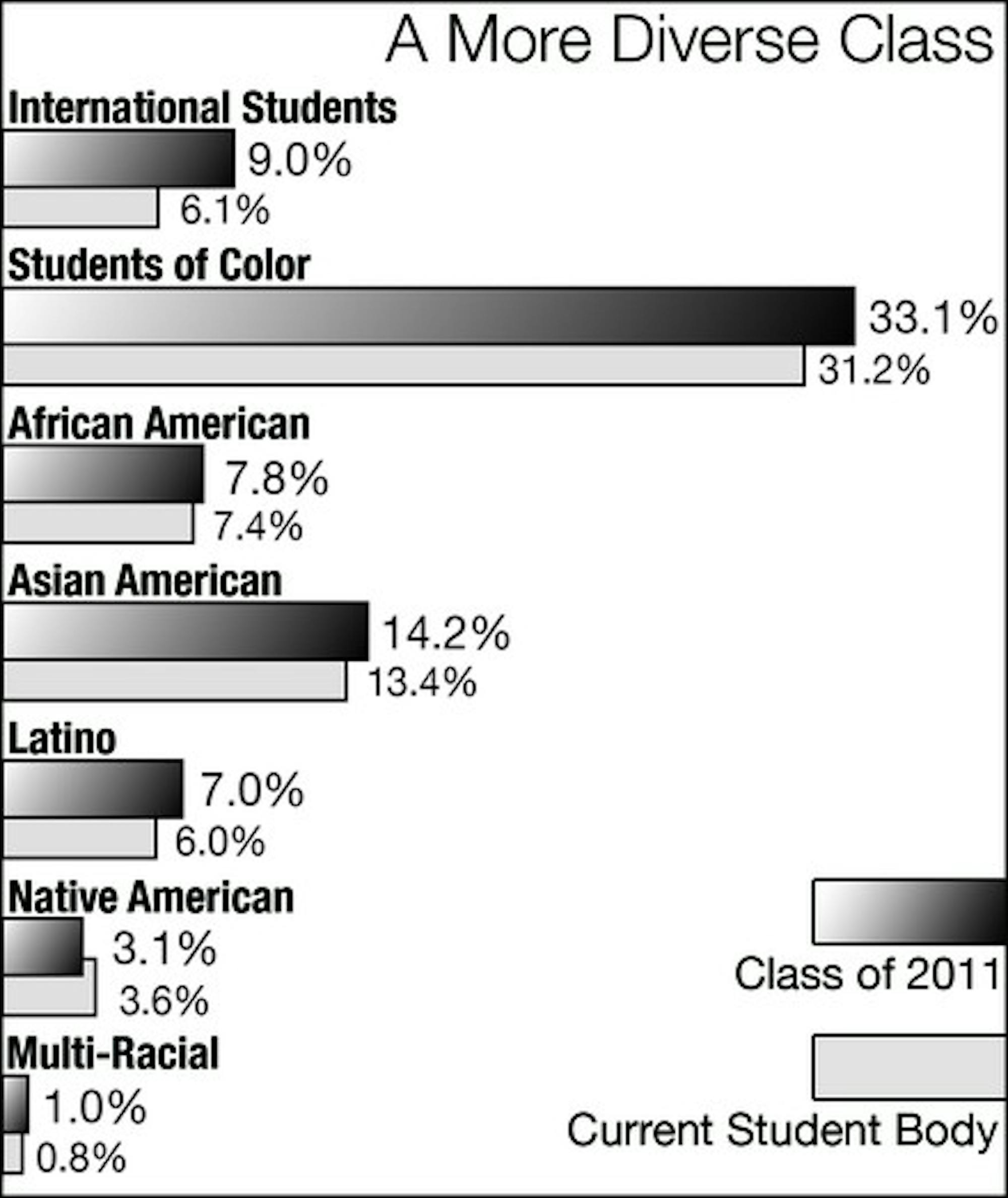
Furstenberg also pointed out the increased diversity of the incoming freshman class, which has the highest percentage of Latino and Asian students in Dartmouth's history, and the highest proportion of black students in roughly 20 years. He highlighted the effectiveness of the College's outreach programs to diverse high schools in bringing prospective students to campus.
"Dartmouth is the kind of place where, once you get here, it sells itself," Furstenberg said.
The Class of 2011 features an increased number of international students, who make up nine percent of the class, compared to 6.1 percent of the current campus population. Increased efforts by admissions officers networking with the United World College System contributed to the spike, according to Furstenberg, who speculated that the Class of 2011 would have one of the highest percentages of international students in the Ivy League.
Furstenberg also noted that, in accepting more international students, the College also admitted a higher number of students from private schools. The number of students in the Class of 2011 coming from public schools dropped to 59.1 percent from 66 percent for the Class of 2010. According to Furstenberg, the drop can be attributed to the fact that most international students come from private schools.
This year also saw a three-percent jump from last year in the number of first-generation college students.
Furstenberg, who will be retiring in June, said the high yield and improved diversity were indicative of the strength of the Class of 2011.
"We've had an extraordinarily strong year," he said.


