The dildos, which director Ford Evans referred to as "a moment of levity" during a post-performance discussion, were inspired by the practices of French farmers, who use one-legged strap-on stools to sit on while milking cows. The use of these rather unusual devices was just one example of how "Cistern: An Uncommon Ritual," the recent performance by the Dartmouth Dance Ensemble, was inspired by agrarian culture and imagery.
Eccentric and titillating as the scene with the dildos may have been, it was not the most memorable number, nor was it demonstrative of the entire show, which was a sublime reflection on community and the power of water as a force in everyday life.
"Cistern" opened with searing strings playing while video images of water scrolled across a screen, evoking a vast Clyfford Still painting in motion. After about five minutes of this, I began to wonder what I'd gotten myself into. A modern show like "Cistern" runs the risk of taking itself too seriously, and during the introduction, I worried that I'd be forced to write the kind of review that takes itself equally seriously, alluding to esoteric abstract expressionist painters for lack of more useful things to say. Fortunately, that won't be happening.
I was pleasantly surprised to find that although the show began without a note of levity, and did have a very sober tone, there were plenty of fun moments besides the dildos. In another scene, the music ceased and the dancers scrubbed the floor under the squawking gestures of an exasperated matron. Comedic scenes of quotidian life like this added a flirtatious edge to the show, which only enhanced the stunning weight of emotion maintained throughout.
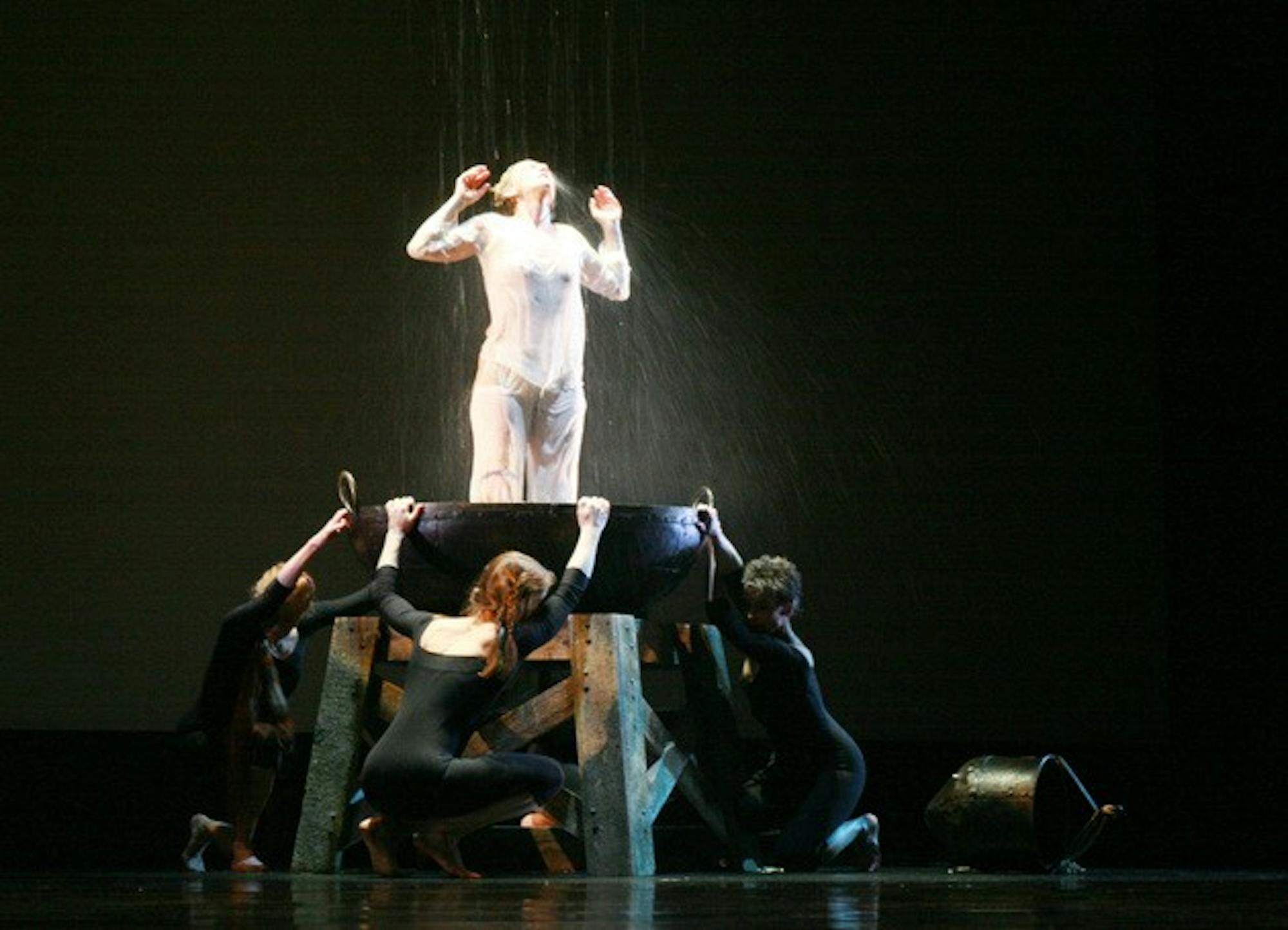
The center of the stage was occupied by a beautiful, rustic cistern raised on a pedestal, with water cascading like rain from the ceiling into its basin. In a playful duet between a man and woman, during which the male dancer lifted the female, dipping her toes in and out of the cistern, I couldn't help but think - quite un-seriously - of Beyonce in a giant champagne glass, or the fact that the cistern reminded me of a human-sized bird bath.
In the opening and final scenes, with the whole cast moving in unison, the dancers seemed cramped. However, the rest of the choreography was spectacular. One scene featuring a male aggression duet evolved into a thrillingly creative use of collective formation. The dancers revolved in and out, up and down the stage, clapping and stomping to a seductive, syncopated rhythm.
As the show progressed, the strength of the emotion rose to truly towering heights. In the last third of the show, the cistern suddenly ran dry, bringing drought to the on-stage community. Reaching into the cistern, the dancers found not joyous water in which to frolic, but ochre shades of mud with which they smeared their faces and bodies.
The intensity of the dancing, the desperation and sadness of these last scenes was truly and rightfully serious.
In the end, "Cistern" felt like a wonderful day in the life of a world represented by dance. The show movingly displayed both the comedy and pathos of a community. Early in the performance, the dancers poured water into a basin, and silky legs and arms curled into tendrils that birthed two beautiful women, reminding me of Botticelli's Birth of Venus. Even at the end, as the dancers were smeared and dirtied, I couldn't help but think that water would wash them clean, and that this show was worthy of very serious, even classical, consideration.