
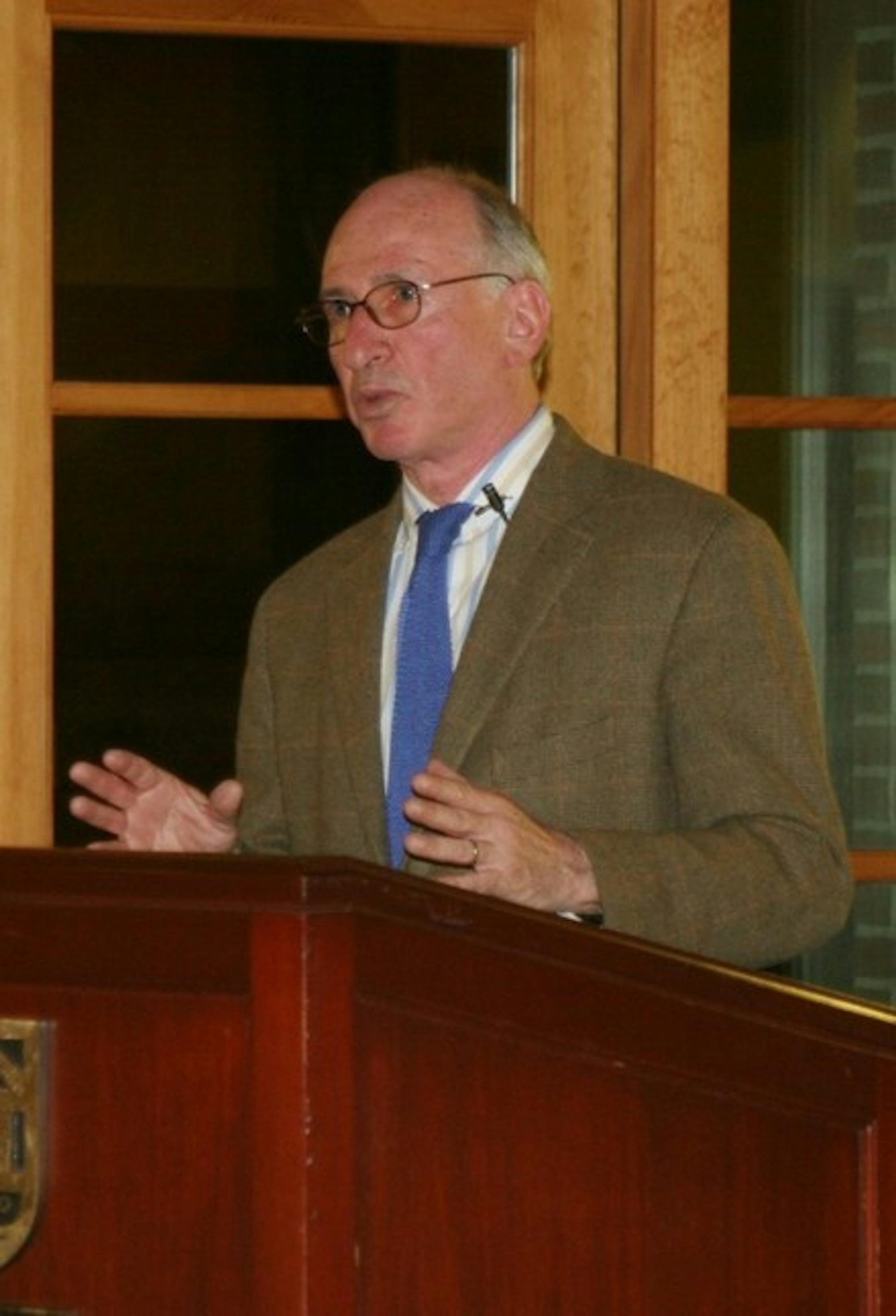
"Our whole mission is to get Tuck students to look at business issues in a global context," Lisa Miller, the associate director of the Center for International Business, said. "The large majority of our students stay in the United States after they graduate. Nonetheless, all of the corporations that they go into have global focuses."
The theme of this year's forum was confronting corruption in global business. Speakers and panelists at the forum investigated a number of conflicting views surrounding the topic.
The event opened with a keynote address by Frank Vogl, titled "The Mounting Global Challenges of Corruption and Business Integrity." Vogl is a co-founder of Transparency International, a non-profit anti-corruption organization.
Vogl addressed the dangers of corruption, stating that behaviors such as money laundering and bribery not only hinder economic growth, but also result in human rights violations, poverty and poor national security. He stated that consistent punishment of corrupt practices, education on moral values and the enforcement of anti-corruption agreements are necessary measures to counter corruption in the business world.
"The integrity path is not an easy one to follow. The temptations to drift are great," Vogl said. "Especially so, in my view, in an era when the rewards for boosting corporate earnings are absolutely massive and when so many businesses appear to have lost their moral compass."
A series of panels also addressed topics in global business corruption. The first panel, "Corruption: Necessary Path or Roadblock to Development?", featured Mallam Nuhu Ribadu, the executive chairman of the Economic and Financial Crimes Commission of Nigeria. Ribadu takes a strong stance against corruption, asserting that it is worse of a problem than terrorism.
The second panel, moderated by Vogl, focused on what global companies can do to fight corruption, stressing the importance of education and discussion. Jacqueline M. Beckett, the senior corporate counsel of the Newmont Mining Corporation, explained that her company had interviewed managers at all levels of the mining industry and created a pamphlet of anecdotes of the managers' personal experiences with corrupt practices. These case studies, Beckett stated, help Newmont employees to think critically about corruption.
Although many companies take successful initiatives similar to those of Newmont, one of the major points of the forum was to remind students that corruption remains a major problem in the business world.
"It would be false to suggest that we are really winning this war. Perhaps we've reached base camp, but we have a full Everest of corruption to climb," Vogl said. "Your generation is expected to demonstrate personal integrity and corporate responsibility in a way that can regain public trust."
This year, the Tuck International Forum was sponsored by the Dickey Center and organized with the Allwin Initiative for Corporate Citizenship. Past forum topics have included the success of businesses in developing countries, skills required by international careers and the Latin American economy.


