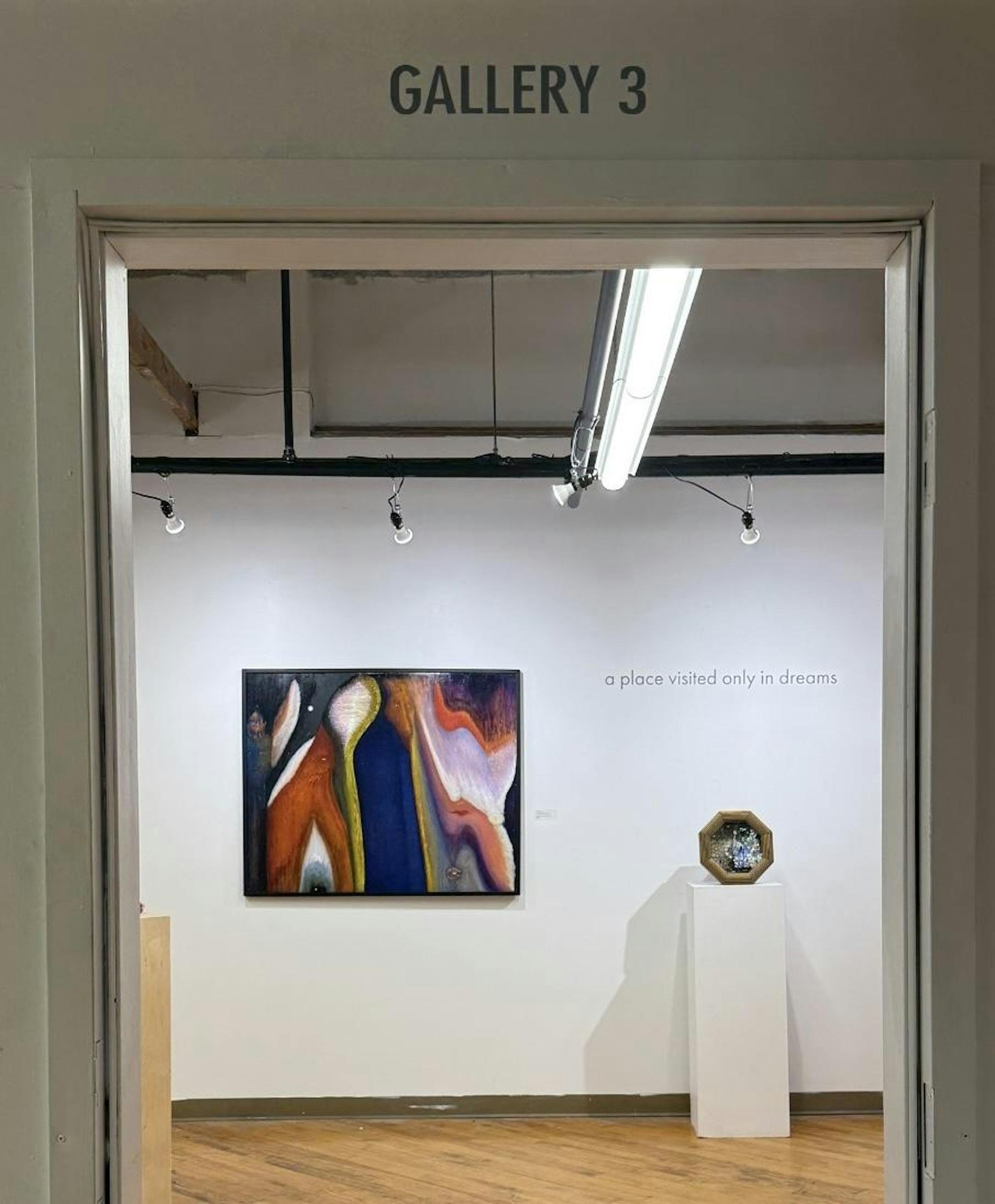
On Sept. 16, the surrealist exhibit “A Place Visited Only in Dreams” opened at the Alliance for the Visual Arts gallery and art center in Lebanon, N.H. Spanning two galleries, the exhibit features 35 artists’ surrealist paintings, collages, photographs, sculptures and videos. The collection will be on display until Nov. 14.
AVA’s curator and exhibitions manager Samantha Eckert said people who have never been to the gallery are often unaware of its scale and scope. In contrast to its humble beginnings at a barn in Norwich, V.T., the current location on Bank Street comprises three floors, including 20 artist studios and a full education program alongside gallery space, according to Eckert.
Eckert said the decision to extend the exhibit across two galleries was motivated by the desire to display more of AVA to visitors. While some of the artworks are displayed in the Linda Roesch Visual Arts Gallery on the first floor, other works are displayed on the third floor in Gallery Three — a space that typically hosts work “curated and maintained by AVA’s community of studio artists,” according to AVA’s website.
Eckert said she believes surrealism is “making a comeback again in contemporary times,” especially with its “human” focus.
“In this age that we’re in with technology and AI, anything that’s handmade is so important to humanity,” Eckert added. “Maybe this is a really cool time for artists… because we’re human, you know?”
She added that the show was timed for fall because she found the spirit of Halloween and Día de los Muertos fitting.
The exhibition’s title was inspired by the last line of a poem by American poet and essayist Aimee Nezhukumatathil, according to Eckert. In “Naming the Heartbeats,” Nezhukumatathil writes, “And what is the name for the movement we / make when / we wake … / like trying / to remember a path or a river we’ve only visited in our dreams?” These lines evoke “the liminal space between waking and dreaming” that the works in the exhibit partly seek to explore, Eckert explained.
One featured artist is Richard Fedorchak, whose art career began in earnest after he obtained a nursing degree while living in a home with several other people involved in the art scene in the 1970s.
“Everybody was doing stuff: There was painting; there was weaving; everything you could think of,” Fedorchak recalled in an interview with The Dartmouth.
Fedorchak said his interest in surrealism began when he discovered the artist Joseph Cornell, whose work was displayed among that of art by surrealist artists, although Cornell never identified himself as a surrealist. Part of Cornell’s appeal for Fedorchak was his similar lack of formal art education.
“I really related to him because he never went to art school and he never went to college,” Fedorchak explained. “But he found his way into a very unique workflow that had to do with assemblage, using objects.”
A testament to Cornell’s influence on his art, one of Fedorchak’s works in the exhibition — a semi-assemblage collage featuring a spray-painted frame, a film strip of an actress he admired, glass and other memorabilia — drew inspiration from Cornell’s artwork.
“It’s not for sale, because it’s kind of precious,” Fedorchak said.
Fedorchak, who has also worked in experimental film since the 1970s, said he is planning a surrealist screening at AVA in the future.
Tuck professor emerita Katharine Conley, who is a co-editor of the International Journal of Surrealism and who has written about the subject in her book “Surrealist Ghostliness,” will also be giving a talk sometime soon at AVA, according to Eckert.
Eckert said AVA also has plans in the works to run an “exquisite corpse” workshop, a surrealist drawing game at the gallery to encourage visitors to explore surrealism in their own ways.
Eckert said the open call for the exhibit announced on Instagram received over 35,000 views and prompted submissions by 56 artists, which was “pretty amazing for our little gallery.”
AVA office manager Sheryl Trainor, who served as a member of the selection committee alongside Eckert, emphasized the variety in medium and geography of submissions received — including a video-based work from a Pakistani artist named Marria Khan currently featured in the exhibit.
In addition to the artwork, artists also submitted a biography and artist statement to be considered, according to Trainor.
Trainor said these materials helped Eckert see “the stories that [the artists] are telling” in a context larger than the works themselves, and then arrange those works in a way that tells the story they seek to convey. Eckert “is really the master of putting things together,” she said.
Eckert added that when selecting pieces, she and the committee considered not only the works themselves, but also the way in which they would interact with other works in the space. She also wanted to showcase artists from a variety of backgrounds including not only type of art practice and hometown, but also their age and point in their art career.
“Sometimes we’ll have high school kids showing in there next to somebody who has their MFA,” Eckert explained. “I love that inclusion of all voices.”