“You don’t know what happens when you do that with people,” one character warned as the others spoke to imaginary plants, stroking them almost sensually. The audience dissolved into laughter.
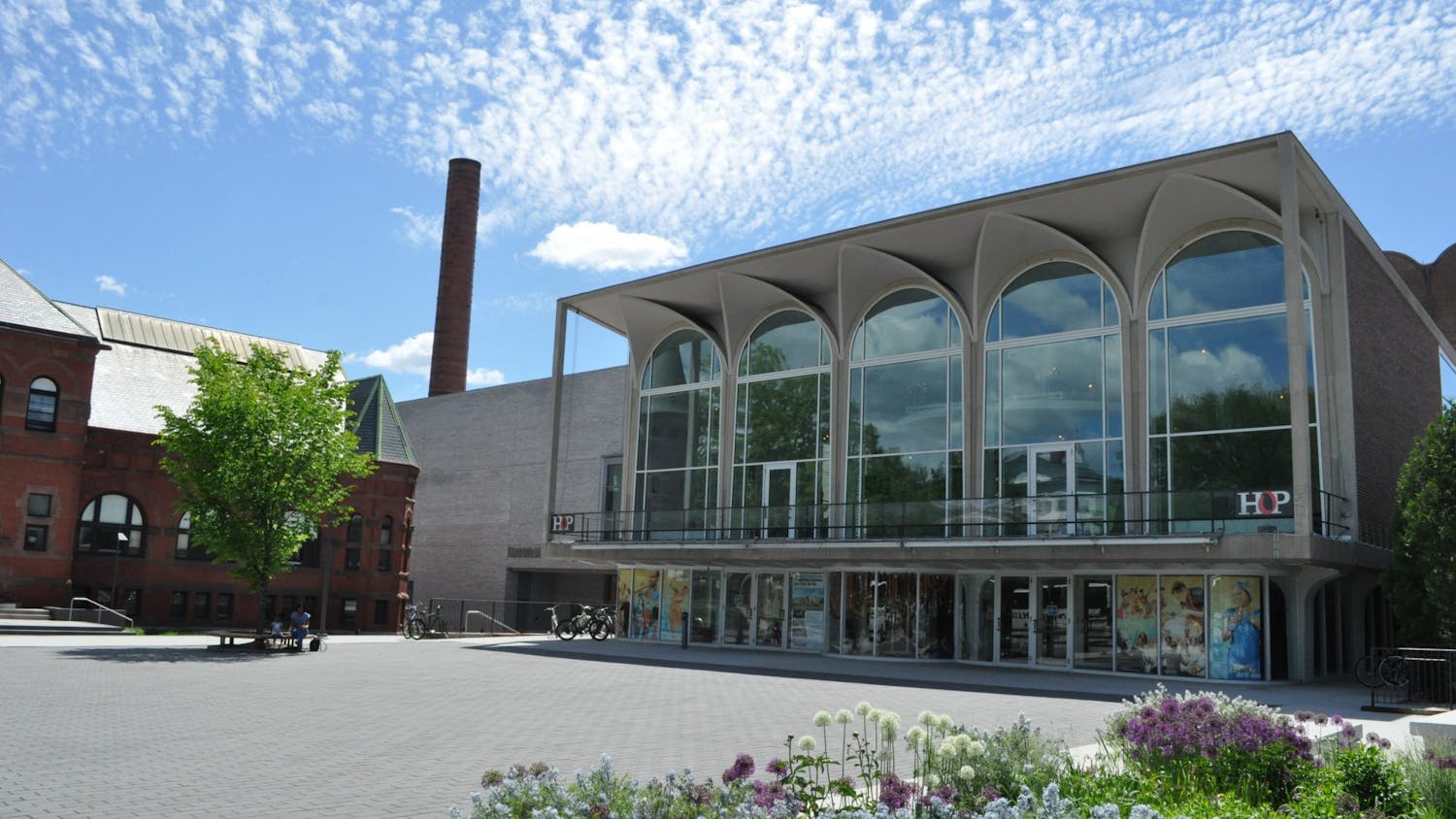
Last Wednesday, touring comedy troupe Bluebird performed a show in Spaulding Auditorium in the Hopkins Center for the Arts. The group specializes in long-form improv, bound by a love for laughter and unscripted scenes. On stage were four veteran performers: Joe Canale, whose acting credits include “The Mindy Project”; Brian Stack, known for his work on late-night shows hosted by Conan O’Brien; Brad Morris, who played a recurring role in the hit TV show “A.P. Bio”; and Stephnie Weir, who made appearances in “Veep” and “Modern Family.” Dartmouth alumna Rachel Dratch ’88 is also a member of Bluebird, but is currently performing in “The Rocky Horror Show” on Broadway.
Each Bluebird performance begins with a conversation between actors and the audience. On Wednesday, an audience member who introduced herself as a third-generation botanist described writing about a Scandinavian moss that burns calories when digested. Listening, I came alive to the untold stories simmering in the room, waiting to be metabolized into art. Viewers became collaborators, and the fourth wall dissolved as we shaped the show. In long-form improv, performers must turn short prompts into a coherent, hour-long narrative. Recurring details, such as the ominous moose of the Green Mountain, provide continuity and connect scenes like episodes in a television show. Despite being improvised, the precision of the actors’ mimework helps viewers suspend disbelief, like the moment Weir pretended to cradle a baby, her arms quivering as she mimicked the sound of its crying.
Improv comedy thrives on surprise, putting a spin on ordinary situations and making them dance. A sushi outing becomes a reality TV taste test. A woman meets a man who plays the ukulele for their future baby, who will hate the instrument’s cries. A “stuffed” student is not dead but “stuffed with cookies.” Each metamorphosis upends an assumption to hilarious effect. We the audience loosen our grip on the familiar, diving headfirst with the actors into the absurd: What if the world were less fixed than we believed? What if all our inherited structures could be taken apart and reordered like LEGO blocks?
The show also touched on contemporary cultural debates. In one scene, a character repeatedly invokes the #MeToo movement in the wrong contexts until he is asked to stop mentioning it altogether, demonstrating how one can perform allyship without genuinely engaging with a cause. In another scene, characters speak compassionately to plants and face threats from anthropomorphic moose over their use of leather. These vignettes turn environmental concerns into absurdist comedy by literally giving nature a voice.
The show unfolding in real time returns us to the building blocks of a play theorized by French theater practitioner Jacques Lecoq: “le jeu,” or the game; “complicité,” togetherness; and “disponibilité,” openness. The Bluebird performers built on one another’s ideas to keep the story alive. When one character slurs his speech, the others interpret it as drunkenness and add to the joke, declaring him a “full-time alcoholic.”
The same instinct to listen and respond applies to the performers’ writing. Before branching out into film and television careers, all four troupe members worked at The Second City, a Chicago theater company, where improv supplied material for pre-written sketches. Weir, who also wrote for the Fox sketch-comedy series “Mad TV,” said in a post-show Q&A with the audience that she believes improvisation showed her how to “keep an idea in the air” when writing and acting.
“We’re so ingrained with ‘yes and’ that we don’t shut down anybody’s ideas,” she said.
In improv, the choice matters less than fully inhabiting it. When the group builds on an idea, a new story forms. During a meet-and-greet with Dartmouth students, the performers illustrated this principle with an example: You may be scrubbing away at something without knowing what it is, but if your partner interprets your actions as Thomas Jefferson writing the Declaration of Independence, you run with it. Improv shows that commitment is more important than finding the “right” move, as scenes are fluid and never under a single actor’s control. You have no idea which story you are telling, or what the ending may be, until you tell it.
Storytelling is contagious, as is laughter. In a way, all art is an attempt to infect the world with your neurosis. The comedians literalized this metaphor in a scene where an aspiring novelist is rushed to the hospital for her literary affliction and risks catching a case of haiku. In improv, inspiration arrives unbidden; there is no knowing what you may catch from another imagination. The show both seeps into the audience and draws on our stories, destabilizing the boundary between performers and spectators.
Dratch, according to the other Bluebird members, dislikes the name “Bluebird.” Perhaps it is a measure too sweet, too wholesome: In folklore, bluebirds symbolize happiness. But improv comedy is rarely a pure symbol for anything. It is a gleeful pandemonium, like a bag of mixed nuts — one of Dratch’s preferred names for the troupe, according to the other members. Just as we “don’t know what happens” when we interact with people as opposed to plants, improv celebrates the unpredictability of unscripted, truthful moments. As a special homage to Dratch, the cast filmed the audience chanting in unison: “Mixed nuts!”