Following the success of “Weapons,” director Zach Cregger might have chosen to go even bigger and more complex for his next feature. That film wove together multiple nonlinear narrative perspectives, culminated in unexpected revelations and invited discussion over its broader social themes.
By contrast, with “Resident Evil,” based on the video game franchise of the same name, Cregger has made a film so linear and straightforward that it is practically devoid of plot and supporting characters. It’s the purest kind of genre film: A rollicking gross-out scarefest that survives purely on the strength of its superb direction and sympathetic lead performance.
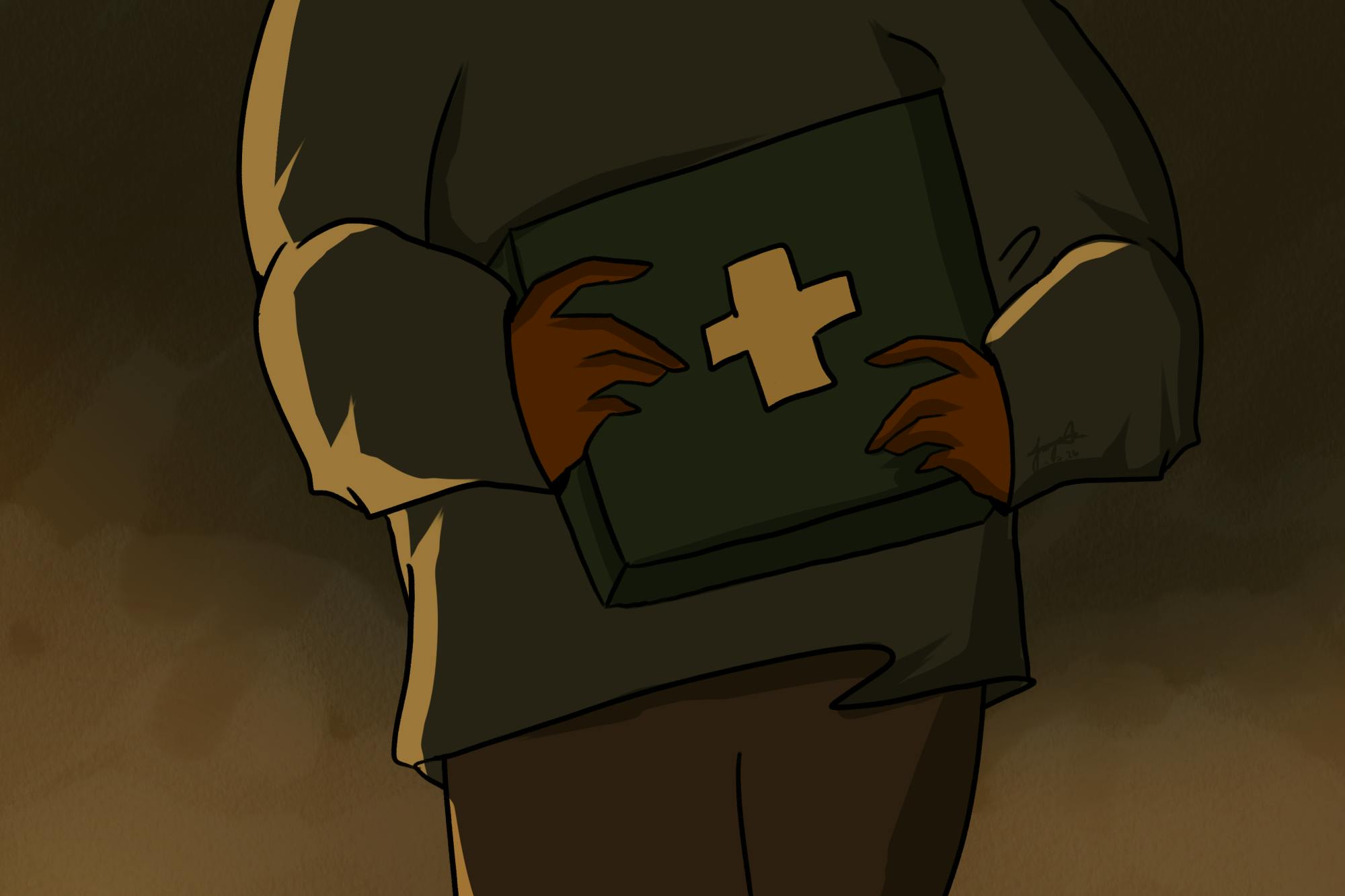
To share the film’s premise is practically to summarize it in full: One night, medical courier Bryan (Austin Abrams) is charged with carrying an important package to a hospital in the fictional Raccoon City. En route, he comes face-to-face with a horrifying outbreak of mutated monsters and must fight to survive. While he encounters a few other survivors who provide expository dialogue to give context to the carnage, the vast majority of the film focuses on Bryan surviving alone.
Although “Resident Evil” does not directly adapt a storyline or characters from the series, it masterfully captures the particular thrill of playing a survival-horror video game. Bryan serves as the avatar, with the camera following closely behind him so that the audience rarely sees beyond his field of view — there are even a few tense moments shot from a first-person perspective, mimicking the feel of a shooter game. Bryan's progression mirrors that of a game protagonist. The audience understands that he is “unlocking” new levels and weapons when he arrives at different locations or finds a gun with more firepower.
At just over 90 minutes, the film’s handful of escalating set pieces — or in some cases, “boss fights” — are all distinct and memorable in the best possible way. Despite its stripped-down story, the film is anything but small-scale, with several elaborate action sequences rife with striking practical effects and visual spectacle. These sequences also showcase Cregger’s masterful visual instincts. He has a keen sense of how to move the camera, when to reveal information and how to manipulate the audience’s expectations, often setting up one image only to surprise us with another. Even amid the chaos, he maintains a remarkably clear sense of geography, ensuring that we always understand where Bryan is and what is happening around him.
Cregger wisely conceives of Bryan as a hapless everyman rather than a grizzled commando. Bryan’s knowledge of firearms comes, fittingly, from video games, and he shrieks when confronted with danger. Even when he makes frustratingly dumb decisions, Abrams keeps the character relatable and easy to root for. Bryan is good-hearted, but also irresponsible and petrified of change. We learn through an early phone conversation between Bryan and his girlfriend that she is pregnant, and she looks to him for some reassurance about what they should do. Bryan is terrified of becoming a father, but, unsure of what to do himself, can only muster the courage to remind her that it is her body and her choice.
It’s a simple but elegant character flaw that complements the film’s horrors. The outbreak of monsters is caused by a virus that virulently mutates organisms. Bryan’s fear of fatherhood becomes literalized in a few key moments, including a gloriously vile crossing through an infected maternity ward. Indeed, no target is off-limits — Cregger seems to take special pleasure in breaking the unwritten “rules” of mainstream horror films, with a few hardcore turns that may shock more squeamish viewers.
Still, “Resident Evil” never gets quite as dark as its mean streak might suggest. Its most depressing moments are readily undercut with slapstick humor, maintaining a comedic horror tone in the style of Sam Raimi’s “Evil Dead” series. While generally very funny, these bits do become ever so slightly grating during the final few minutes, which might have benefited from a more sincere approach. Cregger’s endpoint makes sense, but the action leading up to it muddies the emotional effect of the film’s final moments.
While its simple screenplay may not deliver the same kind of narrative ambition or ultimate catharsis that “Weapons” did, “Resident Evil” is Cregger’s strongest showcase as a director yet. It proudly carries the influence of great genre films, from Martin Scorsese’s one-night odyssey “After Hours” to the urban chase of John Carpenter’s “Escape From New York” and the grotesque practical effects of “The Thing.” Cregger strips the story down to its bare essentials and, for the most part, proves that he doesn’t need anything more.