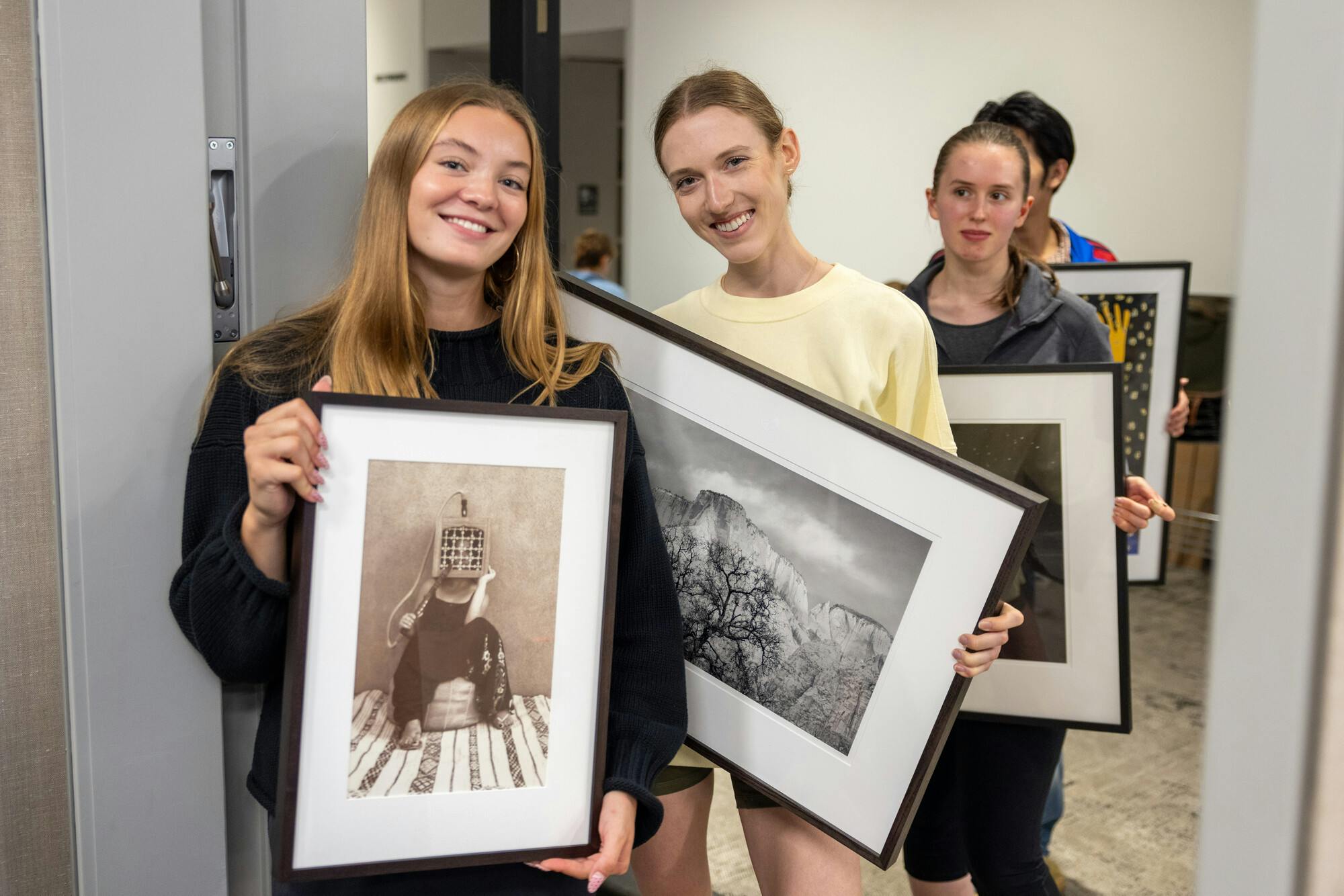
Now in its third year, the Hood Museum of Art’s Student Art Lending program lent 84 works of art for the 2026-27 academic year.
SALAD allows Dartmouth students to borrow original works and display them in their dorm rooms and apartments. The collection has grown from 13 works when the program began in October 2024 to 84 works this year. SALAD Program Director Jenna Blair said the museum added 18 new works to the collection over the past year with input from the museum’s curators, students and director.
“We’re looking across time periods and a diversity of subjects when making the collection,” Blair said.
Blair described last year’s selection day as “one of my favorite days at the museum. It’s a whirlwind.” She said she hopes to see more student involvement in the collection-building process in the future.
After a student selects a work, the museum’s team packs it for the student to bring to their room. The museum provides “installation instructions and command hanging strips and hooks,” Blair said. Students can keep the same work for the entire academic year as long as they remain on campus.
Blair said the program is intended to make students feel more connected to their living spaces and to Dartmouth. Having art in their rooms can make students feel “more at home in our space” and contribute to SALAD’s goal of “enhancing the overall experience of being here at Dartmouth and making it your own,” she explained.
Blair hopes the experience will also encourage students to develop a deeper relationship with the works they borrow.
“Hopefully, living with work inspires a lasting dialogue with art. Objects carry so much meaning,” Blair said. “We are eager to learn what art means to our students, what speaks to them.”
Students picked up their works at the SALAD event on Friday, Sept. 18. Cadence Doering ’30, who attended the pickup, described it as “a really cool program that is rare to see at a lot of colleges.”
She said it was a “great opportunity to learn more about the Hood Museum” and “really connect with the arts here at Dartmouth.”
Ajwa Shahid, a first-time SALAD participant and Ph.D. student who studies computer science and makes art in her free time, said participating is “a great way to meet people who collect art” and stay connected to her hobby.
Ryan Hill ’27, a studio art major and Levinson Intern at the Hood Museum of Art, helped organize and set up the collection for SALAD. He said the program is “a great way to get people to see the Hood in a different way,” giving students “a lot more direct” engagement with the museum.
Hill said the program also exposes students to works they might not otherwise encounter by giving them “dorm decor that you wouldn’t normally get.” Unlike prints by “very popular” painters, the works offered at SALAD are by “smaller contemporary artists,” he added.
Hill pointed to Derrick Adams’ “This Could All Be Yours” as an example of the contemporary work available through SALAD. Adams “just had a show at the Institute of Contemporary Art in Boston over the summer,” Hill said. After seeing the exhibition, Hill recognized the work when he encountered it at the Hood.
Hill said living with art can also change how students experience a work over time.
“It's interesting to just see how a piece changes your mood because it gives you a certain emotion or reminds you of something,” he said.
Shahid, for instance, chose Ohara Koson’s Basket of Flowers, which dates to around 1931. She described the work as special to have “in her room alongside other art.”
Shahid said the flower arrangement in Koson’s work symbolizes balance to her: one flower reaches toward the ground, another toward heaven and another sits between the two, representing humans.
“It is good to reach for the heavens while also remembering where you are from, staying grounded and being humble about the things you already have,” she explained.
The SALAD program also provides students with journals to share their thoughts with future students who receive the same work. About half of the students who loaned works last year wrote in their journals and “shared some lovely reflections,” according to Blair.
“The archive helps us understand how impactful and personal living with a work can be,” she said. “I imagine we might share these with alumni in the future as a way for them to look back on the experience.”
Aiden Lewinter ’28, an art history major borrowing a work from the program for the second time, said the journals gave him a glimpse into the experiences of students who had lived with the work before him.
“It was really cool to see the progression of how different people have different experiences with different artworks,” he said.
Lewinter recalled that one previous student had written that the work “always brightened their day” and that it was something “their friends would always talk about when they came over.” The “lineage” of student lenders is “another thing that connects you to someone else at Dartmouth,” allowing each student to “add to that story,” he said.