
The House Oversight and Governing Reform Committee issued two subpoenas to billionaire Leon Black ’73 today as “a result” of Black’s refusal to answer “specific questions” about nondisclosure agreements he was involved in during a voluntary closed-door testimony, committee chairman Rep. James Comer, R-Ky., told reporters outside the hearing.
Black’s testimony was part of the House Oversight Committee’s ongoing investigation into convicted sex offender Jeffrey Epstein’s connection with wealthy and influential individuals. Between November 2025 and January 2026, the Department of Justice released over 3 million documents as a part of the Epstein Files Transparency Act, which included details of a relationship between Black and Epstein. Over a six year period, Black paid Epstein $170 million from Black to Epstein for “tax and estate-planning services.”
One subpoena ordered Black to provide to the House Oversight Committee any nondisclosure agreements he was involved in and any agreements tied to Epstein or Epstein’s associate Ghislaine Maxwell, according to the New York Times. The other requires Black to return and testify under oath in front of the committee on July 16 for a sworn deposition.
“We believe that information is vital to our investigation,” Comer added.
In a press statement released after the hearing, Black’s lawyer Susan Estrich called today’s hearing a “planned political stunt.”
“Mr. Black came here voluntarily to assist the Committee,” Estrich wrote. “This was nothing more than a planned political stunt. Mr. Epstein had no involvement with any NDA’s, whether they exist or not.”
In his prepared opening statement to the House Oversight Committee, which was obtained and reviewed by The Dartmouth, Black denied any knowledge of Epstein’s “nefarious activity until Epstein was charged with trafficking in July 2019.” He acknowledged that he “knew about” Epstein’s 2008 plea deal — in which Epstein pleaded guilty to solicitation of a minor — but believed it “involved an isolated incident” in part because Epstein was given a “relatively lenient sentence.”
Black also defended Epstein for solving “a massive estate problem for me, that none of the experts and lawyers I consulted had been able to solve,” even as he claimed to see “with hindsight” that Epstein “exaggerated, embellished, manipulated and outright lied” about his fees.
“What I believed to be $95 million of net fees paid to him over five years was actually $158 million,” Black said. “But, at the time I was led to believe by Epstein that I was paying ‘60 cent dollars.’ That assurance was false.”
Black told the House committee that he “wish[es he] had not” given Epstein a “second chance” after the 2008 charges.
“I knew Jekyll. I didn’t know Hyde,” Black said.
In a 2023 settlement between the U.S. Virgin Islands and Black, Black acknowledged that Epstein used Black’s money to “partially fund [Epstein’s] operations in the Virgin Islands” — where he trafficked and abused women and girls. Black agreed to pay $62.5 million to the Virgin Islands in order to be “released from any and all claims and rights of any nature whatsoever which the United States Virgin Islands now has or in the future may have against them related to Jeffrey Epstein,” according to the settlement.
“With the benefit of hindsight, I now know, as does the world, that Epstein was engaged in horrific, sordid activities,” Black said in the deposition. “I feel terrible for Epstein’s victims.”
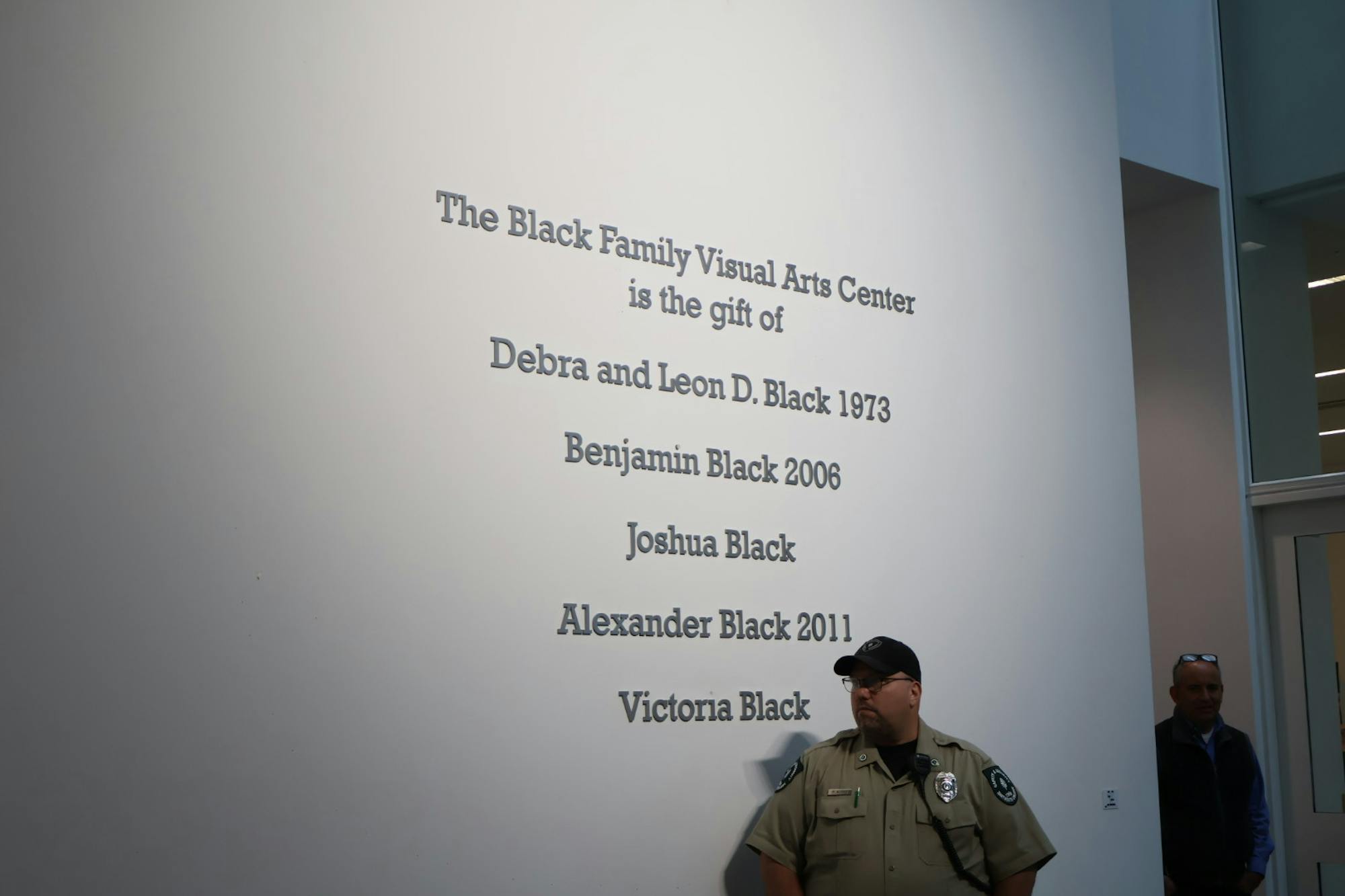
Black served on the College’s Board of Trustees between 2002 and 2011. In 2012, the Black Family Foundation donated $48 million to fund the Black Family Visual Arts Center’s construction at Dartmouth. Since then, Black has faced three lawsuits alleging abuse, sexual harrassment and rape. One was dropped by the plaintiff, one was dismissed and one remains open. In his opening statement, Black told the House Oversight Committee that these allegations were “heinous, fabricated allegations.”
Earlier this month, the Dartmouth Board of Trustees established an ad hoc naming policy committee during their meeting from June 11 to June 14 that will “review and make recommendations to the board regarding the university’s policies and principles for honorary naming and re-naming consistent with the board’s fiduciary responsibility.” It will also review “any future decisions” about honorary naming.
In April, Dartmouth Student Government and the Student and Presidential Committee on Sexual Assault and the Women of Dartmouth alumni group called for the College to rename BVAC. After moving in its April meeting to establish a trustee ad hoc committee on naming policies, the board “continued to carefully consider the topic of naming across campus, including recent feedback from the community about the Black Family Visual Arts Center.”
College spokesperson Jana Barnello previously told The Dartmouth that the College has “no current financial relationship” with Black. When contacted for comment on Black’s testimony, the College declined.
In 2021, Black stepped down as chief executive officer and chairman of private equity firm Apollo Global Management — which he co-founded in 1990 — amidst public scrutiny and an internal investigation into his relationship to Epstein. The investigation found that from the mid-1990’s to 2018, Black had a “social relationship” with Epstein, and the “professional services” between them occurred between 2012 to 2017.
In the conclusion of his opening statement, Black said his testimony was “an opportunity” for him and his family to “move forward” with their “commitment to advance worthy causes for society,” including “health research,” “women in need,” “veterans,” “Jewish causes,” “academia” and “the arts.”
The full transcript of Black’s testimony will be released in the coming days.
Tierney Flavin ’28 is a reporter and editor. She is from Kansas City, Mo. and plans to major in Government and Sociology.


