
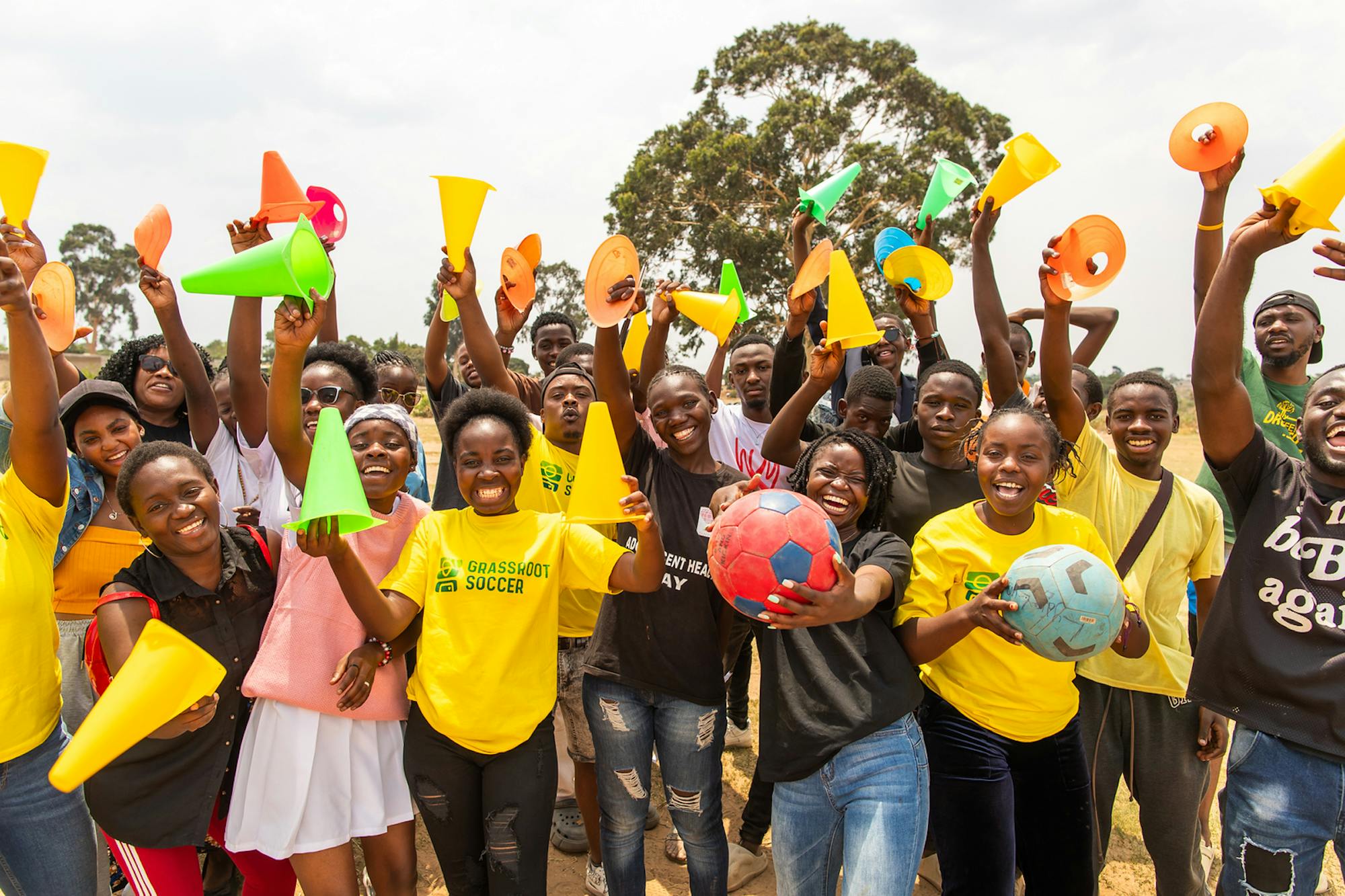
Grassroot Soccer, a nonprofit organization co-founded by Dartmouth alum Tommy Clark ’92, MED ’01, uses soccer to educate young people around the world about HIV and AIDS, mental health, reproductive health and other health issues. According to the Grassroot Soccer website, since its founding, the organization has reached more than 25 million adolescents across over 60 countries.
The roots of Grassroot Soccer stretch back long before the organization’s official launch in 2003. After graduating from Dartmouth, Clark travelled to Zimbabwe to play professional soccer for Highlanders Football Club and teach English, where he saw the devastation of the HIV and AIDS epidemic firsthand.
“In the years that followed, more and more people that I knew ended up passing away from AIDS,” Clark said. “But, the whole time I was there, I never had a conversation about HIV. This was really decimating southern Eastern Africa, and nobody was talking about it.”
At the same time, Clark began to recognize soccer’s unique influence on Zimbabwean communities. Professional players were local celebrities, and young people looked up to them.
“Soccer was so popular — my team would get 25,000 people at a game,” Clark said. “The popularity of the sport, and the celebrity of the star players who were my teammates, could be used to get this disease out in the open, people talking about it, sharing accurate health information and reducing stigma.”
After a year of playing professional soccer, Clark returned to the United States to attend the Geisel School of Medicine. While in medical school, he continued hearing devastating reports from Zimbabwe as more members of his community died from AIDS.
Clark then began to reflect on his own experiences, becoming increasingly convinced that soccer — and the role models within the sport — could help break through the silence surrounding HIV.
According to Clark, this idea gained traction through conversations with Stanford University psychology professor Albert Bandura, whose social learning theory states that people learn and implement behaviors by modeling others, and the importance of role models in inspiring behavior change.
Following his graduation from Geisel, Clark did his pediatrics residency at the University of New Mexico, where he completed a month-long rotation focused on community advocacy. Here, Clark proposed the idea of using soccer role models to combat the silence and stigma surrounding HIV in Zimbabwean communities.
From there, the idea for Grassroot Soccer was born. Clark teamed up with fellow Highlanders FC player Methembe Ndlovu; University of New Mexico teammate Kirk Friedrick; and CBS Survivor: Africa winner Ethan Zohn to turn the idea into reality.
However, the organization found that it still needed to develop an approach to spread awareness and improve behaviors.
With those insights in mind, Clark designed a curriculum that teaches adolescents about HIV and AIDS through interactive games and drills. Essential to the program are the coaches, who lead the programming and mentor the children to inspire safe healthy behavior and reduce stigma surrounding difficult health topics.
“I think about the people that have had the biggest impact in my life, it’s probably been coaches,” Board of Trustees chair Gregg Lemkau ’91, who formerly chaired the GRSboard, said. “You had a whole bunch of kids who are looking up to coaches and being willing to listen to coaches to give them these important life skills. It’s the impact of these coaches that really makes [Grassroot Soccer] work.”
With the program ready to implement, Clark, along with co-founders Ndlovu, Friedrich and Zohn, established GRS as a 501(c)(3) nonprofit organization in 2002 and returned to Zimbabwe to launch a pilot program with local high schools. By 2006, GRS had attracted funding from major foundations such as the Gates Foundation, and Clark became the organization’s chief executive officer.
According to their website, over 20 years later, GRS has expanded its programming to over 60 countries and reached more than 25 million adolescents.
Clark said the program has prioritized building evidence around its effectiveness, with dozens of research studies helping refine its approach. According to Grassroot Soccer, the model has been clinically proven to improve health knowledge and behaviors among adolescents.
“We’ve really invested in building evidence around our approach and doing different types of research studies,” Clark said. “That’s been a differentiator, and it has allowed our program to be better.”
The impact of the organization extends beyond statistics, participants and leaders said, with the relationships formed between coaches and children helping make the lessons resonate.
“It’s this fully immersive experience of seeing these kids just light up and engage with these coaches who they really look up to,” GRS Global Board of Directors co-chair and HIV and AIDS activist Dawn Averitt said. “They’re like role models, and the beauty of the program is that it’s really fun.”
Clark has been instrumental in this success, from fundraising to operations..
“Tommy is incredibly good in his role as CEO,” Tuck School of Business finance professor and GRS board co-chair Kenneth French said. “He’s very charismatic. He’s a really good fundraiser. He’s got a lot of strengths and uses them well. We’re really fortunate to have him.”
Through the decades, GRS has also expanded in scope, now offering programs and education for mental health, sexual violence, reproductive health and other health issues.
“It’s been incredible to see what they’ve done in terms of evolving the mission,” Lemkau said. “Recognizing that this delivery mechanism of getting critical information to kids in places they wouldn’t otherwise get it can be used for all sorts of things. We can actually broaden the places we have impact with.”
The non-profit has attracted notable figures such as former First Lady Michelle Obama and singer Elton John to two-time American World Cup winner Christen Press, and soccer players such as the 2024 British Broadcasting Corporation Women’s Footballer of the Year Barbra Banda have participated in GRS tournaments.
Many former program participants have also returned to coach.
“The vast majority of the coaches that I met had been participants in the past, so they grew up with this kind of goal and aspiration to become a coach,” Averitt said. “That speaks volumes about not only the program and the way Grassroot Soccer engages these kids, but also the value of their long term engagement in the community.”
With political challenges, such as the closure of the United States Agency for International Development, affecting international aid organizations around the world, GRS remains a fixture in the international aid community and will continue to be so for years to come.
“We’re just getting started,” Clark said. “There’s a lot of problems in the world, and a lot of things that people can do with their money. But I can think of few better things to do than invest in the potential of young people.”


