
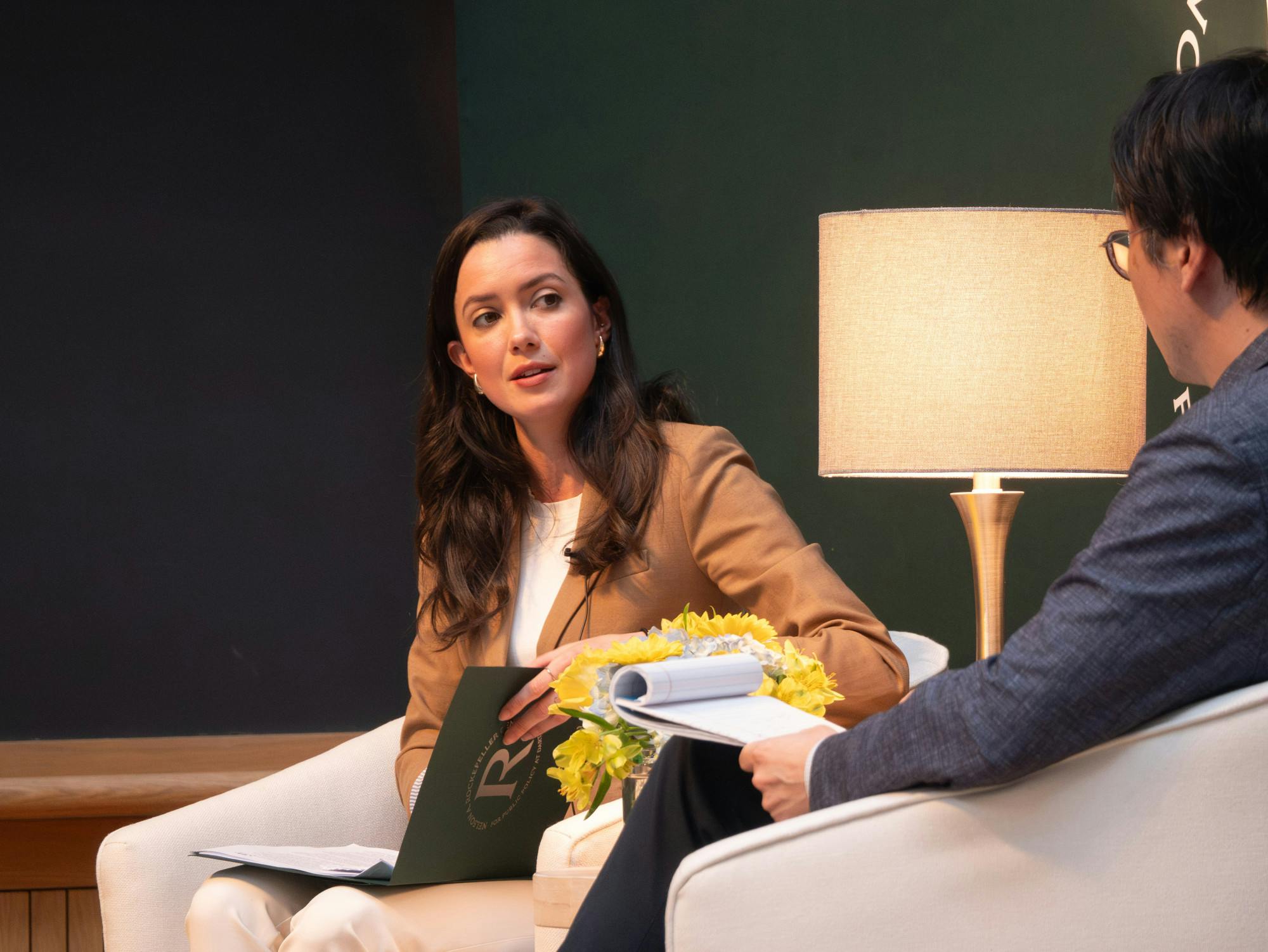
During an event at the Rockefeller Center for Public Policy on May 5, Washington Post investigative reporter Silvia Foster-Frau urged students to “support the news” and to “raise your voice” against injustice.
The event — which was moderated by sociology professor Sunmin Kim — was part of the Rockefeller Center’s “Law and Democracy: The United States at 250” speaker series. Approximately 50 people attended the event in Hinman Forum, with an additional 130 people streaming the event online, according to Rockefeller Center associate director for public programs and special events Dvora Greenberg Koelling.
Foster-Frau covers immigration for The Washington Post. She is currently on leave as a Nieman Journalism Fellow at Harvard University. She won the Pulitzer Prize for National Reporting in 2024 for her work on the “American Icon” series, which focused on the AR-15’s role in gun violence.
Foster-Frau opened the event by discussing her first job in journalism: writing for a newspaper in Greenwich, Conn., which she called “one of the wealthiest” in the country.
“I wrote about polo matches and fundraisers,” Foster-Frau said. “Frankly, in Greenwich, it was often a slow news day.”

After joining the San Antonio Express News in Texas, her coverage shifted to “pretty hard topics,” including the first Trump administration’s immigration policies.
“I interviewed immigrants living in U.S. detention and those living in Mexican border encampments, I spoke to deported immigrants … I went to immigration courts,” Foster-Frau said.
Foster-Frau said she believes that immigration reporting may have influenced the first Trump administration’s decision to end its family separation policy, under which nearly all adults entering the United States illegally were prosecuted and separated from their children.
“I try to imagine for a moment, if the public had not heard all of those stories that the immigration reporters were telling, how different our country might look without them,” Foster-Frau said.
In June 2018, Trump signed an executive order ending the administration’s family separation policy.
In response to a question from Kim about whether there was a “categorical change” between the immigration policies of the first Trump administration and those of the second Trump administration, Foster-Frau answered that the second administration has focused less on the border and more on immigrants “in the interior of the country.”
Foster-Frau added that the second Trump administration’s immigration policies are “not doing so well at the polls.”
“Unless you’re at the border, [border enforcement] is kind of this abstract thing — it’s not affecting your work in your community,” Foster-Frau said. “But going into cities across the country does start to shake up everybody.”

Following a question from Kim about how misinformation has affected the immigration debate in the United States, Foster-Frau said that she tries to fact-check her interviewees “in real time” if they say something “incorrect.”
“I also mostly just try to understand them,” Foster-Frau said. “I’m curious about where they got those ideas from and how, and then explaining that to the rest of the public when it is something you know that is misinformed.”
The moderated discussion was followed by an audience Q&A. In response to a question about how artificial intelligence plays a role in misinformation, Foster-Frau said she believes that AI “absolutely can be a threat to journalism.”
AI is “making it very hard to figure out when we see videos of things happening in the world, whether they’re legitimate or not, and [we have] to develop new processes to authenticate those videos and verify their accuracy,” Foster-Frau said.
However, AI could also be a “very useful tool.” She noted that AI has helped her with translating articles into Spanish.
“We were able to produce a lot more Spanish versions of the articles, which was really important to me, since I’m writing a lot about immigrants who are Spanish speakers,” Foster-Frau said.

After a question about how journalists combat feelings of helplessness that can come with work on difficult subjects, Foster-Frau said that it is “fulfilling” to be able to “contribute in your own meaningful way.”
“You’re educating the public about what’s happening; you’re unveiling something that’s never been known before; you’re holding somebody powerful to account for the harms that they’re creating,” Foster-Frau said.
In an interview after the event, Evan Walsh ’29 said the talk was “an interesting perspective on the role of journalism.”
Rockefeller Center lecturer Julie Kalish ’91 said she was “struck” by Foster-Frau’s discussion of how journalists cover “tragic events.”
“That [journalists] should be able to talk with one another and hold back on their own interests as publications to be able to prioritize the realities for the families and the victims — that’s awesome,” Kalish said


